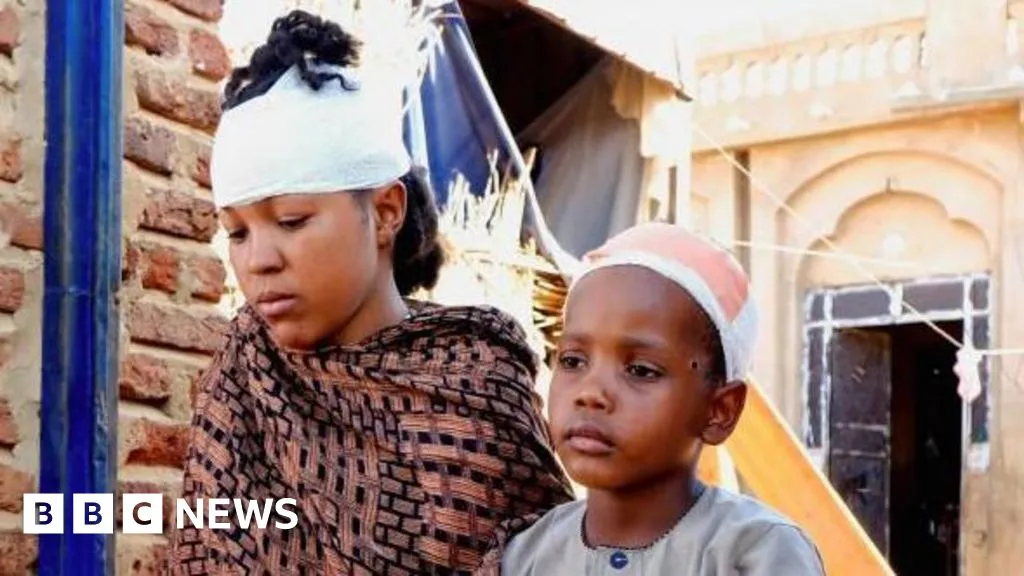
Fears of a massacre in this city on the front line of Sudan's warReutersA 27-year-old university student, Sarah was at a crowded fuel station in the city of el-Obeid, on the front line of Sudan's civil war, when a drone struck without warning.She says the station lit up before everything went dark. "In front of us there were injured people, blood, burnt cars, and smashed cars." We have withheld the student's real name for her safety in a city that is the latest flash-point in the three-year war between the army and the paramilitary Rapid Support Forces (RSF).Sarah told the BBC by phone that she was fortunate to survive the attack, but had sustained injuries."I got shrapnel in my leg and hand because I was outside the car when the second missile struck."Currently under army control, el-Obeid - the capital of North Kordofan state with a population of around 500,000 - has one of the largest military bases in central Sudan. But the army has been unable to repel the drone strikes, with 27 hitting the city in June, the highest monthly total since the conflict began, according to violence monitoring group Acled. UN human rights chief Volker Turk said at least 45 people were killed and 41 injured in 15 drone strikes between 6 and 28 June. He added that the city has been under siege-like conditions for 18 months, with summary executions, abductions, torture and sexual violence taking place along routes used by people fleeing the conflict."The signs from el-Obeid are clear and unmistakable: Another human rights catastrophe is unfolding in Sudan," Turk said last week in an address to the UN Human Rights Council in Geneva.Nathaniel Raymond, the executive director of US-based Yale University's Humanitarian Research Lab, told the BBC that el-Obeid was strategically significant for the warring sides, lying between the RSF-controlled west of the country, with the east mostly in the hands of the army."If you control el-Obeid, you control the road to the capital, Khartoum and [its twin city] Omdurman, and so the army has to defend el-Obeid," he said.A doctor at a hospital in the city told the BBC they were struggling to cope with the influx of casualties."We receive injured patients after almost every drone attack. Most of the injuries involve limbs while some patients suffer from head injuries," she said.One of the most distressing cases the doctor has treated was a seven-month old baby."Her hand had to be amputated because of the severity of the injury, but sadly she did not survive."The situation is frightening. You leave your house as if you will never return," the doctor said, trying to hold back tears. "We are really suffering from the drones - no-one knows how and when they will die."Amnesty International secretary-general Agnès Callamard has warned that al-Obeid could face violence on a scale similar to that seen in el-Fasher when the RSF captured it after laying siege to it, also for 18 months. "What happened in el-Fasher is not an oddity. It is not a moment of madness. It is a playbook," she said. The UN said early last year that the conflict in el-Fasher bore the "hallmarks of genocide," with more than 6,000 people killed in just three days, with the mostly Arab RSF fighters accused of slaughtering non-Arab groups. The RSF has repeatedly denied these accusations. In a statement responding to warnings of an impending massacre in el-Obeid, the paramilitary group said it would "work diligently" to ensure the full protection of the city's residents, and that it was operating in full compliance with international law.But Raymond said that el-Obeid does not currently display the same ethnic dynamics that characterised the violence in el-Fasher, adding: "Right now, we don't see any indication of a large-scale plan by RSF to attack."Acled's Nohad Eltayeb said the RSF had effectively encircled the city from the north, west and south, but the army had reinforced its positions with allied militias to "continue to hold a vital supply corridor connecting the city with eastern territories". "While it is very likely that the RSF will attack the city, this logistical lifeline and reinforcements render a complete RSF takeover improbable," she said in a report released on 30 June.Sarah said the drones strikes have mainly targeted fuel stations or fuel tankers, with other residents saying that water and sewage trucks, apparently mistaken for fuel tankers, have also been hit. Many of the drones have targeted fuel stationsRaymond said satellite imagery showed that at least eight fuel stations had suffered damage consistent with bombardment between late May and late June. As a result, fuel is starting to run short in the city leading to huge price rises.el-Obeid's main electrical substation, as well as residential neighbourhoods and markets, also came under attack in an apparent attempt to cripple daily life, he added."Without fuel and electricity, the water pumps in the city will stop working and civilians, including internally displaced people, will start drinking water that could be contaminated and cause waterborne disease," Raymond told the BBC.el-Obeid's population includes about 100,000 people who have fled violence in other other areas, hoping the city would be safe.Raymond said that in a single month, about 700 temporary structures had been built in camps for displaced people around el-Obeid. Among those who moved to the city is a humanitarian worker whom we have named Ahmed.He first fled Kadugli, the capital of South Kordofan, then Khartoum, and now fears he will have to leave el-Obeid as drone strikes intensify."People are always in shock and fear. They are unable to sleep," he told the BBC."Many of us sleep outside because of the heat. When the drones are flying overhead, making that noise, every night becomes a sleepless night."Sarah said many people were scared to step out of their homes. "People now leave their homes saying goodbye to their families because they don't know if they will return or not."
SRCBBC News - World
LANGEN
LEANCenter
WORDS985
ENT12
TUE · 2026-07-07 · 23:32 GMTBRIEF NSR-2026-0708-91116
NSR-2026-0708-91116News Report·EN·Human Rights
Fears of a massacre in this city on the front line of Sudan's war
El-Obeid, a city on Sudan's front line, faces fears of a massacre amidst ongoing conflict between the army and the Rapid Support Forces (RSF). The UN human rights chief states the city has been under siege-like conditions for 18 months, with summary executions and abductions reported.
8 hours agoShareSaveAdd as preferred on GoogleAkisa WanderaBBC AfricaBBC News - WorldFiled 2026-07-07 · 23:32 GMTLean · CenterRead · 4 min
BBC News - WorldFIG 01
Reading time
4min
Word count
985words
Sources cited
5cited
Entities identified
12entities
Quality score
100%
§ 01
Briefing Summary
AI-generatedNEWSAR · AI
El-Obeid, a city on Sudan's front line, faces fears of a massacre amidst ongoing conflict between the army and the Rapid Support Forces (RSF). The UN human rights chief states the city has been under siege-like conditions for 18 months, with summary executions and abductions reported. In June alone, 27 drone strikes hit the city, killing at least 45 people and injuring 41, according to UN data. These attacks, often targeting fuel stations, have disrupted daily life and led to fuel shortages. While the RSF denies plans for a massacre and vows to protect residents, experts note the city's strategic importance. The RSF has encircled el-Obeid, but army reinforcements make a complete takeover improbable.
Confidence 0.90Sources 5Claims 5Entities 12
§ 02
Article analysis
Model · rule-basedFraming
Human Rights
Conflict
Tone
Mixed Tone
AI-assessed
CalmNeutralAlarmist
Factuality
0.80 / 1.00
Factual
LowHigh
Sources cited
5
Well sourced
FewMany
§ 03
Key claims
5 extracted01
At least 45 people were killed and 41 injured in 15 drone strikes in el-Obeid between June 6 and 28, according to UN human rights chief Volker Turk.
statisticVolker Turk (UN human rights chief)
Confidence
1.00
02
El-Obeid has been under siege-like conditions for 18 months, with summary executions, abductions, torture, and sexual violence occurring.
factualVolker Turk (UN human rights chief)
Confidence
0.95
03
A seven-month-old baby had her hand amputated due to a drone strike injury and later died.
quoteDoctor at a hospital in el-Obeid
Confidence
0.90
04
Fears of a massacre in el-Obeid, a city on the front line of Sudan's civil war, are growing due to escalating drone attacks.
factual
Confidence
0.90
05
Amnesty International warns el-Obeid could face violence similar to el-Fasher.
predictionAgnès Callamard (Amnesty International secretary-general)
Confidence
0.85
§ 04
Full report
4 min read · 985 words§ 05
Entities
12 identifiedKey playerOppositionContextPositiveNeutralNegative
Organizations5
§ 06
Keywords & salience
10 termsel-obeid
1.00
sudan civil war
1.00
drone strikes
0.90
human rights catastrophe
0.80
rapid support forces (rsf)
0.70
army
0.70
civilian casualties
0.60
siege-like conditions
0.50
strategic significance
0.40
humanitarian crisis
0.40
§ 07
Topic connections
Interactive graph Network visualization showing 8 related topics
View Full Graph Person Organization Location Event|Click node to navigate|Edge numbers = shared articles