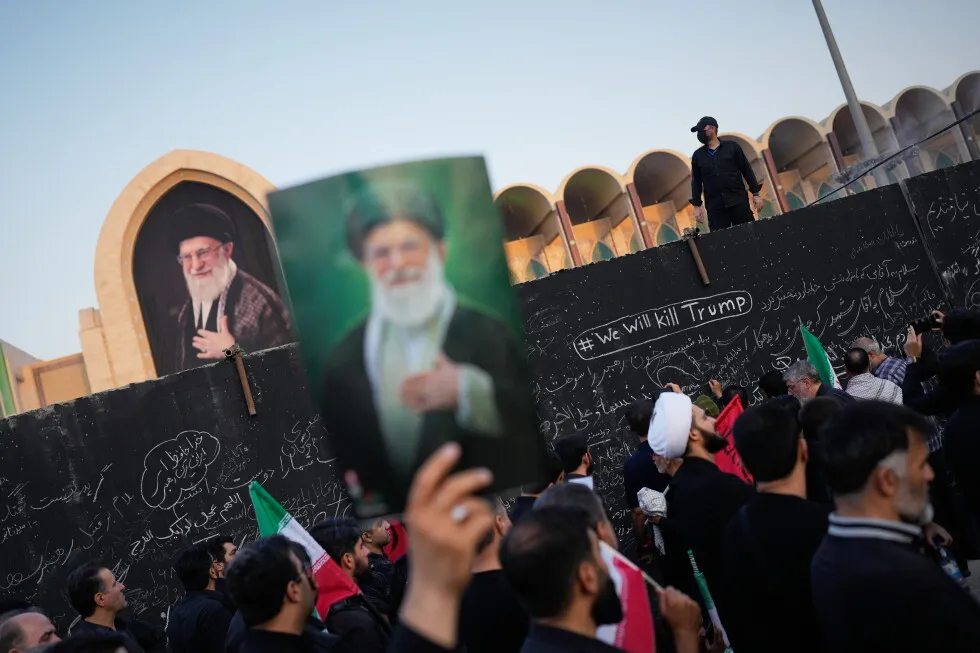
A bitterly divided Iran grapples with Khamenei’s legacy as he is laid to rest 1 of 3 | A mourner holds a portrait of the late Iranian Supreme Leader Ayatollah Ali Khamenei as he walks past a wall bearing messages, including one in English that reads “We will kill Trump,” during the funeral ceremonies for Khamenei and members of his family at the Imam Khomeini Mosalla Grand Mosque in Tehran, Iran, Saturday, July 4, 2026. (AP Photo/Altaf Qadri) 2 of 3 | A woman weeps at the Imam Khomeini Mosalla Grand Mosque during funeral ceremonies for the slain Iranian Supreme Leader Ayatollah Ali Khamenei and members of his family in Tehran, Iran, Sunday, July 5, 2026. (AP Photo/Altaf Qadri) 3 of 3 | The truck carrying the coffins of the slain Iranian Supreme Leader Ayatollah Ali Khamenei and members of his family makes its way through mourners during the funeral procession toward Azadi Tower in Tehran, Iran, Monday, July 6, 2026. (AP Photo/Vahid Salemi) By AMIR-HUSSEIN RADJY and SARAH EL DEEB Updated 8:51 AM MESZ, July 9, 2026 Add AP News on Google Add AP News as your preferred source to see more of our stories on Google. Share Share Facebook Copy Link copied Print Email X LinkedIn Bluesky Flipboard Pinterest Reddit CAIRO (AP) — He is the grandson of an influential Shiite cleric, born in Qom — the heart of religious studies in Iran — and raised in a traditional family that embraced the theocracy. But by his late 20s, he had stopped praying and given up on clerical rule. Now, he can barely discuss politics or religion with his siblings and father. The tech worker, now in his mid-30s, says Iranian society is deeply divided, even among opponents of the Islamic Republic, and he blames one man — Ayatollah Ali Khamenei. The supreme leader who ruled Iran for over three decades will be laid to rest Thursday after being killed at the start of the war. Processions of his coffin in Tehran and other cities brought out gigantic crowds of supporters in a show of strength by the hard-liners at the core of the Islamic Republic, who lionized him as a defender of clerical rule who had stood up to the West and Israel. But underneath run deep veins of discontent that have grown over decades of bloody repression, international sanctions and economic mismanagement, and have widened since authorities killed thousands of anti-government protesters in January. “A gap has opened up in homes across the country that is really remarkable,” said the tech worker by phone from Tehran, where he now lives. Like others interviewed by The Associated Press to discuss Khamenei’s rule, he spoke on condition of anonymity out of security fears. Khamenei’s death, in Israeli strikes on Feb. 28, crowned his legacy in the eyes of Iran’s rulers and his supporters, who consider him a martyr. Echoing the slogans of ultra-hardliners who oppose talks with the U.S., some who turned out for the funeral called for U.S. President Donald Trump to be killed in revenge. Ayatollah Ali Khamenei, who led Iran with iron fist while confronting the US, will be buried 4 MIN READ 69 Iran prepares for dayslong funeral for late Supreme Leader Ayatollah Ali Khamenei, killed in war 6 MIN READ 184 Iran begins dayslong funeral for Supreme Leader Ayatollah Ali Khamenei, killed in war 6 MIN READ 184 “Our goal is to prove to the world that we will not submit to oppression and tyranny, and that we will avenge the blood of our leader,” said Hossein Akbari, a 60-year-old mourner in Tehran. Khamenei took the reins in 1989 after the death of Ayatollah Ruhollah Khomeini, the charismatic ideologue who had led the overthrow of the U.S.-allied shah a decade earlier and inspired a mass following. Under the banner of resisting the West, Khamenei defied sanctions to build up the country’s nuclear program, its arsenal of missiles and its network of militant allies across the region. Within Iran, he entrenched hard-line clerical rule by largely neutralizing the reform movement. He gave the Revolutionary Guard immense military, political and economic power. As younger Iranians sought liberalization, he tried to maintain strict control over people’s personal lives and dress codes. A critical turning point came in 2009 with the repression of protests sparked by vote-rigging allegations in that year’s presidential elections. Dozens were killed in the first major crushing of a large protest movement. It generated widespread hopelessness, according to an Iranian activist and former political prisoner who writes for a reformist-leaning magazine in Tehran. A senior aide to Iran’s reformist President Masoud Pezeshkian acknowledged last month that Iran was “severely polarized” between hard-core supporters of the Islamic Republic and those who want its downfall. But Ali Rabiei said there was a large part of society between the “two poles” that the government could lean on to deliver change within the system. His remarks were carried by the state news agency IRNA. There is no reliable polling in Iran, but elections offer a glimpse of public opinion. Turnout in Iran’s last presidential elections dropped to some of the lowest levels ever, seen as a sign that millions hoping for change saw no use in voting. Still, the hard-line candidate garnered 13.5 million votes, while Pezeshkian, the reformist, received 16.3 million. Repeated eruptions of protests since 2009 were met with bloody crackdowns. January’s was the deadliest, when security forces killed thousands to crush nationwide demonstrations that started over economic woes and then snowballed into calls for Khamenei’s overthrow. The sister of a protester who was shot to death on Jan. 9 in Tehran summarized Khamenei’s legacy in one word: injustice. For working-class families, Iran’s plunging economy has only worsened since the war. “Workers can barely afford to buy bread, everything is so expensive,” she said. “Since my sister died, mentally, financially, our life has fallen apart. All we do is look at photos and videos of my sister and cry. What do we have left?” she said from her home in eastern Iran. A quiet form of dissent appeared over the past month as Iranians marked the holy period of Ashoura, commemorated with funeral-style marches honoring a martyred 7th-century Shiite saint. Videos posted on social media have shown some Iranians joining the processions with photos of family members killed in the January crackdown. Iranians feel despair, uncertainty over the future One legacy of Khamenei is the Islamic Republic’s ability to survive his death and the massive U.S.-Israeli assault. The leadership emerged from the war with an interim deal with the U.S. that won it some immediate gains. The deal promises an even greater windfall — a lifting of sanctions — if Iran and the U.S. reach a final nuclear agreement, though that is uncertain. “It’s a victory for the Islamic Republic,” a 35-year-old woman who joined the January protests said of the deal. But “for Iran’s people, until we see the results, we won’t know if it is.” She worries about the chasm in Iranian society and rifts among opponents of the theocracy, some of whom hope for its quick overthrow while others see the potential for gradual change. “The space for dialogue is very closed, and I don’t mean only the government, I mean the people,” she said. After losing his job at a tech company, a 33-year-old Tehran resident who also joined the January protests said his main concern was the wrecked economy, where unemployment and prices have surged. Many of his friends are now jobless, and his wife’s employer slashed salaries. “All of us, frankly, are just trying to stay alive and all of our struggle is taken up with meeting basic needs like rent and food,” he said. Rebin Rahmani, a Kurdish activist once imprisoned in Iran and now living in Paris, said the theocracy under Khamenei lacked any answer to multiplying political and economic problems — except further repression. “Its insistence on iron-fisted, security-driven approaches will only trigger further unrest,” said Rahmani, a director at the Kurdish Human Rights Network. Protests are “reigniting every few years with renewed force.” Pezeshkian and other pragmatists within the system want to use U.S. talks to try to get sanctions lifted and rebuild the economy. For now, they appear to have the backing of Khamenei’s son and successor, Ayatollah Mojtaba Khamenei, who is still in hiding but lent his tentative support to talks in a written statement. Peacetime might prove the real test of the elder Khamenei’s legacy, said Ali Vaez, Iran director at the International Crisis Group, as rival factions vie to define the future of the Islamic Republic. “Wartime gave the system a degree of cohesion under shared duress. But the governance challenges remain just as stark.” SARAH EL DEEB El Deeb is part of the AP’s Global Investigative team. She is based in the Middle East, a region she covered for two decades twitter mailto
SRCAssociated Press (AP)
LANGEN
LEANCenter
WORDS1 483
ENT12
THU · 2026-07-09 · 07:23 GMTBRIEF NSR-2026-0709-91493
NSR-2026-0709-91493News Report·EN·Political Strategy
A bitterly divided Iran grapples with Khamenei’s legacy as he is laid to rest
Ayatollah Ali Khamenei, Iran's Supreme Leader for over three decades, has been laid to rest following his death in Israeli strikes. His funeral ceremonies in Tehran saw massive crowds of supporters, showcasing the strength of hard-liners who viewed him as a defender of clerical rule.
Associated Press (AP)Filed 2026-07-09 · 07:23 GMTLean · CenterRead · 6 min
Associated Press (AP)FIG 01
Reading time
6min
Word count
1 483words
Sources cited
1cited
Entities identified
12entities
Quality score
100%
§ 01
Briefing Summary
AI-generatedNEWSAR · AI
Ayatollah Ali Khamenei, Iran's Supreme Leader for over three decades, has been laid to rest following his death in Israeli strikes. His funeral ceremonies in Tehran saw massive crowds of supporters, showcasing the strength of hard-liners who viewed him as a defender of clerical rule. However, beneath this display lies deep societal division, fueled by decades of repression, sanctions, and economic mismanagement, exacerbated by the recent killing of thousands of protesters. Khamenei's rule was characterized by defiance of the West, building Iran's nuclear program and missile arsenal, and entrenching hard-line clerical power. The article highlights a significant societal polarization between supporters of the Islamic Republic and those seeking its downfall, with many Iranians struggling with economic hardship and a lack of hope for change.
Confidence 0.90Sources 1Claims 5Entities 12
§ 02
Article analysis
Model · rule-basedFraming
Political Strategy
Conflict
Tone
Mixed Tone
AI-assessed
CalmNeutralAlarmist
Factuality
0.60 / 1.00
Mixed
LowHigh
Sources cited
1
Limited
FewMany
§ 03
Key claims
5 extracted01
Some funeral attendees called for U.S. President Donald Trump to be killed in revenge.
factual
Confidence
1.00
02
Funeral processions for Khamenei drew large crowds of supporters, showing a show of strength by hard-liners.
factual
Confidence
1.00
03
Khamenei's death occurred in Israeli strikes on February 28.
factual
Confidence
1.00
04
Ayatollah Ali Khamenei, Iran's Supreme Leader for over three decades, has died.
factual
Confidence
1.00
05
Iranian society is deeply divided, even among opponents of the Islamic Republic.
quoteTech worker interviewed by AP
Confidence
0.90
§ 04
Full report
6 min read · 1 483 words§ 05
Entities
12 identifiedKey playerOppositionContextPositiveNeutralNegative
Organizations1
Locations7
Events1
Topics1
§ 06
Keywords & salience
10 termskhamenei's legacy
1.00
iranian society divided
0.90
ayatollah ali khamenei
0.80
islamic republic
0.70
funeral ceremonies
0.60
clerical rule
0.60
discontent
0.50
hard-liners
0.50
bloody repression
0.40
international sanctions
0.40
§ 07
Topic connections
Interactive graph Network visualization showing 51 related topics
View Full Graph Person Organization Location Event|Click node to navigate|Edge numbers = shared articles