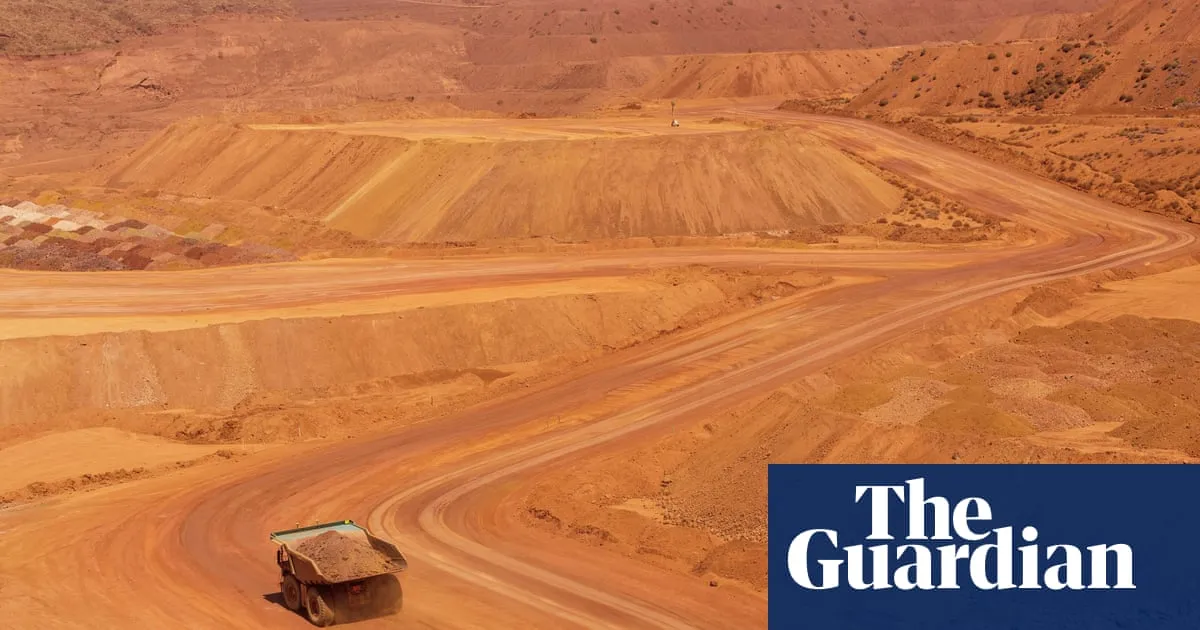
BHP’s decarbonisation slowdown included options to delay electrification of its polluting diesel trucks. Photograph: Aaron Webber/Alamy View image in fullscreen BHP’s decarbonisation slowdown included options to delay electrification of its polluting diesel trucks. Photograph: Aaron Webber/Alamy Former top BHP economist urges tougher government policies to push miners to decarbonise Exclusive: ‘The preferred policy is, of course, a carbon price,’ Dr Huw McKay says, amid slowdown in BHP action on emissions Get our breaking news email, free app or daily news podcast A former chief economist at mining company BHP says stronger climate policy by governments is needed to “move the needle” and incentivise tough decarbonisation decisions at major resource companies. Internal documents, leaked to Australia" class="entity-link entity-organization" data-entity-id="329" data-entity-type="organization">Guardian Australia and the ABC earlier this year, showed BHP had delayed vast renewables projects in the Pilbara, scrapped a project that would have delivered significant cuts to global emissions, and war-gamed options to push the electrification of its polluting diesel truck and train fleets into the next two decades. Experts and analysts have previously said the slowdown in BHP’s decarbonisation progress put Australia’s broader climate targets at risk and exposed significant flaws in a key climate policy, the safeguard mechanism. Former BHP chief economist Dr Huw McKay, now a visiting fellow at Australian National University’s Crawford School of Public Policy, told the Guardian that stronger climate policy was needed to drive urgent action. McKay, who left the company in 2024, said he agreed with the distinguished economist and emeritus professor Ross Garnaut, that voluntary commitments from companies on decarbonisation were unstable and strong government policy was needed. “That’s absolutely right,” he said. “The preferred policy is, of course, a carbon price that is calibrated to move the needle on hard-to-abate emissions. “Inserting a carbon-price obligation like that into the investment process at major resources companies would lead to swifter action.” McKay will this month speak at an ANU seminar on “Heavy industry decarbonisation: insights from the BHP leaks”. The description of the event says he will speak about how “corporate goals and targets are set, the role of broader investment and capital allocation processes, and the influence of policy, financial, and operational environments on decision-making”. BHP has set itself a target of cutting emissions to 30% below 2020 levels by 2030, which it has already achieved using power purchasing agreements, particularly in Chile, and through the 2024 suspension of its struggling Western Australian nickel operations. But its longer-term net zero goal requires it to make significant emissions reductions from its mining operations, which can be achieved by transitioning away from its diesel fleet and transforming its inland power grid, which is currently powered by gas and diesel generation. 4:18 BHP files: leaked memo shows miner backtracking on key climate projects in Australia – video Bowen defends current regime The climate change, Chris Bowen, has defended the current “safeguard mechanism”, which requires about 200 big industrial emitting sites – including several BHP facilities – to cut emissions intensity year-on-year, either onsite or by buying contentious carbon offsets. Bowen said the safeguard mechanism did not rely on voluntary commitments. He said it mandated each large facility covered to cut emissions each year and to reach net zero by 2050. Government data released earlier this year said total onsite emissions covered by the scheme were down 2.3% this year. The leaked BHP documents revealed how the company had repeatedly balked at making major investments in decarbonisation initiatives, despite publicly describing climate change as an “existential” risk to the world and internally acknowledging that urgent emissions reductions efforts effectively underpinned its “licence to operate”. View image in fullscreen Energy minister Chris Bowen defends the safeguard mechanism, saying ‘We won’t be imposing a carbon tax.’ Photograph: Lukas Coch/AAP The company’s first inland Pilbara decarbonisation project – a 50MW solar farm and 20MW battery at its Jimblebar mine – was shelved after being approved and funded by the board. Another 500MW system of solar, wind and battery was significantly delayed. The company has continued to acquire 62 polluting diesel haulage trucks, despite pledges to electrify its highly polluting fleet as early as 2027-2028. In the weeks after the revelations, BHP engaged in a concerted public relations push to promote a trial of two battery-electric trucks in the Pilbara. An event held by the company, along with Rio Tinto and Caterpillar, was attended by the press and the Western Australian premier, Roger Cook. An invitation to journalists said that “flights and transport to site are included”, although WA government officials were not provided with transportation by BHP. The event was held at its Jimblebar mine site. Critics say BHP was simply re-launching a previous announcement about the trial of battery-electric haul trucks. In a statement, a BHP spokesperson said trials were needed because technology was not advanced enough to scale 240-ton battery-electric haul trucks to an operational fleet. “To support the acceleration of this technology, BHP is partnering with equipment producers to run trials of battery-electric equipment including two 240-ton battery electric haul trucks being trialled on a BHP site in the Pilbara, and four battery-electric locomotives which we plan to commence trialling in coming months,” the spokesperson said. “BHP continues to focus on delivering our operational emissions reduction target and long-term net zero goal, including support to accelerate and de-risk the required technology, noting that announced commitments by some companies to acquire new equipment in the future does not mean such equipment currently exists.” Explore more on these topics BHP The BHP files Climate crisis Greenhouse gas emissions Mining (Business) Mining (Environment) news Share Reuse this content
SRCThe Guardian - World News
LANGEN
LEANCenter-Left
WORDS926
ENT12
THU · 2026-07-09 · 15:00 GMTBRIEF NSR-2026-0709-91645
NSR-2026-0709-91645News Report·EN·Environmental
Former top BHP economist urges tougher government policies to push miners to decarbonise
A former chief economist at BHP, Dr. Huw McKay, advocates for stronger government climate policies to compel major resource companies to decarbonize.
Christopher Knaus and Adam MortonThe Guardian - World NewsFiled 2026-07-09 · 15:00 GMTLean · Center-LeftRead · 4 min
The Guardian - World NewsFIG 01
Reading time
4min
Word count
926words
Sources cited
3cited
Entities identified
12entities
Quality score
100%
§ 01
Briefing Summary
AI-generatedNEWSAR · AI
A former chief economist at BHP, Dr. Huw McKay, advocates for stronger government climate policies to compel major resource companies to decarbonize. This call comes amid revelations from leaked internal documents showing BHP has delayed renewable energy projects, scrapped an emissions-cutting initiative, and postponed the electrification of its diesel fleets. McKay believes voluntary corporate commitments are insufficient and a carbon price is the preferred policy to incentivize significant emissions reductions in hard-to-abate sectors. He will discuss these insights at an upcoming ANU seminar. Meanwhile, Climate Change Minister Chris Bowen defends the government's "safeguard mechanism" as a mandated approach to emissions reduction, not reliant on voluntary actions.
Confidence 0.90Sources 3Claims 5Entities 12
§ 02
Article analysis
Model · rule-basedFraming
Environmental
Economic Impact
Tone
Measured
AI-assessed
CalmNeutralAlarmist
Factuality
0.70 / 1.00
Factual
LowHigh
Sources cited
3
Well sourced
FewMany
§ 03
Key claims
5 extracted01
A carbon price, calibrated to address hard-to-abate emissions, is the preferred policy to drive swifter action.
quoteDr Huw McKay
Confidence
1.00
02
Voluntary corporate decarbonisation commitments are unstable, and strong government policy is necessary.
quoteDr Huw McKay and Ross Garnaut
Confidence
1.00
03
A former chief economist at BHP urges tougher government policies to incentivize miners' decarbonisation decisions.
quoteDr Huw McKay
Confidence
1.00
04
BHP had delayed vast renewables projects, scrapped a significant emissions-cutting project, and considered delaying diesel truck electrification.
factualInternal documents leaked to Guardian Australia and ABC
Confidence
0.90
05
BHP's slowdown in decarbonisation progress puts Australia's climate targets at risk and exposes flaws in the safeguard mechanism.
factualExperts and analysts
Confidence
0.80
§ 04
Full report
4 min read · 926 words§ 05
Entities
12 identifiedKey playerOppositionContextPositiveNeutralNegative
Organizations5
§ 06
Keywords & salience
10 termsdecarbonisation
1.00
government policies
0.90
carbon price
0.80
mining companies
0.70
bhp
0.70
climate policy
0.60
emissions
0.60
diesel trucks
0.50
safeguard mechanism
0.40
electrification
0.40
§ 07
Topic connections
Interactive graph No topic relationship data available yet. This graph will appear once topic relationships have been computed.