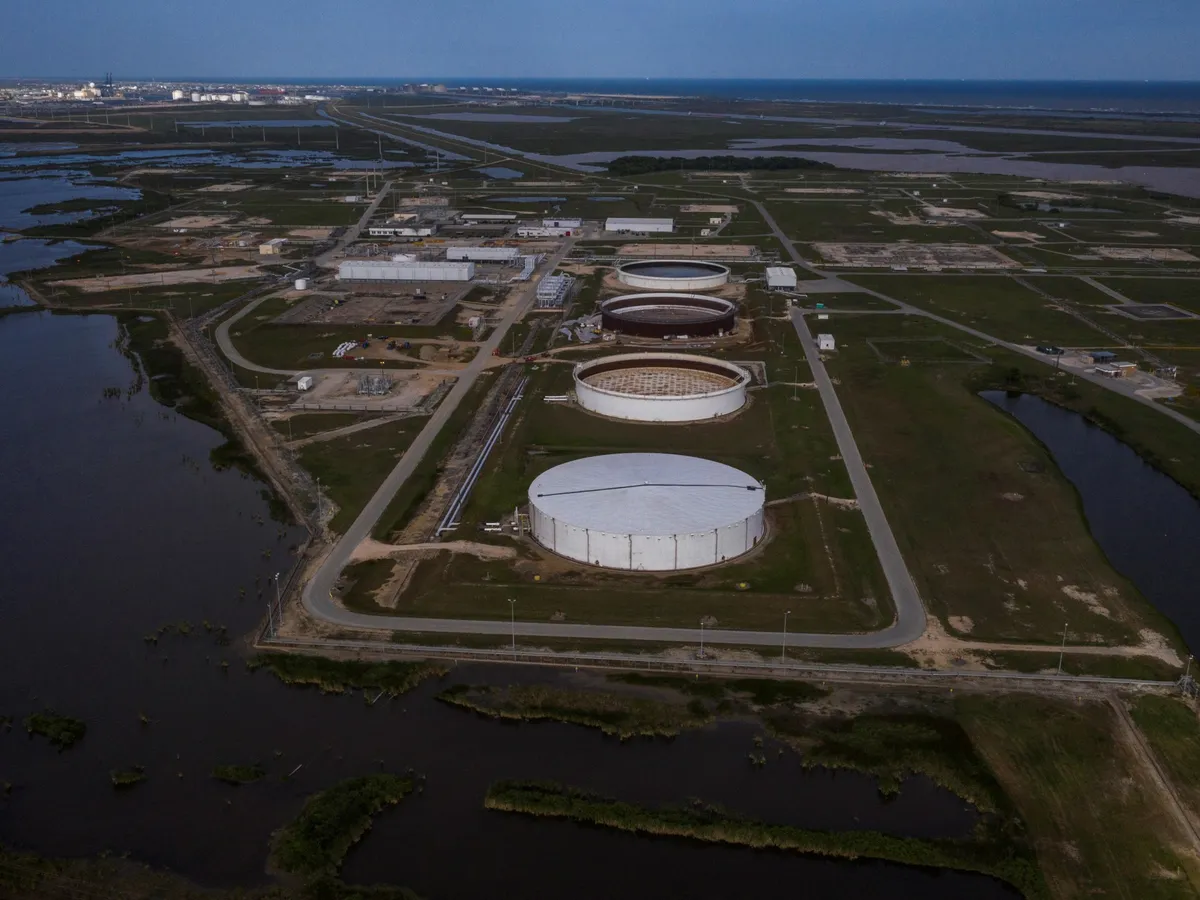
US oil reserves hit lowest level since 1983 amid growing tensions with Iran and global supply concerns.Strategic oil reserves are stores in salt caverns along the US Gulf Coast [File: Adrees Latif/Reuters]Published On 9 Jul 2026Last month, the United States Strategic Petroleum Reserve (SPR) fell to its lowest level since 1983 as renewed tensions between the United States and Iran raised concerns about the stability of global oil supplies and prices.US President Donald Trump acknowledged to reporters on Wednesday that anytime the US strikes Iran, oil prices jump.Recommended Stories list of 4 itemslist 1 of 4Australia to begin selling uranium to India for peaceful purposeslist 2 of 4India floods sweep away thousands of gas cylinderslist 3 of 4FIFA World Cup 2026: Ranking the eight quarterfinalists’ chances of glorylist 4 of 4Erdogan gifts NATO leaders engraved revolvers with live ammunitionend of listAnd they did. Brent futures topped their highest level since June 19 on Wednesday. Brent futures settled at $78.02 a barrel, up 5.2 percent from the day before.Meanwhile, the SPR fell by 6.2 million barrels in the week ending July 3 to 319.5 million barrels, according to data from the Department of Energy, marking its lowest level since the Reagan administration. It has a storage capacity of 713.5 million barrels, a level it was last close to around the 2010s.Today, the US produces more oil than any country in the world and is a net exporter of petroleum products. Roughly 60 percent of the crude oil refined in the US comes from domestic production. The remaining 40 percent is imported, of which roughly 60 percent comes from Canada and another 7 percent from Mexico. Only about 7 percent of the crude oil consumed in the country travels through the Strait of Hormuz.So why do tensions with Iran still affect prices at US petrol pumps?Crude oil isn’t priced based on where it was produced but on global benchmark prices that reflect worldwide supply and demand.“Independence doesn’t mean price security or price independence because oil is a globally traded commodity and all markets are interrelated,” Maksim Sonin, an energy executive who works with Stanford University’s Center for Fuels of the Future, told Al Jazeera.If several million barrels of oil are suddenly at risk because exports through the Strait of Hormuz are disrupted, buyers around the world begin competing for replacement supplies from other countries. That increased competition pushes global crude prices higher, raising costs for US refiners and, ultimately, consumers.“Historically, strategic reserves are meant to be a short-term solution to buy governments time to deal with the situation, rather than a silver bullet or a complete solution. The longer a crisis goes on, the less flexibility governments have with their strategic reserves,” Sonin added.Higher crude prices ripple well beyond topping off at the petrol pump. Airlines pay more for jet fuel, trucking companies spend more on diesel, driving up the cost of food. Higher transportation costs are passed along to consumers through more expensive groceries, goods and travel.In early March, the US first tapped the SPR following the initial strikes on Iran. Despite that, prices for consumers still jumped significantly.On February 28, the day the US and Israel first struck Iran, the price for a gallon of petrol was $2.98 ($0.79 per litre) and by mid-May it had jumped to $4.48 ($1.18 per litre), according to the American Automobile Association (AAA), which tracks daily petrol prices in the US.What is the Strategic Petroleum Reserve?The Strategic Petroleum Reserve is the world’s largest emergency stockpile of crude oil. The SPR is a mix of foreign and domestic crudes which are a combination of sweet and sour.The US established the reserve in 1975 following the Arab oil embargo when several Middle Eastern producers restricted exports to the US, causing severe fuel shortages and exposing the country’s dependence on imported energy. The push to create the reserve began several decades earlier, starting in 1944.Today, hundreds of millions of barrels of crude are stored underground in salt caverns in four locations along the US Gulf Coast and can be released during major supply disruptions. They can be distributed to nearly half of all US oil refineries using interstate pipelines or barges. Once released, the oil will then be refined and sold around the globe to balance the void left by decreased supply.Unlike commercial inventories held by private companies, the SPR exists for extraordinary circumstances like war and natural disasters. It was tapped following Hurricane Katrina in 2005 after the Category 5 storm devastated the Gulf Coast, which produced 50 percent of domestic oil output. The US government also dipped into it for six months after Russia’s invasion of Ukraine, in addition to the current release, which began in March and was done in coordination with the International Energy Agency, a coalition of 28 countries that supports energy supply security through energy policy cooperation.“It’s for shocks like this; it’s for conflict, major overseas disruptions, outages, and whatnot. That’s the point of it. The point is to have a buffer, an emergency fund, to help buffer prices and prevent supplies from being disrupted,” Abhi Rajendran, non-resident fellow at Rice University’s Center for Energy Studies (CES) in Houston, Texas, told Al Jazeera.Why does it matter if most US oil doesn’t come through the Strait of Hormuz?The Strait of Hormuz remains one of the world’s most important energy chokepoints, with roughly one-fifth of global oil supply passing through the narrow and strategic waterway connecting the Gulf to the Gulf of Oman.While the US imports relatively little oil through the strait, many of its allies and trading partners, including South Korea and India, depend heavily on those shipments.When Hormuz shipping is interrupted, those countries would have to secure replacement barrels elsewhere, bidding against buyers around the world for supplies from producers including the US. That puts pressure on prices.That competition tightens the global market and pushes benchmark crude prices higher, even in countries that import little Middle Eastern oil directly.“We’ve been pulling out of our storage, including the SPR, and exporting it to help balance the global market. That’s not necessarily sustainable for a very long period of time,” Rajendran said.Why is the reserve so low?Prior to the most recent release, the SPR reached its lowest level in decades only a few years ago due to emergency releases following Russia’s invasion of Ukraine, which threatened supplies from one of the world’s largest oil exporters.The invasion and subsequent sanctions on Russian fuel sales raised fears that a significant portion of that supply could disappear from global markets, driving Brent crude above $130 per barrel in March 2022. Average US petrol prices climbed above $5 per gallon ($1.32 per litre) for the first time on record.At the time, the administration of former President Joe Biden authorised the largest release in the reserve’s history at 180 million barrels, to help stabilise global markets and ease soaring fuel prices. Congress also mandated additional sales from the reserve in 2023.Those releases helped bring petrol prices down, but significantly reduced the government’s emergency stockpile. Since then, the Department of Energy has been gradually repurchasing oil to replenish the reserve when market conditions allow.What would happen if the US stopped releasing oil?The SPR serves two purposes. It provides emergency supplies when physical shortages emerge, but it also reassures financial markets that governments have tools available to respond to major disruptions.“If the US decides not to release oil from the reserve, it will affect supply and demand because there will be less supply. It would also affect market perception, as markets expect the US to tap its reserves. If that doesn’t happen, it sends a signal that the situation is more severe than expected. That would have a compounded impact on global oil prices,” Sonin added.
SRCAl Jazeera
LANGEN
LEANCenter
WORDS1 286
ENT12
THU · 2026-07-09 · 20:03 GMTBRIEF NSR-2026-0709-91745
NSR-2026-0709-91745News Report·EN·Economic Impact
Why the US Strategic Petroleum Reserve matters amid US-Iran tensions
The US Strategic Petroleum Reserve (SPR) has reached its lowest level since 1983, holding 319.5 million barrels. This decline coincides with renewed US-Iran tensions and global supply concerns, which have driven up oil prices.
Andy HirschfeldAl JazeeraFiled 2026-07-09 · 20:03 GMTLean · CenterRead · 6 min
Al JazeeraFIG 01
Reading time
6min
Word count
1 286words
Sources cited
1cited
Entities identified
12entities
Quality score
100%
§ 01
Briefing Summary
AI-generatedNEWSAR · AI
The US Strategic Petroleum Reserve (SPR) has reached its lowest level since 1983, holding 319.5 million barrels. This decline coincides with renewed US-Iran tensions and global supply concerns, which have driven up oil prices. Despite the US being a net oil exporter, global crude oil prices are determined by worldwide supply and demand. Disruptions to global supply, such as those potentially caused by tensions in the Strait of Hormuz, increase competition for oil, raising prices for US refiners and consumers. The SPR, established in 1975 as an emergency stockpile, is intended for extraordinary circumstances like supply disruptions and has been tapped previously, including in response to the Russia-Ukraine conflict.
Confidence 0.90Sources 1Claims 5Entities 12
§ 02
Article analysis
Model · rule-basedFraming
Economic Impact
Conflict
Tone
Measured
AI-assessed
CalmNeutralAlarmist
Factuality
0.70 / 1.00
Factual
LowHigh
Sources cited
1
Limited
FewMany
§ 03
Key claims
5 extracted01
If oil exports through the Strait of Hormuz are disrupted, buyers compete for replacement supplies, pushing global crude prices higher.
factual
Confidence
1.00
02
Crude oil isn’t priced based on where it was produced but on global benchmark prices that reflect worldwide supply and demand.
factual
Confidence
1.00
03
The US produces more oil than any country and is a net exporter of petroleum products.
factual
Confidence
1.00
04
Brent futures topped their highest level since June 19, settling at $78.02 a barrel, up 5.2 percent.
statistic
Confidence
1.00
05
US Strategic Petroleum Reserve fell to its lowest level since 1983 amid US-Iran tensions and global supply concerns.
statistic
Confidence
1.00
§ 04
Full report
6 min read · 1 286 words§ 05
Entities
12 identifiedKey playerOppositionContextPositiveNeutralNegative
Organizations4
Locations5
§ 06
Keywords & salience
8 termsstrategic petroleum reserve
1.00
us-iran tensions
0.90
global oil supplies
0.80
oil prices
0.70
strait of hormuz
0.60
global benchmark prices
0.50
energy executive
0.40
net exporter
0.40
§ 07
Topic connections
Interactive graph Network visualization showing 2 related topics
View Full Graph Person Organization Location Event|Click node to navigate|Edge numbers = shared articles