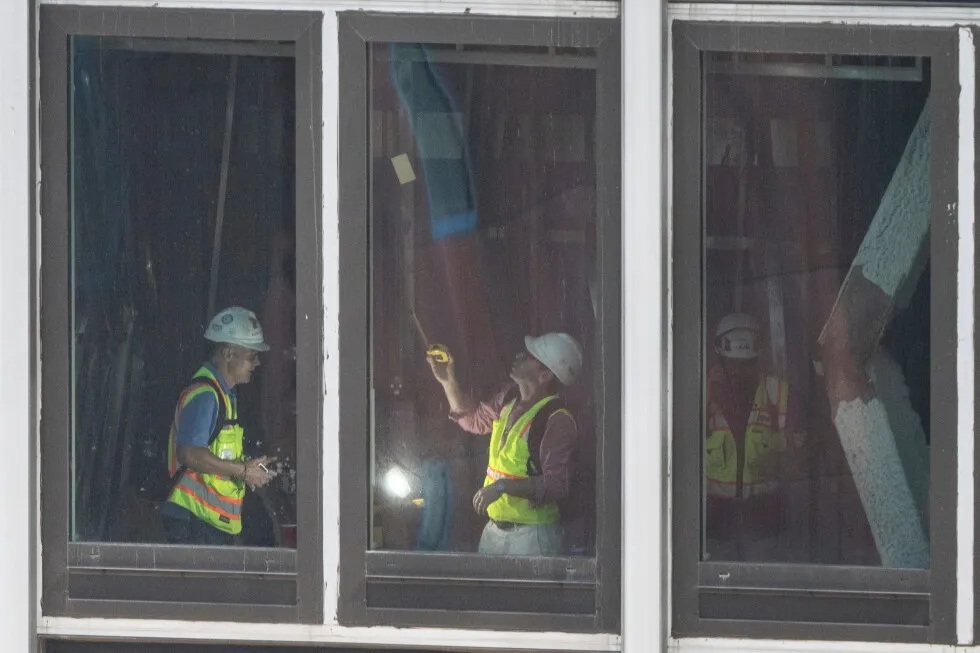
New York construction scare highlights the challenges of converting offices into housing 0 seconds of 1 minute, 14 secondsVolume 0% Press shift question mark to access a list of keyboard shortcuts Keyboard ShortcutsEnabledDisabled Shortcuts Open/Close/ or ? Play/PauseSPACE Increase Volume↑ Decrease Volume↓ Seek Forward→ Seek Backward← Captions On/Offc Fullscreen/Exit Fullscreenf Mute/Unmutem Decrease Caption Size- Increase Caption Size+ or = Seek %0-9 Next Up Bernie Sanders joins Democrats’ calls for Graham Platner to drop out of Maine Senate race 01:00 Subtitle Settings OffEnglish(US)_v Font Color White Font Opacity 100% Font Size 100% Font Family Arial Character Edge None Edge Color Black Background Color Black Background Opacity 50% Window Color Black Window Opacity 0% Reset WhiteBlackRedGreenBlueYellowMagentaCyan 100%75%50%25% 200%175%150%125%100%75%50% ArialCourierGeorgiaImpactLucida ConsoleTahomaTimes New RomanTrebuchet MSVerdana NoneRaisedDepressedUniformDrop Shadow WhiteBlackRedGreenBlueYellowMagentaCyan WhiteBlackRedGreenBlueYellowMagentaCyan 100%75%50%25%0% WhiteBlackRedGreenBlueYellowMagentaCyan 100%75%50%25%0% 00:00 01:14 01:14 More Videos 01:00 Bernie Sanders joins Democrats’ calls for Graham Platner to drop out of Maine Senate race 00:45 Denmark hits back after Trump suggests once again that U.S. should control Greenland 00:45 Paraguay senator on racist remarks targeting France captain Kylian Mbappé 00:57 Trump says interim agreement between U.S. and Iran is 'over' 00:46 Explosions rock Damascus as French President meets with Syrian counterpart 01:30 Joy turns to disappointment for USA World Cup fans from coast to coast 01:29 Trump says US will give Ukraine license to make Patriot missiles to counter Russia 01:56 Trump says he called FIFA president to review US red card: 'That wasn't a foul' Close 1 of 6 | A Manhattan high-rise remained unstable Tuesday after officials found that columns buckled and floors sagged while it was being converted to luxury apartments, forcing evacuations in and around the Midtown construction site. (AP Production: Marissa Duhaney) 2 of 6 | People inspect a buckled support beam inside 235 East 42nd Street, Wednesday, July 8, 2026, in New York. (AP Photo/Yuki Iwamura) 3 of 6 | A general view shows 235 East 42nd Street, Wednesday, July 8, 2026, in New York. (AP Photo/Yuki Iwamura) 4 of 6 | The building at 235 East 42nd Street is seen Tuesday, July 7, 2026, in New York. (AP Photo/Angelina Katsanis) 5 of 6 | People inspect a buckled support beam inside 235 East 42nd Street, Wednesday, July 8, 2026, in New York. (AP Photo/Yuki Iwamura) 6 of 6 | The unstable building at 235 East 42nd Street is seen Tuesday, July 7, 2026, in New York. (AP Photo/Angelina Katsanis) By R.J. RICO, JESSICA HILL and PHILIP MARCELO Updated 12:02 PM MESZ, July 10, 2026 Add AP News on Google Add AP News as your preferred source to see more of our stories on Google. Share Share Facebook Copy Link copied Print Email X LinkedIn Bluesky Flipboard Pinterest Reddit New York (AP) — When two steel columns buckled this week inside the former Pfizer headquarters in midtown Manhattan, the scare prompted evacuations and halted work on one of the nation’s largest office-to-apartment conversions. It also highlighted the complex engineering behind adaptive reuse projects, which have become increasingly popular as officials try to tackle a nationwide housing shortage by transforming offices that have sat underused since the COVID-19 pandemic. The plans call for turning two office buildings — one built in 1909, the other in the 1960s — into about 1,600 apartments by adding more than a dozen stories atop the older structure and redesigning and expanding the other. The buckling occurred on the 21st floor of the newer structure, and crews have installed temporary supports as officials investigate. Engineering experts said the conversion project is complex and poses many challenges, which include making sure older buildings can safely support new loads and carving up office floors to accommodate residential living. But none said the high-profile setback should make people doubt the ability of engineers to complete such projects. “I don’t think it really brings into question our understanding of how to do something like this,” said Ben Schafer, a structural engineering professor at Johns Hopkins University. How do you build a new tower on top of an old one? On its website highlighting the midtown project, adaptive reuse firm Collaborative Construction Management says the nine-story building from 1909 will be “threaded through” with a new addition of about 30 stories of poured concrete. Schafer, who is not involved with the undertaking, said the likely approach is to have the century-old building continue to carry its own weight while building a new structural system to support additions. Life returns to streets around damaged NYC high-rise. Here is what comes next 2 MIN READ Manhattan high-rise deemed stable after columns buckled, and some evacuations are lifted 1 MIN READ Puerto Rican Day Parade marches through Manhattan with pulsing music and vibrant colors 1 MIN READ “My interpretation would be that they’re going to leave that building carrying its own load, and they’re just going to poke holes in it so that they can take the load from the building that they’ve put above it and bring it all the way down to the foundation,” Schafer said. Schafer said construction on the other tower presents a different challenge: punching holes in the existing floor plate to bring light into apartments, while also ensuring that the steel frame can support the newly added loads. City officials have not determined what caused the columns to buckle. But both Schafer and Emily Guglielmo, a San Francisco-based structural engineer, believe the failure likely resulted from the added load. Spokespersons for MetroLoft, the project developer, didn’t respond to requests for comment Thursday. But Nathan Berman, the firm’s founder, acknowledged in an interview with The Wall Street Journal that the added weight from widening the top 15 or so floors of the building likely caused the damage. Guglielmo thinks that either the original design assumptions were misunderstood, something went wrong during the design or construction process, or construction crews overloaded or weakened the structure. Adding stories to existing buildings is common in dense urban areas where land is scarce, she said, but it requires reviewing original construction documents and inspecting the building before determining how additional floors will affect the structure. “In cities and towns that don’t have that available geography, you’re going to see a lot more of this type of a design where there’s an adaptive reuse to an existing building,” Guglielmo said. To many structural engineers, demolition should occur only as a last resort. “Tearing buildings down is a terrible waste,” Schafer said, pointing out that buildings and the construction sector are responsible for about 40% of the world’s energy-related carbon emissions. “From a sustainability standpoint, that’s a disaster.” Beyond the environmental costs, demolishing and hauling away the remnants of huge buildings is especially expensive in dense cities such as New York. If an existing structure can safely be reused, engineers generally prefer that. James LaFave, a structural engineering professor at the University of Illinois, said a steel-framed building from the 1960s, like the former Pfizer structure, would typically be a “very good” starting point for a conversion. Does the scare in New York call into question other adaptive reuse projects? In recent years, officials across the country have embraced office-to-housing conversions as a potential lifeline for downtown business districts that have struggled since the pandemic. New York, especially, has embraced this push, as officials have made zoning changes and enacted tax incentives to spur housing production. A report from the New York City comptroller’s office last year noted there are 44 adaptive reuse projects in the city that, as of early 2025, had either been completed, were underway or could move forward. Pfizer moved out of the building in 2023 after opening a new office near Penn Station, leaving the property vacant. Construction on the property began in 2024. Joshua Harris, director of Fordham University’s Real Estate Institute, said office-to-residential conversions are a key part of solving the housing shortages in New York and other cities, even if they come with risk. “In a certain sense, it’s not terribly surprising that this happened, and we should have a little bit of grace,” he said. “These are very, very complicated surgical procedures being done to very old buildings.” “This is part of the reality of fixing the housing crisis,” Harris continued. “Things like this can happen. It doesn’t look as complex as putting a rocket into space, but, in a real estate sense, construction in an environment like Manhattan on 42nd Street and Second Avenue is very complex.” Guglielmo, the California engineer, said a combination of building codes, inspections and experienced construction crews makes failures like this rare. “We’re very fortunate here in the United States that we are not seeing these types of failures on a day-to-day basis,” she said. “We’re privileged to have really robust building codes that explain to us as engineers how to do our designs in a way that’s safe.” Still, Harris said it is likely a gut check for the industry, as office conversions transform once sleepy business districts across the city into 24/7 neighborhoods, like parts of Wall Street in recent years. “If this building has a problem, all the other projects that have been sort of greenlit, they’re going to want to review to make sure that it’s not something similar,” Harris said. Rico reported from Atlanta and Hill reported from Las Vegas. R.J. RICO Rico is a U.S. Desk editor and reporter based in Atlanta for The Associated Press. He has covered housing, immigration and activism in the South. twitter mailto PHILIP MARCELO Marcelo is a general assignment reporter in the NYC bureau. He previously wrote for AP Fact Check and before that was based in Boston, where he focused on race and immigration. twitter mailto
SRCAssociated Press (AP)
LANGEN
LEANCenter
WORDS1 610
ENT12
FRI · 2026-07-10 · 10:23 GMTBRIEF NSR-2026-0710-91914
NSR-2026-0710-91914News Report·EN·Human Interest
New York construction scare highlights the challenges of converting offices into housing
A recent incident at the former Pfizer headquarters in Midtown Manhattan, where steel columns buckled during a conversion to apartments, has highlighted the complexities of adaptive reuse projects. The scare prompted evacuations and halted work on one of the nation's largest office-to-housing conversions, which aims to create approximately 1,600 apartments from two older buildings.
Associated Press (AP)Filed 2026-07-10 · 10:23 GMTLean · CenterRead · 7 min
Associated Press (AP)FIG 01
Reading time
7min
Word count
1 610words
Sources cited
3cited
Entities identified
12entities
Quality score
100%
§ 01
Briefing Summary
AI-generatedNEWSAR · AI
A recent incident at the former Pfizer headquarters in Midtown Manhattan, where steel columns buckled during a conversion to apartments, has highlighted the complexities of adaptive reuse projects. The scare prompted evacuations and halted work on one of the nation's largest office-to-housing conversions, which aims to create approximately 1,600 apartments from two older buildings. Engineering experts acknowledge the challenges of ensuring older structures can support new loads and reconfiguring office spaces for residential use. While the buckling is under investigation, experts believe it does not fundamentally question engineers' ability to undertake such projects. This event serves as a reminder of the intricate nature of transforming underused offices into much-needed housing, a strategy being pursued nationwide to address housing shortages.
Confidence 0.90Sources 3Claims 4Entities 12
§ 02
Article analysis
Model · rule-basedFraming
Human Interest
Economic Impact
Tone
Measured
AI-assessed
CalmNeutralAlarmist
Factuality
0.90 / 1.00
Factual
LowHigh
Sources cited
3
Well sourced
FewMany
§ 03
Key claims
4 extracted01
The event highlights challenges in converting office buildings to housing.
factual
Confidence
1.00
02
The incident forced evacuations in and around the Midtown construction site.
factual
Confidence
1.00
03
A Manhattan high-rise became unstable during conversion to luxury apartments, with buckled columns and sagging floors.
factual
Confidence
1.00
04
Officials found structural issues at 235 East 42nd Street.
factualOfficials
Confidence
0.90
§ 04
Full report
7 min read · 1 610 words§ 05
Entities
12 identifiedKey playerOppositionContextPositiveNeutralNegative
People4
§ 06
Keywords & salience
8 termsoffice to housing conversion
1.00
construction safety
0.90
building instability
0.80
structural integrity
0.70
urban development
0.60
midtown construction
0.50
new york city
0.50
luxury apartments
0.40
§ 07
Topic connections
Interactive graph Network visualization showing 51 related topics
View Full Graph Person Organization Location Event|Click node to navigate|Edge numbers = shared articles