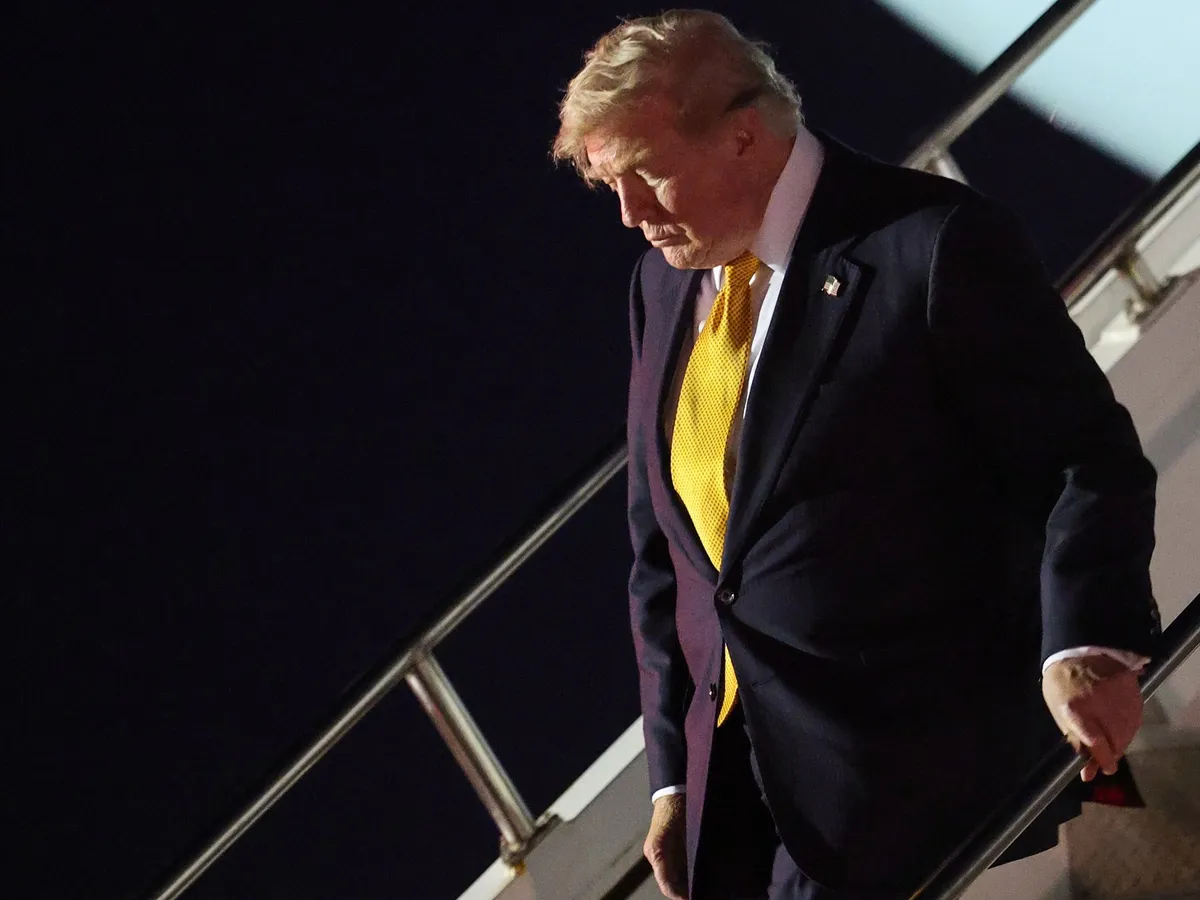
Iran has not responded to Trump’s latest claim, which comes as new attacks threaten the full resumption of the February 28 war.US President Donald Trump steps off Air Force One in Mildenhall, England, on July 8 [Win McNamee/Getty Images]Published On 10 Jul 2026United States President Donald Trump said that Washington has consented to a request from Iran to continue negotiations, as war between the two countries continues.Still, in a social media post on Friday, he reiterated his view that the June 17 ceasefire has ended.Recommended Stories list of 3 itemslist 1 of 3How Strait of Hormuz dispute led to latest US-Iran cycle of fightinglist 2 of 3Strait of Hormuz traffic plunges as US, Iran resume fightinglist 3 of 3Iran says strikes hit southern areas, but US denies it carried attacksend of list“The Iran" class="entity-link entity-organization" data-entity-id="8614" data-entity-type="organization">Islamic Republic of Iran has asked us to continue ‘talks’,” Trump wrote on his Truth Social account.“We have agreed to do so, but the United States has stated to them, in no uncertain terms, that the Cease Fire is OVER!”Iran did not immediately confirm that any request to continue negotiations had been made. The two sides have repeatedly offered different accounts of their dealings throughout the Iran" class="entity-link entity-event" data-entity-id="119503" data-entity-type="event">US-Israeli war against Iran, which began on February 28.Still, Iran’s lead negotiator and Parliament Speaker Mohammad Ghalibaf appeared to signal on Friday that officials were still willing to take the diplomatic route.“At any moment the Americans betray the understanding, we are ready for full-scale defence and will stand firm against them and defend the rights of the Iranian people,” he said on Friday.“Ending the war is a priority for the countries of the world, but everyone should know that this conflict will never end with Iran’s surrender,” he said.Wave of attacksTrump’s latest statement comes as both sides have traded two days of attacks over the passage of commercial traffic in the Strait of Hormuz.In late June, the US and Iran similarly exchanged strikes, after Trump accused the Iranian government of violating the ceasefire by launching drones against container ships.Since Tuesday, the US has targeted about 170 targets in Iran, according to US Central Command, the military branch that oversees operations in the Middle East. Iran has retaliated by targeting US assets across the region.This week’s exchange of fire is the largest threat yet to the June 17 memorandum of understanding (MoU), which called for an immediate end to fighting on all fronts, the lifting of a US naval blockade on Iran, and the opening of the strait.In Friday’s post, Trump did not clarify if the talks he referenced would include a renewed effort to end the fighting, or if they would focus on the issues meant to be addressed within 60 days of the memorandum’s signing.Those issues include the future of Iran’s nuclear programme, the unfreezing of Iranian assets and the future administration of the Strait of Hormuz.Earlier this week, Trump said the US is not seeking a return to its full-fledged war with Iran, even as he threatened to attack Iran’s oil and water infrastructure, “take control” of Iran’s Kharg Island and reinstate the US naval blockade.Qatari officials reportedly visit IranOn Friday, Qatari officials were reportedly visiting Iran “in an effort to de-escalate tensions … and create the conditions for a sort of broader negotiations to continue in Qatar or Pakistan”, Al Jazeera correspondent Victoria Gatenby reported from Doha, Qatar.Qatar’s Ministry of Foreign Affairs did not immediately respond to a request for comment from Al Jazeera.In a post on the social media platform X on Friday, Sheikh Mohammed bin Abdulrahman bin Jassim Al Thani, the Qatari prime minister and minister of foreign affairs, said he had appealed for both the US and Iran to uphold their commitments in a call with Egypt’s foreign minister.Both the US and Iran have accused the other of violating June’s memorandum of understanding, before the latest escalation.Iranian officials have argued that the memo allows Tehran to assert influence over how ships transit the Strait of Hormuz, therefore justifying attacks on vessels that do not comply.The US has maintained the agreement requires Iran to allow for unfettered passage.Still, both Washington and Tehran have incentives to return to diplomacy. The war is politically unpopular in the US and threatens to undermine Trump’s Republican Party in November’s midterm elections.Iran’s already beleagured economy has also suffered throughout the war, boosting the government’s incentive to access frozen funds and have sanctions lifted.Military analyst Alex Alfirraz Scheers told Al Jazeera that any talks were likely to yield “very little” unless some semblance of trust can be revived.“I think in many ways they’re almost symbolic,” he said. “Until there is genuine momentum with regards to trust-building and confidence-building, in the current context these talks will likely lead nowhere.”
SRCAl Jazeera
LANGEN
LEANCenter
WORDS785
ENT10
FRI · 2026-07-10 · 16:30 GMTBRIEF NSR-2026-0710-92022
NSR-2026-0710-92022News Report·EN·Conflict
Trump hints at further Iran negotiations after exchange of fire over Hormuz
US President Donald Trump announced that Washington has agreed to Iran's request to continue negotiations, despite ongoing exchanges of fire in the Strait of Hormuz. Trump stated on social media that the June 17 ceasefire is over, while Iran has not yet confirmed making such a request.
Al Jazeera StaffAl JazeeraFiled 2026-07-10 · 16:30 GMTLean · CenterRead · 4 min
Al JazeeraFIG 01
Reading time
4min
Word count
785words
Sources cited
2cited
Entities identified
10entities
Quality score
100%
§ 01
Briefing Summary
AI-generatedNEWSAR · AI
US President Donald Trump announced that Washington has agreed to Iran's request to continue negotiations, despite ongoing exchanges of fire in the Strait of Hormuz. Trump stated on social media that the June 17 ceasefire is over, while Iran has not yet confirmed making such a request. This development occurs as recent attacks threaten a full resumption of the war that began on February 28. Both sides have accused each other of violating the ceasefire memorandum. Qatari officials are reportedly visiting Iran to de-escalate tensions and facilitate broader negotiations. Despite the renewed diplomatic overtures, military analysts suggest talks may yield little without trust-building.
Confidence 0.90Sources 2Claims 5Entities 10
§ 02
Article analysis
Model · rule-basedFraming
Conflict
Diplomatic
Tone
Mixed Tone
AI-assessed
CalmNeutralAlarmist
Factuality
0.60 / 1.00
Mixed
LowHigh
Sources cited
2
Limited
FewMany
§ 03
Key claims
5 extracted01
Since Tuesday, the US has targeted about 170 targets in Iran, according to US Central Command.
statisticUS Central Command
Confidence
0.90
02
Trump reiterated his view that the June 17 ceasefire has ended.
quoteDonald Trump
Confidence
0.90
03
US President Donald Trump stated Washington has agreed to Iran's request to continue negotiations.
quoteDonald Trump
Confidence
0.90
04
Iran's lead negotiator and Parliament Speaker Mohammad Ghalibaf signaled willingness to take the diplomatic route.
quoteMohammad Ghalibaf
Confidence
0.80
05
Iran did not immediately confirm that any request to continue negotiations had been made.
factual
Confidence
0.80
§ 04
Full report
4 min read · 785 words§ 05
Entities
10 identifiedKey playerOppositionContextPositiveNeutralNegative
Locations3
§ 06
Keywords & salience
10 termsiran negotiations
1.00
strait of hormuz
0.90
us-iran conflict
0.90
ceasefire
0.80
exchange of fire
0.70
diplomatic route
0.60
iran
0.50
united states
0.50
donald trump
0.50
memorandum of understanding
0.40
§ 07
Topic connections
Interactive graph Network visualization showing 51 related topics
View Full Graph Person Organization Location Event|Click node to navigate|Edge numbers = shared articles