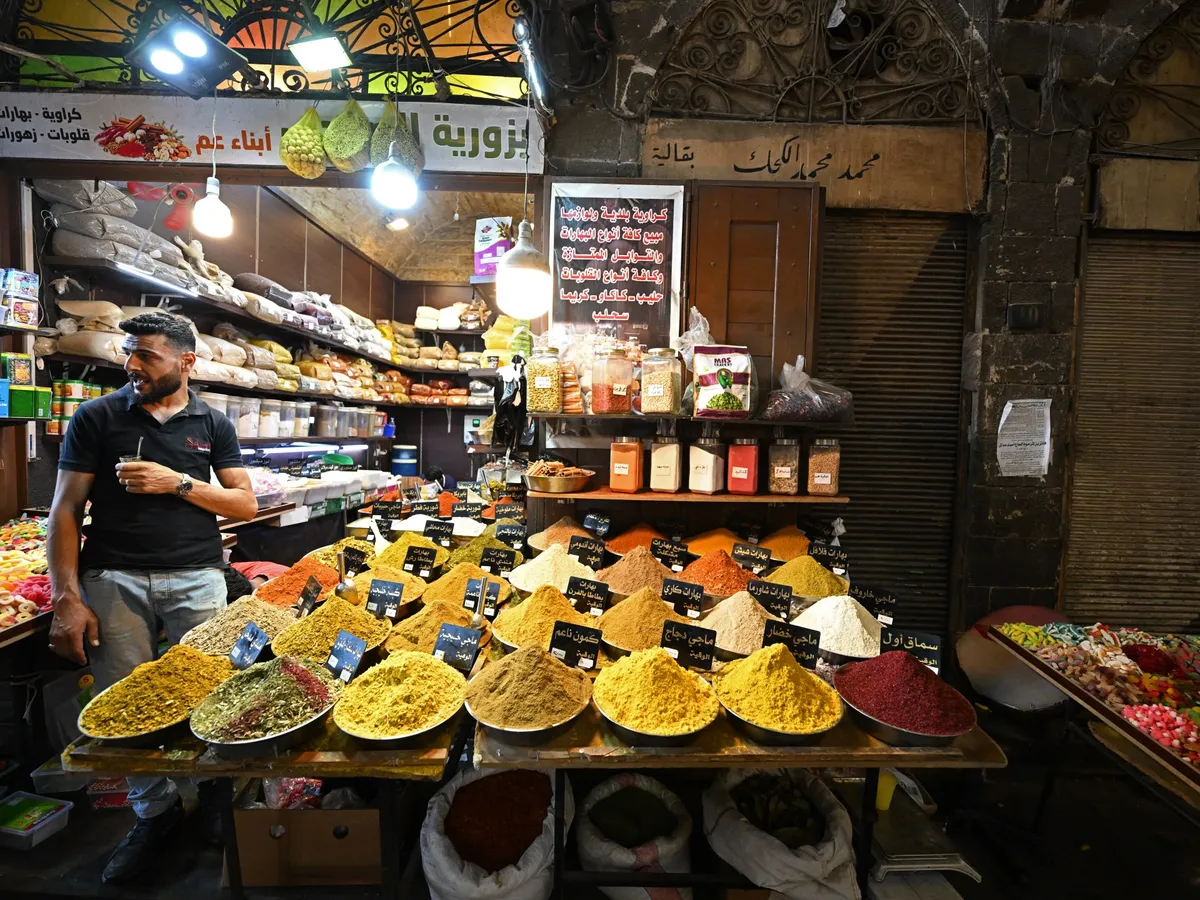
US decision to delist Syria as a ‘state sponsor of terrorism’ sparks cautious optimism among businesses and citizens.A shopkeeper waits for customers in an old market near the Umayyad Mosque in Damascus, July 9 [AFP]Published On 11 Jul 2026Damascus, Syria – For many Syrians, the decades of rule by the al-Assad family – Hafez al-Assad from 1971 to 2000, then his son Bashar from 2000 to 2024 – were filled with oppression from the state and eventually more than a decade of civil war.But one of the most important legacies has been an economic one – the result of the Sanctions imposed by a number of countries, led by the United States, that effectively froze Syria out of the international economic system.Recommended Stories list of 3 itemslist 1 of 3Who is Fadel Shaker? Lebanese pop star released on baillist 2 of 3Bomb attacks rattle Damascus but for most Syrians, life goes onlist 3 of 3The US is building a new pressure architecture against Iranend of listDespite the fall of Bashar al-Assad after rebel groups defeated him in December 2024, many of the Sanctions, including a “state sponsor of terrorism” designation, have remained.The designation has impeded Syria’s rejoining of the international community, while Sanctions have impacted Syrians. Sending money back home from abroad often requires routing transfers through neighbouring countries, such as Lebanon or Turkiye, while access to some websites and online services, including Netflix and Slack, may require a virtual private network.But there has been a positive reaction to the announcement on Wednesday by US President Donald Trump that his administration will remove Syria from the state sponsor of terrorism list.The lifting of previous US Sanctions, such as those related to the Caesar Act, has not transformed the Syrian economy, but it is hoped that those linked to the “state sponsor of terrorism” listing will allow the country to finally flourish.“God willing, it will improve things,” said Ihab, a pastry shop owner in central Damascus.ReintegrationUS Sanctions are thought to have been a huge barrier to foreign investors since the rule of Bashar al-Assad.The World Bank said that since 2011, Sanctions have led to a major collapse in exports and an increase in the trade deficit.After the fall of the al-Assad government, interim President Ahmed al-Sharaa’s administration has identified the removal of all international and US Sanctions as the key to reinvigorating the economy.Al-Sharaa, the former head of the al-Qaeda-aligned Nusra Front, was himself sanctioned by the United Nations and was wanted as a “terrorist” by the US. But he has made efforts to shed those associations and build trust internationally, including by pledging to play a role in the fight against ISIL (ISIS).His efforts have largely been successful, with the European Union and the US removing many of the Sanctions on Syria and on al-Sharaa himself. The Sanctions linked to the US’s “state sponsor of terrorism” list are among the few to remain.The first “state sponsor of terrorism” designation on Syria was during Hafez al-Assad’s rule in 1979, due to the government’s support for Palestinian armed groups.Additional Sanctions were imposed on the state and individuals associated with the al-Assad regime, due to their systematic use of torture and chemical weapons.Some rebel groups were also sanctioned due to their links to al-Qaeda and other banned organisations.Al-Sharaa ended al-Nusra Front’s affiliation with al-Qaeda in 2016 and effectively eschewed the group’s ideology.He also moved to establish a broader, national armed coalition dedicated to fighting the Assad government, later becoming Hayat Tahrir al-Sham.In May 2025, around the time Trump met al-Sharaa in Riyadh, the US president promised to remove many of the Sanctions on the Syrian government. But the expected removal from the “state sponsor of terrorism” list will be particularly welcome as it gets rid of one of the main barriers for international banks and companies.“This is extremely significant because it’s the last major impediment to international economic and political engagement with Syria and with the al-Sharaa administration, and in terms of reintegrating Syria back into the international order and indeed the international economic and political system,” Rob Geist Pinfold, a lecturer on security studies at King’s College London, told Al Jazeera.Struggling economyHowever, he is careful to add that the removal of the designation does not mean a flood of investment will instantly start pouring into Syria.“This is a big hurdle that’s been overcome, but it doesn’t mean that there’s no more hurdles to investment or engagement with Syria.”He added that international actors may be concerned about the government’s control and ability to confront remnants from the al-Assad regime, a potential ISIL (ISIS) comeback, bureaucratic impediments and corruption.Some Syrians were also sceptical that the designation change would lead to instant results.“This needs a long breath,” said a minimarket owner in Damascus, who refused to give his name. “You can’t sleep and wake up and expect change.”He referred to ongoing economic problems and rising costs, as well as a recent fuel shortage.“There’s no economy, and there’s no investment.”Other Syrians were more hopeful that the economy, and other aspects of daily life, would improve. Still, there is a recognition that a little more patience is needed.For some, that patience has worn out, such as the minimarket owner. Others, however, are biding their time.At a juice stall in central Damascus, Zaher counted money received from a customer.“I’m on the street with my cart and nobody is bothering me,” he said. “Electricity is getting better, but nothing gets better after just one day.”“It took God Almighty six days to create Earth,” the 50-year-old said. “These things take time.”
SRCAl Jazeera
LANGEN
LEANCenter
WORDS921
ENT12
SAT · 2026-07-11 · 15:54 GMTBRIEF NSR-2026-0711-92273
NSR-2026-0711-92273News Report·EN·Economic Impact
Syrians optimistic but cautious as sanctions removal revives economic hopes
Syrians are experiencing cautious optimism following the US decision to remove Syria from the "state sponsor of terrorism" list. This move, announced by US President Donald Trump, is seen as a significant step towards reintegrating Syria into the international economic system after decades of sanctions.
Justin SalhaniAl JazeeraFiled 2026-07-11 · 15:54 GMTLean · CenterRead · 4 min
Al JazeeraFIG 01
Reading time
4min
Word count
921words
Sources cited
3cited
Entities identified
12entities
Quality score
100%
§ 01
Briefing Summary
AI-generatedNEWSAR · AI
Syrians are experiencing cautious optimism following the US decision to remove Syria from the "state sponsor of terrorism" list. This move, announced by US President Donald Trump, is seen as a significant step towards reintegrating Syria into the international economic system after decades of sanctions. Businesses and citizens hope this will alleviate economic hardship, which has been exacerbated by the sanctions and the civil war. While previous sanctions removals have not dramatically transformed the economy, the removal of this designation is considered a major hurdle overcome for foreign investment and international engagement. However, experts caution that significant challenges remain for Syria's economic recovery.
Confidence 0.90Sources 3Claims 5Entities 12
§ 02
Article analysis
Model · rule-basedFraming
Economic Impact
Diplomatic
Tone
Measured
AI-assessed
CalmNeutralAlarmist
Factuality
0.70 / 1.00
Factual
LowHigh
Sources cited
3
Well sourced
FewMany
§ 03
Key claims
5 extracted01
Ahmed al-Sharaa was previously sanctioned by the UN and wanted by the US as a 'terrorist'.
factual
Confidence
0.95
02
Sanctions imposed by the US and other countries effectively froze Syria out of the international economic system.
factual
Confidence
0.95
03
Interim President Ahmed al-Sharaa's administration has identified the removal of all international and US sanctions as key to reinvigorating the economy.
factual
Confidence
0.90
04
The World Bank stated that since 2011, sanctions have led to a major collapse in Syrian exports and an increase in the trade deficit.
statisticWorld Bank
Confidence
0.90
05
US decision to delist Syria as a 'state sponsor of terrorism' sparks cautious optimism among businesses and citizens.
factual
Confidence
0.90
§ 04
Full report
4 min read · 921 words§ 05
Entities
12 identifiedKey playerOppositionContextPositiveNeutralNegative
People4
Locations6
§ 06
Keywords & salience
9 termssanctions removal
1.00
economic hopes
0.90
state sponsor of terrorism
0.80
syrian economy
0.70
us sanctions
0.60
international economic system
0.50
bashar al-assad
0.50
foreign investors
0.40
trade deficit
0.40
§ 07
Topic connections
Interactive graph Network visualization showing 51 related topics
View Full Graph Person Organization Location Event|Click node to navigate|Edge numbers = shared articles