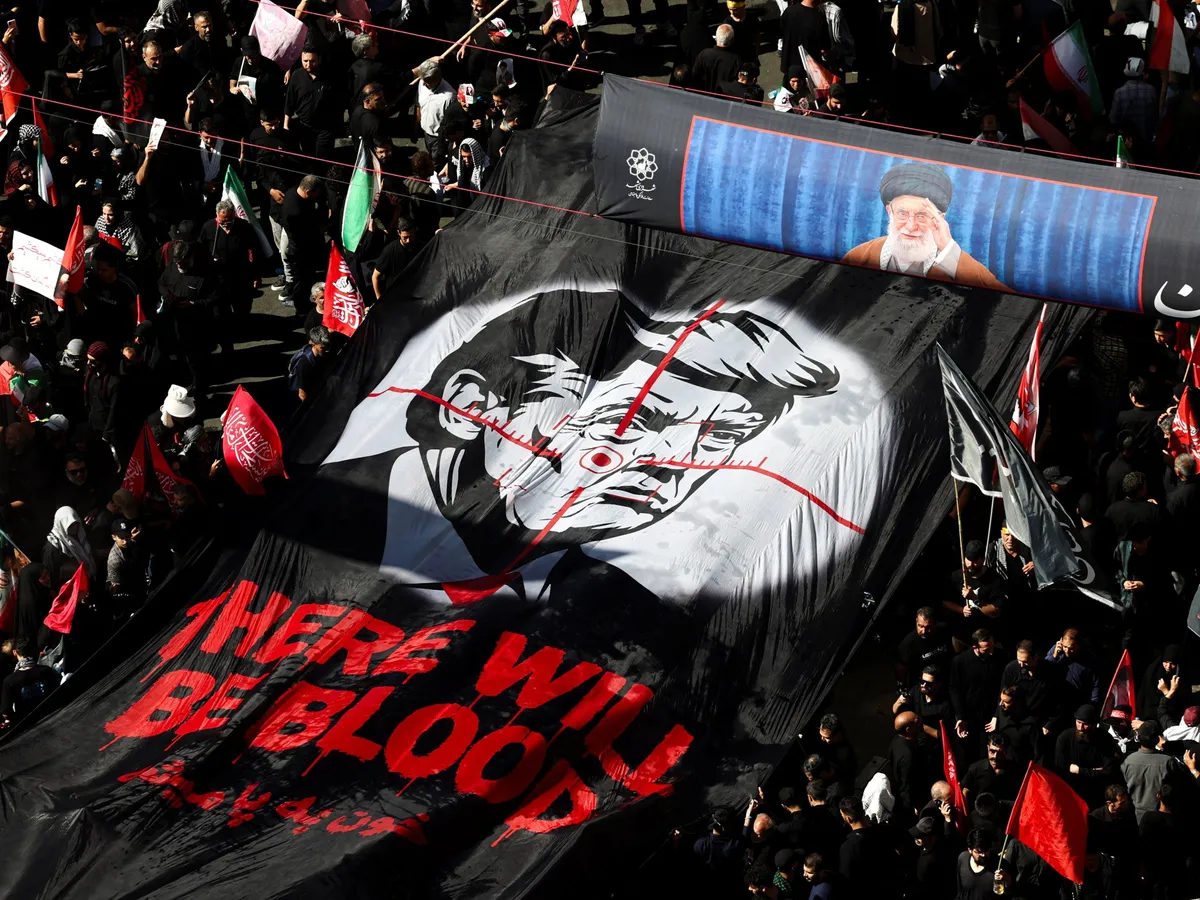
EXPLAINERTehran hits back at several GCC countries, following the most intense US bombing since an MoU was signed last month.Mourners carry a banner against Trump as they gather for the burial of Iran's late Supreme Leader Ayatollah Ali Khamenei, killed in Israeli and US strikes on February 28, in Mashhad, Iran, July 9, 2026 [Majid Asgaripour/West Asia News Agency via Reuters]Published On 12 Jul 2026Iran has mounted attacks on Gulf states and declared the Strait of Hormuz closed after the United States conducted its third round of strikes in a week, in a serious escalation as the ongoing conflict spirals.Tehran on Sunday claimed attacks on Bahrain, Kuwait, Jordan, Qatar and Oman, calling them its response to renewed US bombings on cities along its southern coast.Recommended Stories list of 4 itemslist 1 of 4US attacks Iran overnight; Tehran targets US sites in the regionlist 2 of 4Hormuz shipping in focus as Iran-US rhetoric heats uplist 3 of 4Trump trades threats with Iran’s leader, Araghchi holds talks with Omani FMlist 4 of 4Trump administration subpoenas New York Times reporters over coverageend of listThe widescale US strikes came after Iran shut the Strait of Hormuz — a critical waterway and one of the biggest flashpoints in the conflict — accusing Washington of violating a memorandum of understanding (MoU) signed between the two sides last month.So, where is the conflict headed? Here is everything we know.Why has Iran attacked Gulf states and closed Hormuz?Iran launched missile and drone attacks targeting US military bases and facilities in several Gulf states, while the US Central Command (CENTCOM) carried out a third round of strikes targeting radar, missile, and drone sites across southern Iran last week.The US attacks came after Iran opened fire on commercial vessels in the Strait of Hormuz and announced the closure of the strategic waterway until further notice, with one crew member missing, according to CENTCOM.Iran’s powerful parliament speaker and key peace negotiator, Mohammad Bagher Ghalibaf, said on Sunday, “The era of one-sided deals is over.”“We told you: keep your word or pay the price. Reality is knocking,” Ghalibaf posted on X with an image of Article 5 of the MoU, which relates to the reopening of the Strait of Hormuz.On Wednesday, US President Donald Trump announced that the ceasefire with Iran was over. His statement was followed by Iran’s Supreme Leader Mojtaba Khamenei pledging to avenge his father’s killing.How did we reach here?The fragile MoU reached between the US and Iran had several glaring gaps, keeping the door to escalation ajar.The tensions spilled over into the Strait of Hormuz again last Monday, when Iran’s Islamic Revolutionary Guard Corps (IRGC) struck three commercial vessels, including a Qatari liquefied natural gas (LNG) tanker off the coast of Oman.The next day, the US carried out strikes on Iranian military targets, and Tehran responded with missile and drone attacks on US bases across the Gulf, prompting Trump to call off the ceasefire.The tit-for-tat attacks continued. On Saturday night, the IRGC announced the closure of the Strait of Hormuz until further notice after attacking a container ship using what it called an unapproved route. On Sunday, a second vessel on the strait was hit.Where did the latest US strikes hit?CENTCOM said its third round of strikes on Iran last week was “holding Iranian forces accountable” for their recent attack on a Cyprus-flagged ship in the Strait of Hormuz.It said it hit about 140 military targets that “included Iranian missile and drone sites, naval capabilities, ammunition storage facilities, communication networks, and coastal surveillance locations”.It added that more than 300 targets were struck over the course of three nights throughout the week “to degrade Iran’s ability to attack civilian mariners and commercial vessels freely transiting the strait”.Iran’s state broadcaster IRIB said the US launched air attacks on the outskirts of the city of Veysian, in the western Lorestan province, while another strike hit a military base in Iran’s Khondab.Officials from Bushehr, on Iran’s southern coast, told local media that US forces attacked five cities in the province, including Asaluyeh, Dir, Bushehr, Dashti and Tangestan.Tehran has said the loss of lives and the extent of damage are under review.Where did Iran hit back overnight?Since the start of the ongoing conflict in late February, Tehran has accused the Gulf Cooperation Council (GCC) countries of actively supporting US military operations by hosting its bases and allowing it to use their airspace.OmanThe IRGC claimed a “heavy and surprise” attack on logistics support centres and refuelling platforms used by US aircraft carriers at the port of Duqm in Oman, according to IRIB.The IRGC’s public relations office told IRIB the sites were “destroyed” in the attack.QatarThe IRGC said it also targeted Qatar’s Al Udeid airbase with ballistic missiles and claimed to have destroyed a fighter plane maintenance centre, as well as a command-and-control centre at the base.Qatar’s Ministry of Defence said it intercepted incoming Iranian fire. Three people, including a child, were wounded as a result of falling shrapnel from the interception of Iranian attacks, Qatar’s Ministry of Interior said.KuwaitIran’s army said it used explosive drones to target a Patriot air defence system, an ammunition depot and a radar site belonging to the US military in Kuwait.BahrainIn another wave of drone attacks, Tehran targeted a US communications system and radar site in Bahrain.JordanThe IRGC said it targeted US military facilities at Prince Hassan airbase in Jordan with several ballistic missiles, and claimed to have destroyed a command-and-control centre at the base, as well as hangars housing MQ-9 drones.What’s happening in the Strait of Hormuz?Iran has closed down the strait after firing a warning shot that struck a vessel travelling on an unapproved route, and said on Sunday it had disabled a second vessel.The strait will remain closed until “the end of US interference in this region”, the IRGC said.Iranian officials told state media the US military has been trying to create an “illegal route” through the Strait of Hormuz, causing insecurity in the area.The narrow-yet-vital waterway — touted as the artery of global trade, hosting 20 percent of energy flow — has been at the centre of tensions between the US and Iran since the preliminary deal was signed.Tehran has consistently insisted that only routes approved by Iran shall be taken up during transit through the strait. It says it is open to managing the strait only with Oman, the other coastal country.The US and the GCC countries have rejected Iran’s claim on the strait and demanded that navigation be freed of interference or any sort of fees.On Saturday, Iranian Foreign Minister Abbas Araghchi landed in Oman, where the leaders discussed the shipping and management of the Strait of Hormuz, the Ministry of Foreign Affairs said.Tankers and cargo vessels in the Gulf of Oman, along shipping routes linking the Strait of Hormuz and the Arabian Sea, June 16, 2026 [AP Photo]How have Gulf countries reacted?Some countries had sirens blaring on Sunday afternoon, with governments asking residents to stay indoors.Oman said it is taking “all necessary measures to deal with the developments to preserve the safety of the country and its residents”. The Sultanate of Oman affirmed “its condemnation and denunciation of this attack”, which came just hours after the country hosted Iran’s foreign minister to address security issues in the Strait of Hormuz.Qatar also strongly condemned Iran’s attacks on its territories, as well as in the region, noting that “the continuation of these aggressions represents a dangerous escalation that will complicate efforts aimed at containing tensions, undermine political and diplomatic endeavors aimed at achieving security and stability in the region, and holds the Islamic Republic of Iran fully legally responsible for these aggressions and all their repercussions and consequences”.
SRCAl Jazeera
LANGEN
LEANCenter
WORDS1 274
ENT12
SUN · 2026-07-12 · 09:13 GMTBRIEF NSR-2026-0712-92362
NSR-2026-0712-92362News Report·EN·Conflict
Iran attacks five Gulf nations, shuts Hormuz after US bombing: All to know
Iran has attacked five Gulf nations and closed the Strait of Hormuz following a series of US bombings on its southern coast. Tehran claimed responsibility for attacks on Bahrain, Kuwait, Jordan, Qatar, and Oman, stating it was a response to renewed US strikes.
Yashraj SharmaAl JazeeraFiled 2026-07-12 · 09:13 GMTLean · CenterRead · 6 min
Al JazeeraFIG 01
Reading time
6min
Word count
1 274words
Sources cited
3cited
Entities identified
12entities
Quality score
100%
§ 01
Briefing Summary
AI-generatedNEWSAR · AI
Iran has attacked five Gulf nations and closed the Strait of Hormuz following a series of US bombings on its southern coast. Tehran claimed responsibility for attacks on Bahrain, Kuwait, Jordan, Qatar, and Oman, stating it was a response to renewed US strikes. The US Central Command conducted its third round of strikes targeting Iranian radar, missile, and drone sites. This escalation follows Iran's prior closure of the Strait of Hormuz, a critical shipping lane, and attacks on commercial vessels, which Iran stated was due to US violations of a recent memorandum of understanding. The conflict has intensified with tit-for-tat attacks and the breakdown of a ceasefire.
Confidence 0.90Sources 3Claims 5Entities 12
§ 02
Article analysis
Model · rule-basedFraming
Conflict
Diplomatic
Tone
Sensational
AI-assessed
CalmNeutralAlarmist
Factuality
0.60 / 1.00
Mixed
LowHigh
Sources cited
3
Well sourced
FewMany
§ 03
Key claims
5 extracted01
Iran’s powerful parliament speaker and key peace negotiator, Mohammad Bagher Ghalibaf, said on Sunday, “The era of one-sided deals is over.”
quoteMohammad Bagher Ghalibaf
Confidence
1.00
02
US President Donald Trump announced that the ceasefire with Iran was over.
factualDonald Trump
Confidence
0.90
03
Iran launched missile and drone attacks targeting US military bases and facilities in several Gulf states, while the US Central Command (CENTCOM) carried out a third round of strikes targeting radar, missile, and drone sites across southern Iran last week.
factual
Confidence
0.80
04
Iran has mounted attacks on Gulf states and declared the Strait of Hormuz closed after the United States conducted its third round of strikes in a week.
factual
Confidence
0.80
05
Tehran on Sunday claimed attacks on Bahrain, Kuwait, Jordan, Qatar and Oman, calling them its response to renewed US bombings on cities along its southern coast.
factualTehran
Confidence
0.70
§ 04
Full report
6 min read · 1 274 words§ 05
Entities
12 identifiedKey playerOppositionContextPositiveNeutralNegative
People4
§ 06
Keywords & salience
9 termsstrait of hormuz
1.00
us bombing
0.90
iran attacks
0.90
gulf states
0.80
escalation
0.70
memorandum of understanding
0.60
ceasefire
0.50
donald trump
0.40
ayatollah ali khamenei
0.40
§ 07
Topic connections
Interactive graph Network visualization showing 51 related topics
View Full Graph Person Organization Location Event|Click node to navigate|Edge numbers = shared articles