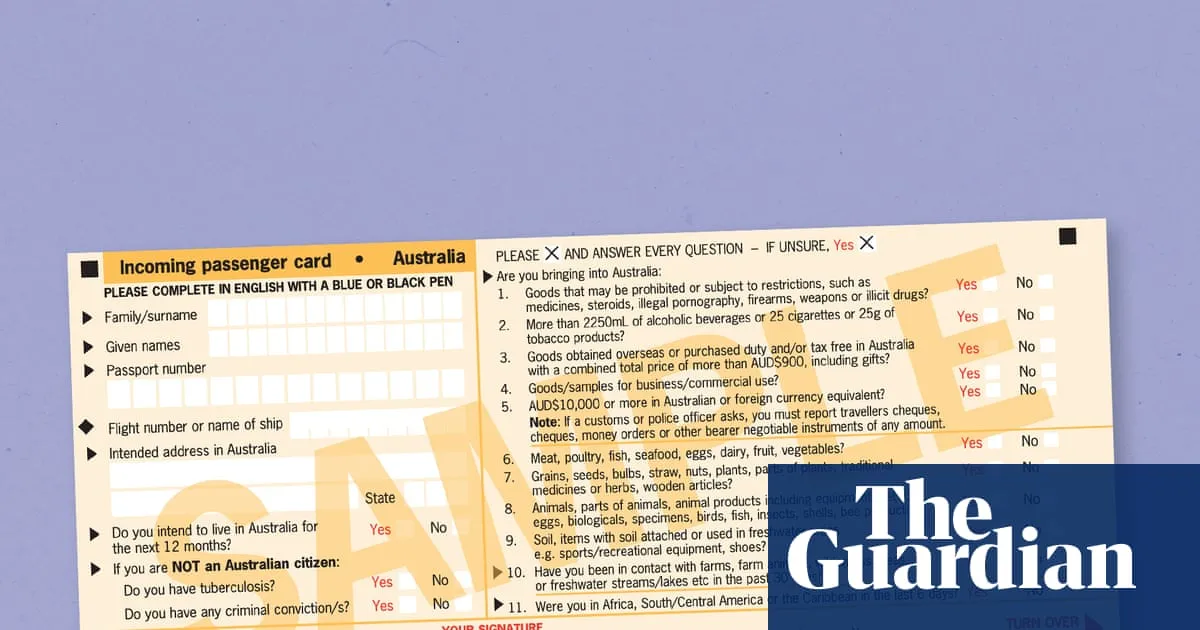
Paper arrival cards for entry to Australia are to be replaced by digital declarations. Composite: Australian Border Force View image in fullscreen Paper arrival cards for entry to Australia are to be replaced by digital declarations. Composite: Australian Border Force Australia to ditch paper arrrival cards for incoming travellers Digital customs declaration to be phased in at all international airports and seaports after successful Qantas trial Get our breaking news email, free app or daily news podcast The days of filling out paper arrival cards are to end for millions of travellers arriving in Australia on international flights. The Albanese government has announced it will roll out digital passenger cards to all Australian international airports and seaports after a “successful” trial on Qantas flights into Brisbane, Sydney and Melbourne. The paper forms, which ask passengers arriving in Australia for personal information and to declare any food, plant or animal products, have long been an annoyance for travellers arriving on long-haul flights. The government said it would spend $56.1m over four years to modernise airport systems and introduce the digital Australian travel declaration. The trial program run by Qantas will be expanded to other capitals including Perth and Adelaide by the end of 2026. A digital declaration will then be phased in for all airlines and at seaports over the next 12 to 18 months. The minister for trade and tourism, Don Farrell, said a simpler and quicker arrivals process would mean “visitors can spend less time filling out forms and more time enjoying everything Australia has to offer”. The home affairs minister, Tony Burke, said the modernisation was “essential to Australia’s prosperity and national security” and would create a “seamless border process” for international visitors and Australian travellers. Digital systems for incoming passengers operate at many airports globally, including major hubs in Japan, Singapore and New Zealand. The Albanese government said the declaration would initially be accessible via a webform option but it aimed to work with the industry to make the form accessible through airline apps. The Qantas trial was made available through the airline’s app, with travellers completing the form digitally before flying. The government said the broader rollout would reduce manual processes for passengers and enable digital collection of information ahead of time. It said it would also “increase data quality for risk assessments, allow for rapid updates and management of global risks and events, such as biosecurity outbreaks, and meet passenger expectations for a biometric-enabled, seamless digital border experience”. Julie Collins, the agriculture minister, stressed that the government would “never compromise on biosecurity”. “Modernising our border is an important part of maintaining that protection,” she said. A 2024 report by the Australian Chamber of Commerce and Industry, called Australia’s paper system “antiquated” and warned that it risked damaging Australia’s reputation as a desirable tourist destination. The report called for the paper cards to be abolished and said efforts to modernise incoming and outgoing passenger systems could bring an additional $50bn to the Australian economy every year. Explore more on these topics Australian immigration and asylum Qantas Airline industry Air transport Australian politics news Share Reuse this content
SRCThe Guardian - World News
LANGEN
LEANCenter-Left
WORDS521
ENT12
SUN · 2026-07-12 · 15:00 GMTBRIEF NSR-2026-0712-92424
NSR-2026-0712-92424News Report·EN·Technology
Australia to ditch paper arrrival cards for incoming travellers
Australia is replacing paper arrival cards for international travellers with a digital customs declaration. The Albanese government announced the rollout to all international airports and seaports following a successful trial with Qantas flights.
Lisa CoxThe Guardian - World NewsFiled 2026-07-12 · 15:00 GMTLean · Center-LeftRead · 3 min
The Guardian - World NewsFIG 01
Reading time
3min
Word count
521words
Sources cited
3cited
Entities identified
12entities
Quality score
100%
§ 01
Briefing Summary
AI-generatedNEWSAR · AI
Australia is replacing paper arrival cards for international travellers with a digital customs declaration. The Albanese government announced the rollout to all international airports and seaports following a successful trial with Qantas flights. This initiative, costing $56.1 million over four years, aims to streamline the arrivals process, reduce manual work, and enhance national security and biosecurity. The digital declaration will initially be available via a webform and is expected to be integrated into airline apps. The transition will be phased in over the next 12 to 18 months, with the goal of creating a seamless digital border experience for travellers.
Confidence 0.90Sources 3Claims 5Entities 12
§ 02
Article analysis
Model · rule-basedFraming
Technology
Economic Impact
Tone
Measured
AI-assessed
CalmNeutralAlarmist
Factuality
0.80 / 1.00
Factual
LowHigh
Sources cited
3
Well sourced
FewMany
§ 03
Key claims
5 extracted01
Digital systems for incoming passengers operate at many airports globally, including major hubs in Japan, Singapore and New Zealand.
factualArticle
Confidence
1.00
02
Modernising our border is an important part of maintaining that protection.
quoteJulie Collins
Confidence
1.00
03
The Albanese government will spend $56.1m over four years to modernise airport systems and introduce the digital Australian travel declaration.
statisticArticle
Confidence
1.00
04
Paper arrival cards for entry to Australia will be replaced by digital declarations.
factualAustralian Border Force
Confidence
1.00
05
A digital declaration will be phased in for all airlines and at seaports over the next 12 to 18 months.
predictionArticle
Confidence
0.90
§ 04
Full report
3 min read · 521 words§ 05
Entities
12 identifiedKey playerOppositionContextPositiveNeutralNegative
Organizations3
§ 06
Keywords & salience
9 termsdigital declaration
1.00
arrival cards
0.90
paper forms
0.80
travellers
0.70
international airports
0.60
qantas
0.50
australian border force
0.50
modernise airport systems
0.40
seamless border process
0.40
§ 07
Topic connections
Interactive graph Network visualization showing 51 related topics
View Full Graph Person Organization Location Event|Click node to navigate|Edge numbers = shared articles