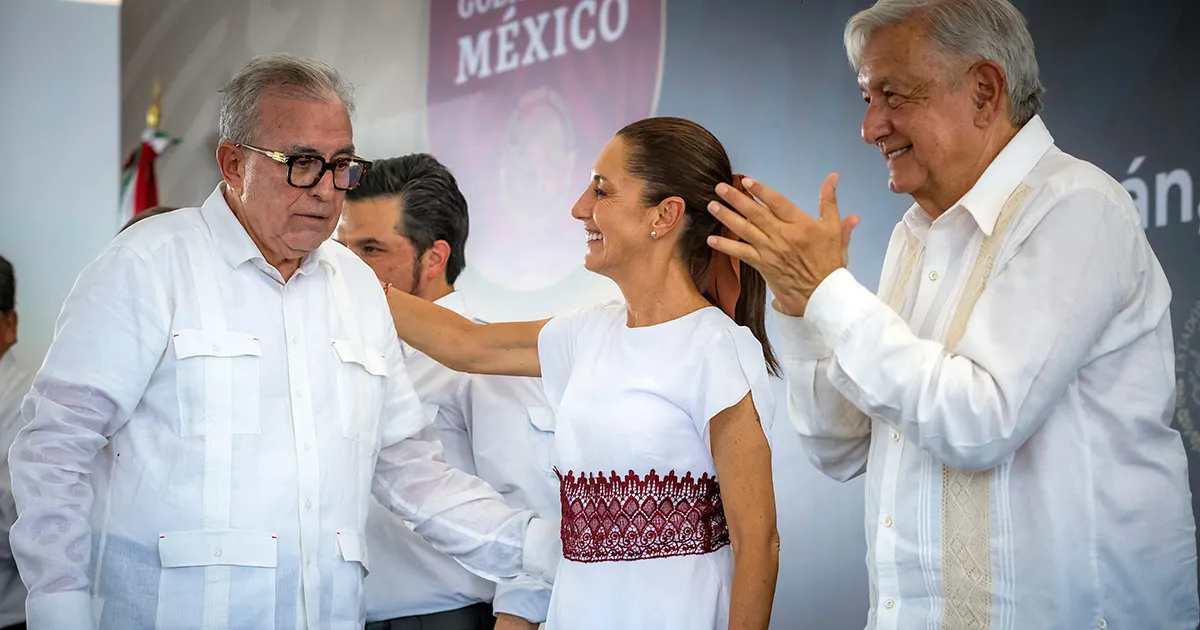
Rubén Rocha Moya, governor of Mexico’s Sinaloa state, left, with then-President-elect Claudia Sheinbaum, center, and then-President Andrés Manuel López Obrador in 2024. The U.S. has charged Rocha with drug corruption, but Sheinbaum has refused to arrest him. Rashide Frias/AFP via Getty Images After months of U.S.-Mexico tensions sparked by the Trump administration’s threats to strike unilaterally at Mexican drug traffickers, the two governments are heading for a potentially more serious confrontation over President Claudia Sheinbaum’s refusal to arrest Mexican officials charged in the United States with drug corruption. U.S. Justice Department officials have yet to present a full picture of their evidence against 10 current and former Mexican officials, whose indictments were announced on April 29. They include the governor of Sinaloa state, Rubén Rocha Moya, an ally of the president and a prominent figure in her leftist political party. But as the Trump administration steps up its efforts to target Mexican government figures who are accused of protecting the drug trade, Sheinbaum is taking a hard-line stand against extraditing Rocha and the others charged in a New York federal court, Mexican officials said. “She is very clear about this,” a senior Mexican official said of the U.S. request for Rocha’s extradition. “She has decided no.” The impasse presents the Trump administration with a potentially critical test of its aims in Mexico, raising questions about how far it will go to challenge the corruption that has long sustained Mexico’s trade in illegal drugs. By elevating the importance of the drug issue and threatening harsh economic penalties if Sheinbaum did not join forces to combat it, the administration has pushed Mexico to dramatically escalate its fight against organized crime. After years in which Sheinbaum’s political mentor, former President Andrés Manuel López Obrador, withdrew from confrontation with the drug mafias, her security forces have worked with U.S. intelligence and law enforcement agencies to destroy clandestine drug labs, seize large caches of drugs, and kill or capture ranking crime bosses. Sheinbaum also circumvented the two countries’ extradition treaty to hand over at least 92 accused traffickers sought by the United States — voicing none of the concerns about U.S. evidence that she has cited in refusing to arrest the Sinaloa officials. Still, U.S. officials acknowledge privately, the two countries’ intensified counter-drug campaign has emphasized tactical strikes and short-term gains rather than a coherent, longer-term strategy to undermine organized crime groups, confront endemic corruption or strengthen Mexico’s criminal justice system. To many senior Trump administration officials, particularly in the Justice Department and the White House, attacking the high-level corruption that sustains the drug trade represents a crucial next step. They have argued it is a step that U.S. prosecutors should take aggressively if Mexico will not do so, according to U.S. officials who spoke on condition of anonymity to discuss internal deliberations. Some diplomatic and intelligence officials, however, are wary of pushing Sheinbaum too hard, seeing her position as precarious. They fear that demanding she take on her own party’s old guard might prompt her to pull back on Mexico’s cooperation with U.S. drug enforcement and immigration policies, the officials said. The U.S. policy debate also turns on a question that continues to obsess Mexico’s political class nearly two years into her presidency: How much independence does Sheinbaum really have from her political patron López Obrador, who remains a commanding figure within their National Regeneration Movement? After keeping largely silent on Mexico’s changing relationship with Washington, López Obrador thrust himself back into the public debate on June 3 with a blistering attack on the New York indictments. U.S. officials were simply using drug corruption as a pretext, he claimed, to undermine Morena, as the leftist party he founded is known. “To be clear,” the former president wrote , “some U.S. officials are plotting to weaken Morena and strengthen the rightist opposition in Mexico with the idea of once again having a submissive, corrupt, mafioso and cruel government.” Such a regime, he added, would be more amenable to Washington’s “interventionist designs.” Sheinbaum did her best to respectfully downplay the significance of the former president’s screed. But current and former Mexican officials noted that López Obrador’s missive, while supportive of her, did nothing to dispel suspicions that he continues to pull strings in her administration. To many analysts of Mexican politics, the source of Sheinbaum’s unyielding response to the Rocha indictment seems plain: her fear that if some accused officials cooperate with the U.S. authorities in the Sinaloa case and possibly other investigations, the Trump administration could target other Morena leaders, including key allies of López Obrador. “I think the message from Andrés Manuel was, ‘Claudia, you have to stop this or they are going to destroy us,’” a Mexican security expert, Eduardo Guerrero, said in an interview. “But the longer she waits to turn Rocha over, the tougher the punishment from the United States is going to be.” Trump administration officials have done little to assuage such concerns. Asked two weeks after the Sinaloa indictment about the administration’s plans for dealing with Mexican corruption, the head of the Drug Enforcement Administration, Terrance C. Cole, told the Senate Appropriations Committee , “I can assure you this is just the start about what’s to come in Mexico.” Terrance C. Cole, head of the Drug Enforcement Administration, testifying to the Senate in May. He said the Sinaloa indictments were “just the start” of such actions on Mexico. Michael Brochstein/Sipa via AP Turning Themselves In When Rocha was elected in 2021 as governor of Sinaloa, a stronghold of Mexico’s drug trade for almost a century, the former teachers’ union organizer was known as a skilled political operator and a close friend of then-President López Obrador. But his campaign was assailed for what opposition parties and civic groups called the blatant role that criminal gangs played on Rocha’s behalf — intimidating voters, stuffing ballot boxes, and kidnapping and threatening numerous opposition candidates. Despite detailed complaints to Mexico’s elections authorities, López Obrador and Sheinbaum strongly defended Rocha. Rocha insisted he had nothing to do with the mafias but suggested that it would be impossible to govern the state without somehow coordinating with them. “You have to find a way to do it,” he said in a television interview during the campaign. Questions about Rocha’s links to the traffickers exploded again in July 2024, after a son of Joaquín Guzmán Loera, the imprisoned drug boss known as El Chapo, kidnapped his father’s longtime partner in the Sinaloa cartel, Ismael Zambada García. The son, Joaquín Guzmán López, then flew Zambada across the U.S. border, delivering him to U.S. agents on an airstrip in New Mexico and surrendering himself. In a statement released by his lawyer, Zambada said he was kidnapped outside Culiacán, the state capital, when he went to meet Rocha and a Sinaloa congressman, Héctor Cuén, who supposedly wanted the drug boss to mediate a dispute between them. Instead, Zambada claimed, he was betrayed by Guzmán while Cuén, whom he described as “a longtime friend,” was murdered. Ismael Zambada García, left, and his godson, Joaquín Guzmán López, who kidnapped him in Mexico and delivered him to the U.S. authorities in July 2024. U.S. Department of State via AP Rocha at the time denied any involvement in the episode, saying he was traveling in Los Angeles. A spokesperson for the state government, from which Rocha has taken a leave of absence, said it would not comment on the accusations against him. Rocha could not be reached for comment. Both Guzmán and his brother Ovidio, who was extradited to the United States in 2023, have since provided federal prosecutors with extensive accounts of their relationships with Mexican government figures, as has at least one of their former lieutenants, law enforcement officials said. Investigators in New York also obtained detailed ledgers of the gang’s bribe payments, which were referenced extensively in the Rocha indictment. After Zambada’s kidnapping, three U.S. officials said López Obrador’s government made repeated requests for information on what Zambada and the Chapitos, as Guzmán’s sons are known, might have been telling U.S. investigators. But the prosecutors answered those queries only when they finally laid out their case: “As he had promised, since he was elected governor, and in exchange for the Chapitos’ support in his election, Rocha Moya has allowed the Chapitos to operate with impunity in Sinaloa,” the indictment stated. A truck on fire in Culiacán, Sinaloa State, Mexico, in September 2024 Ivan Medina/AFP via Getty Images Mexican national guardsmen cover a body found on the road in Culiacán in September 2024. After Sinaloa cartel leader Zambada was captured, the region underwent a wave of violence, killings and disappearances. AP Photo/Eduardo Verdugo It also said Rocha had met personally with the Chapitos’ leaders and allowed them to name corrupt law enforcement officials to his government. Rocha’s aides took the traffickers’ bribes, allowed them to operate with impunity, arrested their rivals, freed them from jail when they were arrested themselves and warned them of law enforcement operations supported by the United States, the prosecutors said. Rocha has denied the allegations. Barely a day after a federal court in New York unsealed the indictment of the 10 men, Sheinbaum dismissed that evidence as insufficient. She said the suspects could be investigated in Mexico but that she would not act without “overwhelming and irrefutable proof” of their guilt. Such provisional arrest requests are often granted as a matter of course; by treaty, the country asking for extradition has 60 days to present more detailed evidence after the initial arrest is made. But Sheinbaum has argued that the indictment and various other Justice Department documents given to Mexico did not come close to justifying the U.S. request. Some U.S. diplomats were initially skeptical of the New York prosecutors’ apparent reliance on imprisoned traffickers as primary witnesses in such a politically sensitive case, officials familiar with the matter said. More recently, though, at least one of the accused Mexicans has changed that calculus. The former Sinaloa secretary of public safety, Gerardo Mérida, turned himself in to U.S. marshals at the Arizona border on May 11. Mérida — a retired army general accused of taking more than $100,000 a month from the cartel while in office — pleaded not guilty in New York. But he later indicated to the prosecutors that he might be willing to cooperate with their investigation in return for leniency, one official familiar with the matter said. Mérida’s court-appointed attorney, Sarah Krissoff, did not respond to calls and emails asking for comment on his status. A second suspect in the case, former Sinaloa finance secretary Enrique Díaz Vega, is also believed to have turned himself in to the U.S. authorities, but the Justice Department has not confirmed that. Nicholas Biase, a spokesperson for the U.S. attorney for the Southern District of New York, declined to comment on the status of either suspect, and Vega could not be reached for comment. Months ago, current and former U.S. officials said, Sheinbaum’s powerful security chief, Omar García Harfuch, told American diplomats privately that the Mexican president was determined to take on the country’s corruption problem and would prove her bona fides by prosecuting officials of her own party. Since the Rocha indictment, however, she has taken a very different tone, accusing Washington of egregious meddling in Mexico’s affairs. “An action of this magnitude has no precedent in the history of our bilateral relationship,” Sheinbaum said at a political rally in late May. “When they dictate from abroad who is guilty and who is not, that is no longer cooperation. We are talking about interference!” Aides to Sheinbaum have begun to suggest that she could indeed scale back anti-narcotics cooperation if Washington pushes too hard on the Rocha case, two U.S. officials said. Whether she has the wherewithal to follow through remains to be seen. But such threats have worked for Mexico in the past. When U.S. agents arrested Mexico’s former defense minister, Gen. Salvador Cienfuegos Zepeda, in Los Angeles in late 2020, former Attorney General William Barr abruptly dropped the case after López Obrador threatened to limit Mexico’s counter-drug cooperation. Despite the American concession, López Obrador still seized on the arrest to shut down several joint counter-drug programs and push through a new national security law curtailing the work of U.S. agents in Mexico. With the Biden administration focused on preserving Mexico’s cooperation on immigration, López Obrador later abandoned the so-called Mérida Plan, the two countries’ 14-year campaign to jointly fight drug trafficking and strengthen the Mexican criminal justice system. “But these guys are not Biden,” a former Mexican foreign minister, Jorge G. Castañeda, said of the Trump administration in an interview. While Sheinbaum’s predecessors could almost always rely on U.S. leaders to prioritize Mexico’s stability above other interests, he added, “Trump just doesn’t care.” The post A U.S.-Mexico Impasse Will Test How Far the Trump administration Will Go to Fight drug trade appeared first on ProPublica .
SRCProPublica
LANGEN
LEANCenter-Left
WORDS2 152
ENT10
MON · 2026-07-13 · 09:00 GMTBRIEF NSR-2026-0713-92594
NSR-2026-0713-92594News Report·EN·Diplomatic
A U.S.-Mexico Impasse Will Test How Far the Trump Administration Will Go to Fight Drug Trade
The U.S. has indicted ten current and former Mexican officials, including Sinaloa Governor Rubén Rocha Moya, on drug corruption charges.
Tim GoldenProPublicaFiled 2026-07-13 · 09:00 GMTLean · Center-LeftRead · 9 min
ProPublicaFIG 01
Reading time
9min
Word count
2 152words
Sources cited
3cited
Entities identified
10entities
Quality score
100%
§ 01
Briefing Summary
AI-generatedNEWSAR · AI
The U.S. has indicted ten current and former Mexican officials, including Sinaloa Governor Rubén Rocha Moya, on drug corruption charges. President Claudia Sheinbaum has refused to arrest or extradite them, citing insufficient evidence, which has created an impasse with the Trump administration. This confrontation tests how far the U.S. will go to combat drug trafficking and corruption in Mexico. While Sheinbaum's administration has increased counter-drug efforts, her refusal to extradite Rocha Moya, an ally of former President López Obrador, signals a hard-line stance. The situation raises questions about Sheinbaum's independence and the potential for strained bilateral relations if the U.S. escalates its pressure.
Confidence 0.90Sources 3Claims 5Entities 10
§ 02
Article analysis
Model · rule-basedFraming
Diplomatic
Political Strategy
Tone
Mixed Tone
AI-assessed
CalmNeutralAlarmist
Factuality
0.70 / 1.00
Factual
LowHigh
Sources cited
3
Well sourced
FewMany
§ 03
Key claims
5 extracted01
The U.S. has charged Rubén Rocha Moya, governor of Sinaloa state, with drug corruption.
factualU.S. Justice Department
Confidence
1.00
02
Sheinbaum's security forces have intensified counter-drug efforts with U.S. agencies, including destroying labs and capturing crime bosses.
factualarticle's synthesis
Confidence
0.90
03
The Trump administration has threatened unilateral strikes against Mexican drug traffickers and is now testing Mexico's stance on extraditing officials.
factualarticle's synthesis
Confidence
0.90
04
President Claudia Sheinbaum has refused to arrest Mexican officials charged in the U.S. with drug corruption, including Governor Rocha.
factualMexican officials
Confidence
0.90
05
U.S. officials privately acknowledge the intensified counter-drug campaign has focused on tactical gains rather than long-term strategy.
factualU.S. officials (privately)
Confidence
0.80
§ 04
Full report
9 min read · 2 152 words§ 05
Entities
10 identifiedKey playerOppositionContextPositiveNeutralNegative
People3
§ 06
Keywords & salience
10 termsdrug corruption
1.00
drug trade
1.00
u.s.-mexico relations
0.90
extradition
0.80
trump administration
0.70
claudia sheinbaum
0.70
organized crime
0.60
sinaloa
0.50
impasse
0.50
counter-drug
0.40
§ 07
Topic connections
Interactive graph Network visualization showing 51 related topics
View Full Graph Person Organization Location Event|Click node to navigate|Edge numbers = shared articles