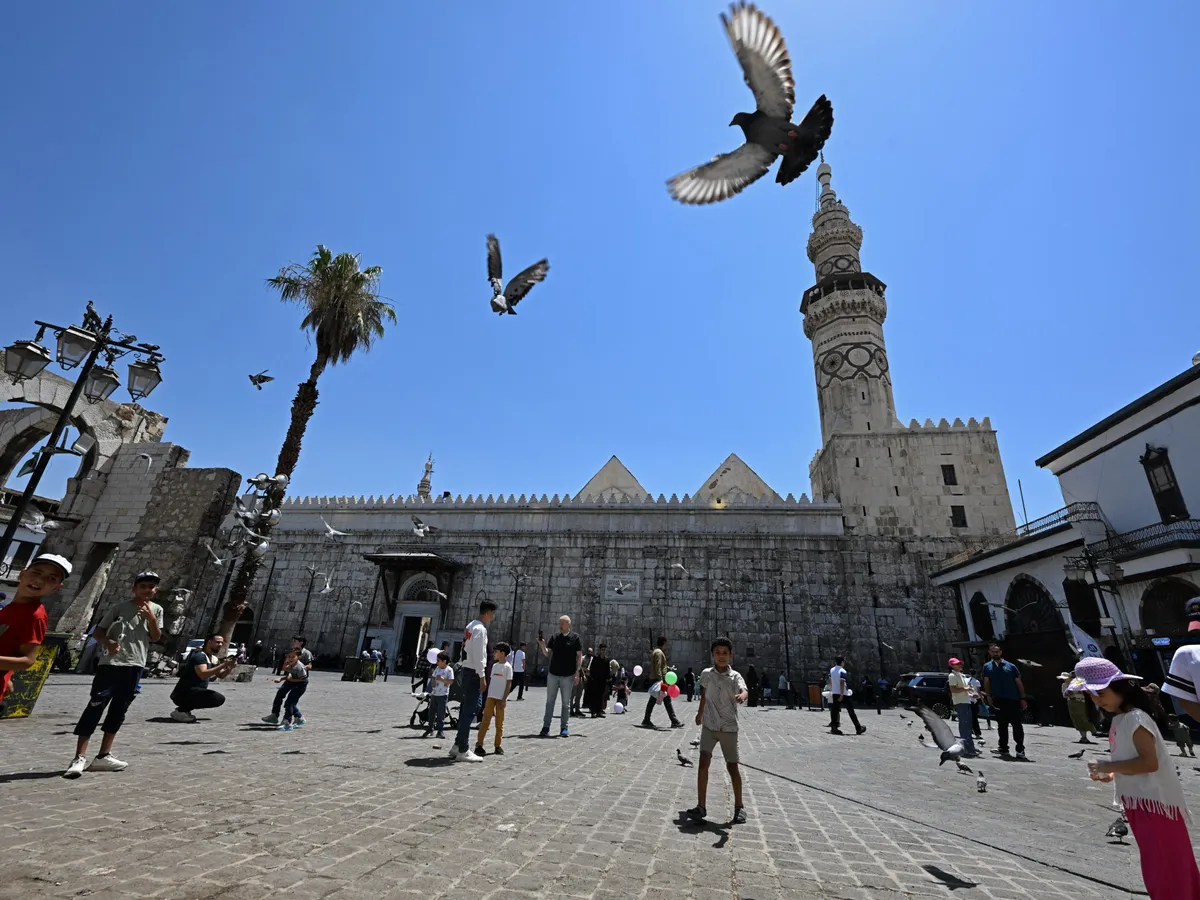
Damascus residents say state-supplied electricity has noticeably improved recently but complain about the cost of energy.People walk through an old market area near the Umayyad Mosque in Damascus on July 9, 2026 [AFP]Published On 13 Jul 2026Damascus, Syria – Nasri Tadros sweeps dust away from the electric scooters parked outside his small shop in central Damascus.“I have three generators for my shop, and this runs on batteries,” he said, pointing to a battery-operated lighter he uses to fire up charcoal. He stepped into the narrow shop that he rents, where he has worked for the past two years, selling and delivering products for hookahs.Around Damascus, solar panels and diesel generators are a common sight. During the harshest years of the war, they supplemented the sparse state-provided electricity, which only came a few hours a day between long cuts.As Damascus enters the summer months, there is concern about the dry heat, which reaches the high 30s in Celsius (up to almost 100F). However, locals say that while cuts are still common, electricity has recently improved to five or six straight hours of supply before a cut.“Nothing can work without electricity,” Tadros said, the air conditioning blasting away inside his modest store.ProgressBy the end of the dynastic rule of the Assad regime – father Hafez (1970-2000) and son Bashar (2000-24) – Syria was left in ruins. A popular 2011 uprising was brutally repressed by Bashar and the country slowly crumbled until a rebel operation forced the longtime ruling family into exile.Bashar al-Assad’s departure in late 2024 was met with great joy by many Syrians, but he left behind a challenge for Syria’s liberators. The country’s economy is in dire straits, and state infrastructure, including the electricity sector, requires serious rebuilding.As of 2023, before the fall of the Assad regime, Syria received 52 percent of its electricity from natural gas and close to 45 percent from oil, according to the International Energy Agency (IEA). Only 3 percent came from hydropower and even less from solar.In June 2025, the World Bank approved a $146m grant to improve Syria’s electricity supply and to develop the sector. When the government of President Ahmed al-Sharaa moved into northeast Syria earlier this year, it took over the country’s largest oil-producing region.During the war, the area, which was controlled by the Kurdish-led Syrian Democratic Forces (SDF), produced about 10,000 barrels of oil per day. Now, it is about 100,000bpd and could reach up to 200,000bpd by the end of the year. After the Syrian army’s offensive, the government and the SDF reached a ceasefire.The Syrian government has also secured gas import deals with countries like Azerbaijan, Jordan and Egypt, and in May 2025 signed a $7bn energy deal with Qatari, Turkish and US firms. Much of this progress has come about thanks to Western sanctions relief, which has been a priority of the new government.“Consumer tariffs have been restructured, and solar power is helping, albeit modestly, to fill the gap,” John Calabrese, a nonresident senior fellow at the Middle East Institute, told Al Jazeera.Remaining challengesHowever, the gap remains. Almost everyone interviewed about Syria’s electricity situation turned the conversation towards affordability and the high cost of alternative energy.“I would be lying if I said electricity was not improving,” a shop owner, who asked his name be withheld because he was critical of the new government, told Al Jazeera. “I have solar energy,” he added. “But it’s expensive.”While solar panels have become a more regular sight in Damascus, solar energy has a high initial investment cost, which means many low-income families, with almost 90 percent of the country below the poverty line, cannot afford it.“Fuel supplies remain the core bottleneck,” Calabrese said. Syria has been suffering from fuel shortages of late, causing long queues at petrol stations. The energy minister announced on Saturday that supplies of diesel and petrol were being increased, and distribution accelerated.Other issues also remain. Some reports say the Syrian Petroleum Company is facing internal tensions between the CEO and the board.“Bureaucratic and governance friction is an obstacle to further progress,” Calabrese said.Back at the corner store, the shop owner who requested anonymity animatedly waved his arms in the air. “In the first world, electricity is a right,” he said in thick Damascene-accented Arabic. “Here, it is a dream.”
SRCAl Jazeera
LANGEN
LEANCenter
WORDS711
ENT12
MON · 2026-07-13 · 09:34 GMTBRIEF NSR-2026-0713-92597
NSR-2026-0713-92597News Report·EN·Economic Impact
‘It’s expensive’: Syria’s electricity has improved, but challenges remain
Damascus residents report noticeable improvements in state-supplied electricity, with longer periods of consistent power. However, the cost of energy remains a significant concern.
Justin SalhaniAl JazeeraFiled 2026-07-13 · 09:34 GMTLean · CenterRead · 3 min
Al JazeeraFIG 01
Reading time
3min
Word count
711words
Sources cited
3cited
Entities identified
12entities
Quality score
100%
§ 01
Briefing Summary
AI-generatedNEWSAR · AI
Damascus residents report noticeable improvements in state-supplied electricity, with longer periods of consistent power. However, the cost of energy remains a significant concern. Following the departure of the Assad regime in late 2024, the new government, led by President Ahmed al-Sharaa, has prioritized rebuilding the nation's infrastructure, including the electricity sector. International aid, including a $146 million World Bank grant, and increased oil production from previously Kurdish-controlled regions are contributing to these improvements. The government has also secured gas import deals and signed a substantial energy deal with international firms. Despite these advancements, high initial costs for alternative energy sources like solar power and ongoing fuel shortages present persistent challenges for many Syrians.
Confidence 0.90Sources 3Claims 5Entities 12
§ 02
Article analysis
Model · rule-basedFraming
Economic Impact
Political Strategy
Tone
Measured
AI-assessed
CalmNeutralAlarmist
Factuality
0.70 / 1.00
Factual
LowHigh
Sources cited
3
Well sourced
FewMany
§ 03
Key claims
5 extracted01
The World Bank approved a $146m grant in June 2025 to improve Syria's electricity supply.
statisticWorld Bank
Confidence
1.00
02
Syria received 52% of its electricity from natural gas and 45% from oil in 2023.
statisticInternational Energy Agency (IEA)
Confidence
1.00
03
Syria secured gas import deals with Azerbaijan, Jordan, and Egypt.
factualarticle
Confidence
0.90
04
Syria's oil production increased from 10,000 bpd to 100,000 bpd after the new government took over the largest oil-producing region.
statisticarticle
Confidence
0.90
05
Damascus residents report noticeable improvement in state-supplied electricity recently.
quoteNasri Tadros
Confidence
0.90
§ 04
Full report
3 min read · 711 words§ 05
Entities
12 identifiedKey playerOppositionContextPositiveNeutralNegative
People3
Organizations3
§ 06
Keywords & salience
10 termssyria electricity
1.00
energy cost
0.90
infrastructure rebuilding
0.80
assad regime
0.70
solar panels
0.60
generators
0.60
world bank grant
0.50
economic challenges
0.50
oil production
0.40
damascus
0.40
§ 07
Topic connections
Interactive graph Network visualization showing 51 related topics
View Full Graph Person Organization Location Event|Click node to navigate|Edge numbers = shared articles