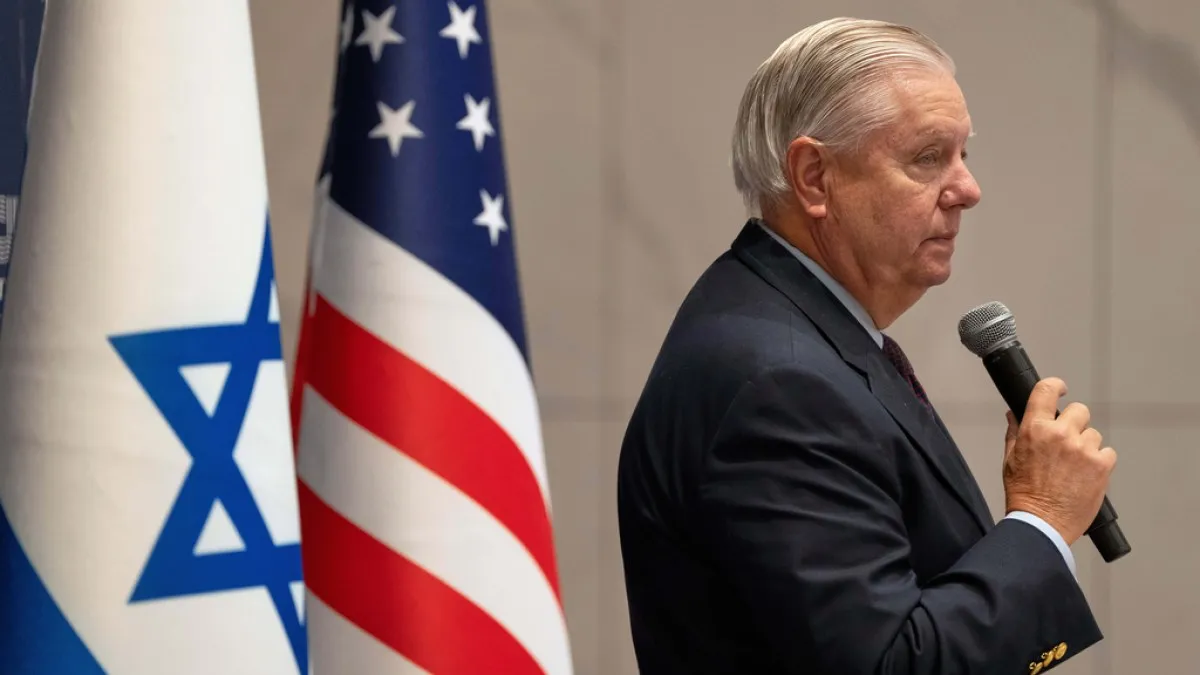
Late US senator backed invasion of Iraq, war on Iran and approach of ‘more for Israel’ as he became a Trump confidant.United States Senator Lindsey Graham speaks to the media in Tel Aviv, Israel, December 21, 2025 [File: Maya Levin/AP]Published On 13 Jul 2026Washington, DC – When the devastating Hurricane Helene hit the southeastern shores of the United States in 2024, the late Senator Lindsey Graham appeared on Fox News to discuss the aftermath of the natural disaster in South Carolina.For five minutes, he expressed anger and frustration at what he presented as failures by the administration of then-Democratic President Joe Biden in responding to the hurricane.Recommended Stories list of 3 itemslist 1 of 3Who will replace Trump ally Lindsey Graham in the US Senate?list 2 of 3Lindsey Graham, hardline backer of US-Israeli wars, dies aged 71list 3 of 3Mitch McConnell releases health update, says he is ‘regaining’ strengthend of listThen, unprompted, he abruptly shifted the conversation from the woes of his home state to his concern about Israel amid its genocidal war on Gaza.“I’ve been going all over South Carolina. Like most people, I haven’t slept much. But look what’s going on in Israel,” Graham said.“Our friends in Israel, surrounded by people that want to kill them, destroy them, a second Holocaust in the making, and Biden says, ‘Be proportional.’ What is the proportional response to people who want to kill you and your family? They’re running out of ammunition in Israel. We have to help our friends.”The Republican senator, who died of a “brief and sudden illness” late on Saturday, according to his office, seemed to always find a way to stay focused on his hawkish foreign policy advocacy and devotion to Israel.Throughout his decades-long career, Graham backed the 2003 invasion of Iraq, staunchly opposed Russia and China, called for unflinching and unlimited support for Israel, and was one of the most vocal cheerleaders of the war on Iran.Michael Hanna, US programme director at the International Crisis Group think tank, said two elements of Graham’s career will define the late senator’s legacy: his advocacy for military interventions, and his staunch support for President Donald Trump.“He has cultivated over many, many years a reputation for hawkishness and pushing for military solutions to US foreign policy problems,” Hanna said.“He was a major supporter of the Iraq War, and he has been a big booster of the use of military force ever since. That’s very clear. Of course, in the last months now of his life, he’s been very engaged in pushing Donald Trump to use military force against Iran.”After decades of fighting in Iraq and Afghanistan, many US politicians – including Trump, who promised to be a peace president – avoided appearing pro-war. Not Graham. He remained uncompromising in favouring military interventions, particularly in the Middle East.Earlier this year, when Graham called on US forces to participate alongside Israel in bombing Lebanon, Republican Congressman Tim Burchett took a jab at the senator’s zeal for military strikes.“Lindsey Graham hasn’t seen a fist fight he hasn’t wanted to turn into a bombing raid,” Burchett told reporters.Pro-Israel viewsUnconditional support for Israel has been a central tenet for most US foreign policy hawks in the post-9/11 era. And Graham was no exception.The late Republican often made a show in calling for more military aid to the US ally.After a 2021 Israeli assault on Gaza that killed hundreds of Palestinians, Graham headed to Israel and posed next to Prime Minister Benjamin Netanyahu with a sign that said, “More for Israel”.He then secured an additional $1bn in US military aid for the country.On Sunday, Netanyahu eulogised Graham, saying that the Republican legislator often sought more US support for Israel than his government requested or needed.Netanyahu told Fox News that Graham “went ballistic” when the Israeli prime minister told him that he would push to phase out US military assistance to Israel.“He was so concerned with our security, which he believed was your security, that he actually fought the prime minister of Israel on keeping America’s aid, or actually increasing it,” Netanyahu said.Several Israeli officials, including far-right National Security Minister Itamar Ben-Gvir, lauded Graham after his death.At times, Graham’s pro-Israel advocacy turned into outright resentment and dehumanisation of Palestinians. On several occasions, he compared the Palestinian people to Nazis and suggested that dropping a nuclear bomb on them would be justified.“Why is it OK for America to drop two nuclear bombs on Hiroshima and Nagasaki to end their existential threat war? Why was it OK for us to do that? I thought it was OK,” he told NBC News in 2024.“So, Israel, do whatever you have to do to survive as a Jewish state.”Many of the treaties that make up international humanitarian law were put in place after World War II to prevent the kind of atrocities that occurred in the conflict, including genocide and the use of nuclear weapons.But for Graham, there did not appear to be any limits that Israel could inflict on Palestinians.“We’re in a religious war here. I am with Israel. Do whatever the hell you have to do to defend yourself. Level the place,” he said at the start of the war on Gaza in October 2023.Hatem Abudayyeh, national chair of the US Palestinian Community Network (USPCN), described Graham as “another criminal warmonger who met his end supporting death and destruction around the world”.“Lindsay Graham spent his career cheerleading war, occupation and genocide, and the fact that he’s being eulogised by genocidal monsters like Itamar Ben-Gvir and Netanyahu speaks volumes,” Abudayyeh told Al Jazeera.Despite his statements against Palestinians, Graham’s colleagues – including many Democrats – lauded him as witty and decent.Trump tiesGraham appeared to loathe the Iranian government as much as he revered Israel.In January, the senator met with Trump and had the president sign and hold a hat that said “Make Iran Great Again” – a message that signalled support for regime change in Tehran.Weeks later, the US and Israel started bombing Iran, and Graham emerged as one of the most vocal defenders of the war.Hanna said Graham was one of the many figures who succeeded in convincing Trump to go to war with Iran, also citing the lobbying efforts of Netanyahu and pro-Israel commentator Mark Levin.“He definitely had the president’s ear, so I would say influential. But Trump is, as he says many times, the decider,” Hanna said.“I think it’s hard to ascribe policy outcomes to Lindsey Graham in singular form. There were numerous people pushing for the war – among them, Lindsey Graham.”Graham regularly met and golfed with Trump, and the two Republicans often exchanged compliments. But their relationship was not always smooth.When Graham was vying for the Republican presidential nomination in 2016, he called Trump a “race-baiting, xenophobic religious bigot”.“I think he’s a kook. I think he’s crazy. I think he’s unfit for office,” Graham said during the campaign.But as Trump secured the Republican nomination and subsequently the presidency, consolidating his grip on the party, Graham became one of his most loyal allies.The late senator’s rapprochement with the president sparked anger and rebuke from Democrats and anti-Trump conservatives, who accused him of abandoning his principles to appease the president.Graham was a close friend to Senator John McCain, who died in 2018 and was a frequent target of Trump’s insults and attacks.Hanna said the close alliance between Trump and Graham remains puzzling.“Lots of people have speculated about the whys of this transformation and what Lindsey Graham gets out of this. It remains peculiar,” he told Al Jazeera.
SRCAl Jazeera
LANGEN
LEANCenter
WORDS1 248
ENT12
MON · 2026-07-13 · 21:04 GMTBRIEF NSR-2026-0713-92749
NSR-2026-0713-92749Analysis·EN·Political Strategy
Lindsey Graham’s legacy: Israel advocate, Trump ally, Iran war supporter
Late US Senator Lindsey Graham, who died recently, was known for his hawkish foreign policy and unwavering support for Israel. Throughout his career, Graham advocated for military interventions, including backing the 2003 invasion of Iraq and calling for action against Iran.
Ali HarbAl JazeeraFiled 2026-07-13 · 21:04 GMTLean · CenterRead · 5 min
Al JazeeraFIG 01
Reading time
5min
Word count
1 248words
Sources cited
1cited
Entities identified
12entities
Quality score
100%
§ 01
Briefing Summary
AI-generatedNEWSAR · AI
Late US Senator Lindsey Graham, who died recently, was known for his hawkish foreign policy and unwavering support for Israel. Throughout his career, Graham advocated for military interventions, including backing the 2003 invasion of Iraq and calling for action against Iran. He consistently pushed for increased US military aid to Israel, even securing an additional $1 billion after a 2021 assault on Gaza. Graham also became a confidant of Donald Trump. His legacy is marked by his advocacy for military solutions and his strong pro-Israel stance, which at times included controversial rhetoric regarding Palestinians.
Confidence 0.90Sources 1Claims 5Entities 12
§ 02
Article analysis
Model · rule-basedFraming
Political Strategy
Conflict
Tone
Mixed Tone
AI-assessed
CalmNeutralAlarmist
Factuality
0.60 / 1.00
Mixed
LowHigh
Sources cited
1
Limited
FewMany
§ 03
Key claims
5 extracted01
Graham expressed concern about Israel's situation amid the war on Gaza, comparing it to a potential 'second Holocaust'.
quoteLindsey Graham
Confidence
1.00
02
Michael Hanna stated that Graham's legacy will be defined by his advocacy for military interventions and support for Donald Trump.
quoteMichael Hanna
Confidence
1.00
03
Graham consistently supported military interventions and was a strong advocate for Israel.
factual
Confidence
1.00
04
Senator Lindsey Graham advocated for the 2003 invasion of Iraq.
factual
Confidence
1.00
05
Graham called for US forces to participate with Israel in bombing Lebanon.
factual
Confidence
0.90
§ 04
Full report
5 min read · 1 248 words§ 05
Entities
12 identifiedKey playerOppositionContextPositiveNeutralNegative
People3
Organizations1
Locations6
§ 06
Keywords & salience
9 termslindsey graham
1.00
israel advocacy
0.90
trump ally
0.80
iran war supporter
0.80
military interventions
0.70
iraq invasion
0.60
gaza war
0.50
hawkish foreign policy
0.50
joe biden
0.40
§ 07
Topic connections
Interactive graph Network visualization showing 20 related topics
View Full Graph Person Organization Location Event|Click node to navigate|Edge numbers = shared articles