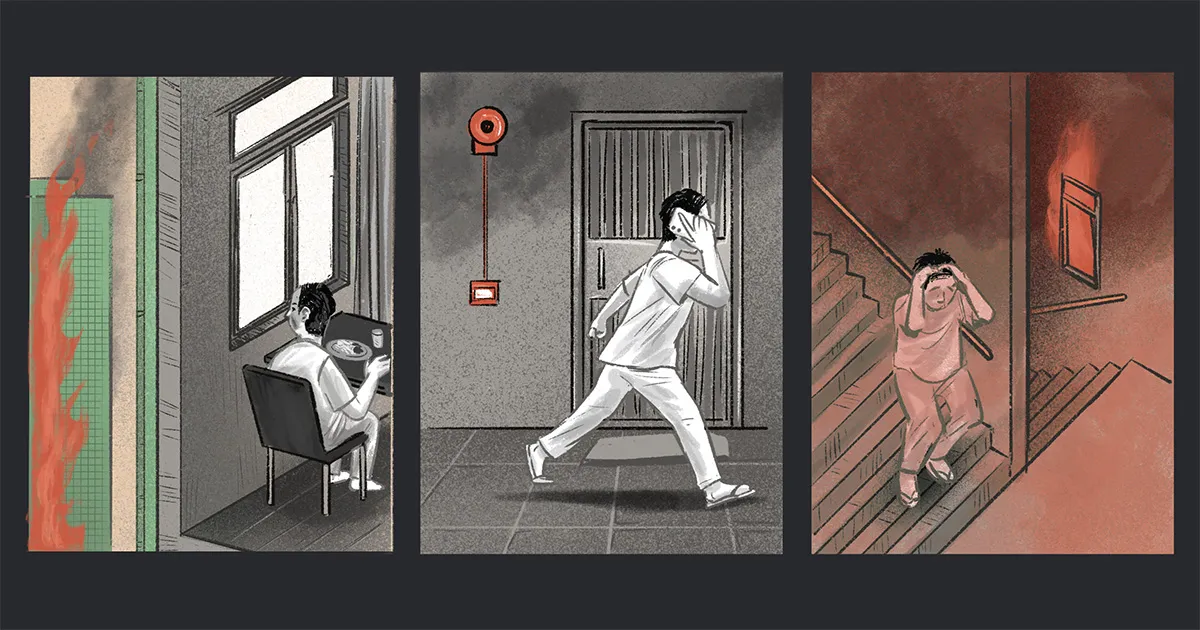
The pace of vertical fire spread at Wang Fuk Court Flashes are first caught on surveillance camera at the lightwell on the first floor of Wang Cheong House at 2.43pm Naked flame is first spotted by a passer-by, who makes an emergency call at 2.51pm Fire spreads to the fourth floor at 2.55pm Fire spreads to the eighth floor at 2.57pm Fire spreads to the roof at 2.58pm Part 4 Reasons behind the heavy toll July 14, 2026 Ten metres per second – that is how fast the flames spread upwards at Wang Fuk Court. During the fifth and final round of evidential hearings investigating Hong Kong’s deadliest inferno in decades, experts appointed by the government and the committee pointed out how a series of shortfalls had made the fire at the Tai Po residential complex spread at an unprecedented scale and led to the heavy death toll of 168.“It is not the first instance of this kind of fire, except for its magnitude.” - Professor Asif Usmani, fire engineering expert appointed by the independent committeeCore causes for heavy toll identified by both groups of experts Onset of the fire The fire was believed to have started at the lightwell between flats 104 and 105 of Wang Cheong House. At the time of the fire, the area was packed with carton boxes, mosaic tiles, foam boards and construction waste. Disposable cutlery and cigarette ends were also found at the scene.“Most probably, a glowing source, such as a lit cigarette end, ignited combustible materials, such as carton paper boxes, at the scene.” - Interdepartmental Fire Investigation Task ForceSmouldering, referring to a process where items burn without a visible flame, is considered the key mechanism that allowed the fire to develop and escalate without being noticed at first.Government chemist Dr Lee Wing-man told the panel that paper materials piled at the lightwell could easily smoulder, and burst into flames when there was wind, while the fire would further escalate when other combustible materials were present. Dr Lee Wing-manUse of non-fire-retardant sheeting and nets While earlier hearings scrutinised allegedly non-fire-retardant scaffolding mesh, the latest round brought up a previously overlooked element: plastic sheeting. According to Lee, at the time of the fire, sheeting was very likely to have been present to cover unused construction materials such as tiles, as in the case of working platforms at other blocks. Lab tests on sheeting obtained on site found it kept burning until it was entirely consumed, spreading quickly and generating flaming droplets. The Government Laboratory also tested samples of scaffolding mesh found across five blocks, and discovered some failing the fire-retardancy test. Police earlier said the suspects had allegedly mixed non-fire-retardant nets with compliant ones to deceive investigators.In a separate test on five samples collected from Wang Cheong House, where the fire first started, four of them were found to be substandard. When burning, non-fire-retardant mesh releases 27 times the heat generated by the compliant ones. Experts opined that the fire had spread quickly along the non-fire-retardant scaffolding mesh and sheeting, and if compliant nets were used, the initial fire could have self-extinguished. Chimney effect Experts agreed that the lightwell design of Wang Fuk Court blocks led to the chimney effect, contributing to the exponential spread of the fire, which was then aggravated by the leapfrog effect. The rapid and serious vertical development of the blaze broke windows, causing the fire to spread to flats. When they caught fire, the blaze spread to previously unaffected parts of the scaffolding. Burning embers also carried flames to other buildings. Across the whole inferno, 12 fire plumes emerged across six buildings. Eleven of them occurred within the first two hours, affecting at least 470 flats. The first six fire plumes happened within 30 minutes, affecting more than 300 flats. Some 560 flats were severely damaged by the fire, with 90 per cent of them located alongside the fire plumes. Styrofoam boards As the fire and heat rose along the building facade, styrofoam boards applied to flat windows during the renovation project became another cause for concern. The easily combustible material accelerated the spread of the inferno as falling, burning boards became new sources of fire. Experts from the Government Laboratory conducted burning tests on 16 samples of styrofoam boards collected across the eight buildings, and all of them ignited within 15 seconds. The burning foam boards kept scorching the glass in windows, causing them to crack which allowed fire and toxic gas to enter flats. For residents, these boards blocked their views of the outside, delaying their response. Only 14.4 per cent of 291 survivors who responded to a government survey said that they saw smoke and found out there was a fire. Deactivation of fire alarms Another factor leading to the high death toll was the deactivated fire alarm system, which experts believed left many residents unaware of the inferno. Being late to respond, the residents would only find out later that their escape routes had already been blocked out by fallen debris, and compromised by fire and smoke. Temporary stairwell access Even for many of those who managed to flee their flats, emergency staircases meant to save their lives became another hurdle. The committee heard that some fireproof windows installed on stairwells were removed and replaced with movable boards to allow workers’ easy access to scaffolding. But these openings allowed toxic smoke and fire to enter. Experiments done by experts showed that the temporary openings also caused significant heat inside the staircases. In a lightwell fire similar to the Wang Fuk Court blaze … “The conclusion is that, for many residents, the effective time for escape was zero.” - Victor Dawes SC,lead counsel of the independent committeeTimeline of key events December 12, 2025 The government establishes an independent committee to investigate the cause of the fire and examine systemic problems in large-scale building maintenance and renovation works. April 8 to April 17 The second round of hearings The hearings expose a series of failures that led to fire equipment and alarm systems of the estate being deactivated for months during renovations. The Fire Services Department also explains its firefighting tactics, which prioritised containing the blaze over immediate evacuation in the initial stage due to the “unprecedented” scale of the fire.May 6 to May 8 The fourth round of hearingsSeveral government departments shift the blame to the Housing Bureau’s Independent Checking Unit (ICU) for failing to identify and address potential fire risks before the blaze. Rudolf Lau Fu-kwok, who was head of the ICU when the inferno broke out last November, denied any oversight failure but said the unit had conducted reviews and proposed a series of improvement measures after the fire.June 22 to June 25 The fifth round of hearingsThe committee’s experts contend that the inferno resulted from a “systemic failure” in public policy. They point to the lack of firefighting strategies on the facades of high-rise buildings and the prolonged use of combustible materials in “temporary” works. They make 11 recommendations for immediate implementation, such as banning the simultaneous cladding of high-rise buildings in proximity, stricter regulations for buildings occupied during renovations, and the continuous monitoring of sites using automated detection and suppression systems.Missing pieces of the puzzle The independent committee, during the final round of hearings, decided against applying for statutory powers to compel witnesses to testify, in a move that has left some survivors concerned that key figures may avoid scrutiny. Peggy Wong Pik-kiu Tai Po district councillor[submitted written statement] Wong, a former consultant to the Wang Fuk Court owners’ corporation, was accused by multiple residents of meddling in estate owners’ meetings, intimidating attendees who held opposing views, and manipulating ballots by gathering proxy votes. In her written statement, Wong, a member of the city’s biggest party, the Democratic Alliance for the Betterment and Progress of Hong Kong, admitted collecting proxies ahead of two meetings in 2021 and 2024. But she stressed that she and her office colleagues did not do so when residents voted on the renovation contractor’s proposal in January 2024 and denied distributing gifts in exchange for proxies. The committee did not disclose Wong’s full statement. Tang Kwok-kuen Former chairman of the Wang Fuk Court owners’ corporation management committee Tang, who chaired the owners’ corporation and pushed the renovation scheme ahead, came under scrutiny over the sky-high maintenance costs and alleged bid-rigging in the selection of the project consultant and contractor. He was also said to be responsible for some controversial decisions that might have contributed to the fire, including allowing the contractor to erect bamboo scaffolding across all eight blocks simultaneously. It remains unclear whether Tang submitted a written statement to the committee. Hau Wah-kin and Gordon Ho Kin-yip Directors of Prestige Construction and Engineering[submitted written statement] As the directors of the renovation project’s main contractor, Hau and Ho played a pivotal role in the alleged malpractice that led to the tragedy, including the use of non-fire-retardant scaffolding mesh and polyfoam boards to block the windows and the removal of fireproof windows from emergency passages. The pair face charges of conspiracy to defraud, while Ho faces five charges of manslaughter. Although they submitted written statements to the committee, the contents were not made public. Amanda Lau Ka-man An officer with the Housing Bureau’s Independent Checking Unit (ICU) Lau informed project consultant Will Power one day ahead of an inspection of the fire retardancy of scaffolding mesh at Wang Fuk Court on October 28, 2025. A staff member from contractor Prestige subsequently told his colleagues to check in advance which parts of the mesh were compliant. She did not submit any statement to the committee. Her supervisor, senior maintenance surveyor Andy Ku Siu-ping from the ICU who said he could account for her work, explained that the prior notification was intended to ensure the registered inspector would be present. He added that the ICU had not expected the contractor to use the opportunity to pass off substandard netting. Lai Wing-lee The ISS property manager at Wang Fuk Court Lai was the highest-ranking officer from the property management company stationed at the estate. Several of his subordinates testified before the committee. The ISS office at the estate was involved in deactivating the fire alarm and hose reel systems and in supervising the renovation contractor. Lai was also accused of sending a redacted video of a scaffolding mesh burning test to the owners’ corporation, editing out the moment when the fire was deliberately put out. The next steps The committee will hear closing submissions on July 15 and is expected to submit its report to the government by September. Authorities are expected to take follow-up actions in three aspects.
SRCSouth China Morning Post
LANGEN
LEANCenter-Right
WORDS1 777
ENT8
TUE · 2026-07-14 · 01:31 GMTBRIEF NSR-2026-0714-92802
NSR-2026-0714-92802News Report·EN·Human Interest
What made Hong Kong's Tai Po fire so deadly?
Hong Kong's deadliest inferno in decades, which claimed 168 lives at Tai Po's Wang Fuk Court, was exacerbated by multiple factors. Experts identified the rapid vertical spread of flames, reaching speeds of ten meters per second, as a primary cause.
Davies Christian Surya,Matthew Cheng,Leopold ChenSouth China Morning PostFiled 2026-07-14 · 01:31 GMTLean · Center-RightRead · 8 min
South China Morning PostFIG 01
Reading time
8min
Word count
1 777words
Sources cited
3cited
Entities identified
8entities
Quality score
100%
§ 01
Briefing Summary
AI-generatedNEWSAR · AI
Hong Kong's deadliest inferno in decades, which claimed 168 lives at Tai Po's Wang Fuk Court, was exacerbated by multiple factors. Experts identified the rapid vertical spread of flames, reaching speeds of ten meters per second, as a primary cause. The fire is believed to have originated from smoldering combustible materials, including carton boxes and cigarette ends, in a lightwell. The use of non-fire-retardant scaffolding mesh and plastic sheeting significantly accelerated the blaze, with some mesh releasing 27 times more heat than compliant materials. The building's lightwell design created a chimney effect, further intensifying the fire's spread, which was also fueled by easily combustible styrofoam boards used during renovations. Additionally, deactivated fire alarms contributed to the high death toll by delaying resident response.
Confidence 0.90Sources 3Claims 5Entities 8
§ 02
Article analysis
Model · rule-basedFraming
Human Interest
Legal & Judicial
Tone
Measured
AI-assessed
CalmNeutralAlarmist
Factuality
0.80 / 1.00
Factual
LowHigh
Sources cited
3
Well sourced
FewMany
§ 03
Key claims
5 extracted01
The fire at the Tai Po residential complex led to a heavy death toll of 168.
statisticExperts appointed by the government and the committee
Confidence
0.95
02
Lab tests found that plastic sheeting used to cover construction materials kept burning until entirely consumed, spreading quickly and generating flaming droplets.
factualGovernment Laboratory
Confidence
0.90
03
Flames spread upwards at Wang Fuk Court at a speed of ten metres per second.
statisticExperts appointed by the government and the committee
Confidence
0.90
04
The fire is believed to have started at the lightwell between flats 104 and 105 of Wang Cheong House, an area packed with combustible materials.
factualInterdepartmental Fire Investigation Task Force
Confidence
0.85
05
Smouldering is considered the key mechanism that allowed the fire to develop and escalate without being noticed at first.
factualDr Lee Wing-man, Government chemist
Confidence
0.80
§ 04
Full report
8 min read · 1 777 words§ 05
Entities
8 identifiedKey playerOppositionContextPositiveNeutralNegative
Locations4
§ 06
Keywords & salience
9 termstai po fire
1.00
vertical fire spread
0.90
fire engineering
0.80
combustible materials
0.70
smouldering
0.70
non-fire-retardant sheeting
0.60
heavy death toll
0.50
hong kong
0.40
wang fuk court
0.40
§ 07
Topic connections
Interactive graph Network visualization showing 19 related topics
View Full Graph Person Organization Location Event|Click node to navigate|Edge numbers = shared articles