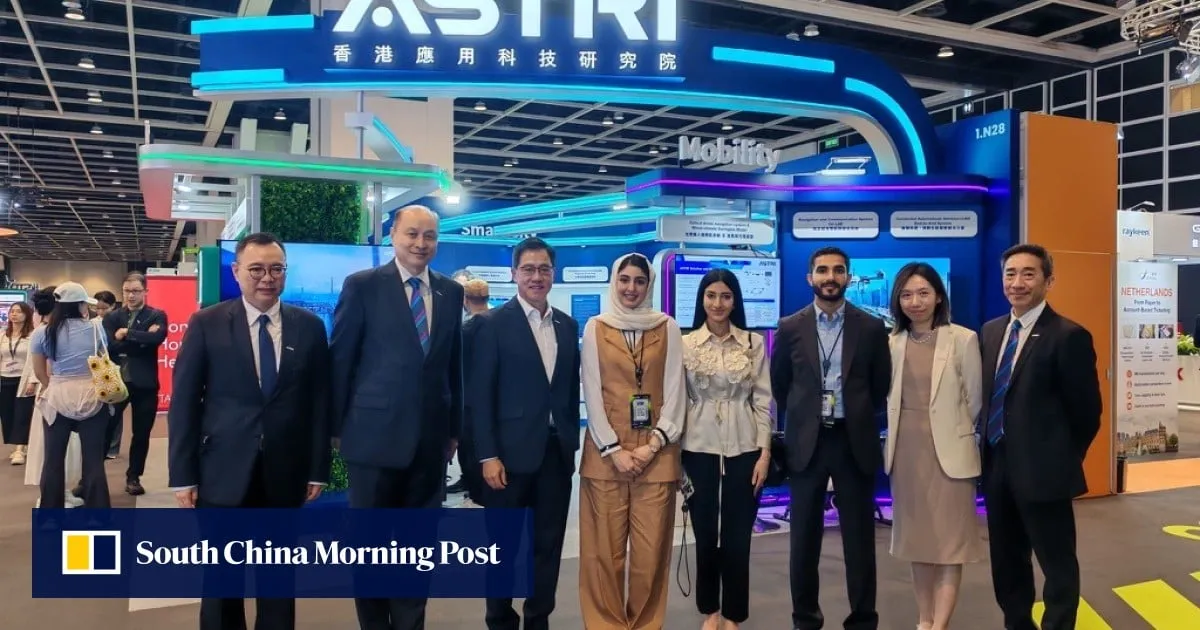
[The content of this article has been produced by our advertising partner.]Hong Kong Applied Science and Technology Research Institute (ASTRI) has begun to realise tangible results from its merger with the Nano and Advanced Materials Institute (NAMI), completed in April 2026, with new combinations of AI and Advanced Materials appearing among the technologies on display at LEAP East.Dr Ying Huang, Chief Technology Officer of ASTRI, said the integration of the two organisations had enabled researchers to identify areas where ICT capabilities and materials expertise can reinforce each other more effectively. Complementary capabilities drive innovation“The merger has substantially strengthened ASTRI's cross-disciplinary research capabilities, with powerful synergies emerging between technology and materials expertise,” he said.“We have a very strong AI+ community in the industry. For materials research – particularly in discovering molecular or structural properties – leveraging advanced AI can significantly accelerate the work."He said the teams had identified specific areas of collaboration that improve the efficiency of discovery work previously conducted using conventional machine learning methods.Sensing technologies for Robotics was cited as one example. Materials researchers had developed piezoresistive materials to detect pressure, while the ICT team had worked on optical sensing supported by AI to capture finer surface details.Combining these approaches has produced stronger results for systems that require both pressure detection and detailed texture analysis.“We have developed something akin to artificial skin. The materials side already possesses technology that can sense pressure electronically, while on the ICT side we use optics and AI analysis for more refined sensing. Combining the two produces a stronger solution,” said Dr Huang.Dr Ying Huang (seventh from right), CTO of ASTRI, discusses how the merger with NAMI has enabled new combinations of ICT and Advanced Materials at LEAP East.Industry partnership model ensures commercial relevanceThe institute continues to require industry partners to contribute a portion of project funding, a practice that helps ensure research addresses genuine commercial requirements. "To ensure research has commercial value, we must find industry sponsors in the field who will contribute real money to the project," he said. Once a technology reaches a workable stage, the team seeks additional partners to scale its application.An AI-enhanced firewall, first developed in an IoT device trial with a government department, was subsequently adapted and scaled for commercial use. The cybersecurity solution was packaged into a router format and is now offered by a telecom company to its SME clients.Tapping Middle East market through LEAP EastTechnologies on display at ASTRI booth during LEAP East included a two-phase immersion cooling system already in trial operation at a government department facility. The system has delivered energy savings of more than 20 per cent and achieved a power usage effectiveness rating of less than 1.1. It also received recognition at an international invention exhibition last year.A two-phase immersion cooling system developed by ASTRI, already deployed on 10 servers at a government department facility for over a year, achieving energy savings of more than 20 per cent.Other exhibits featured long-life batteries designed for demanding conditions, including versions capable of operating at temperatures up to 85°C for up to ten years without replacement, and batteries that meet European standards for emergency communication following vehicle incidents. Long-life batteries developed by ASTRI, capable of operating at temperatures up to 85°C for up to ten years without replacement, are among the technologies on display at LEAP East.A photovoltaic-storage hybrid inverter and a drone system for high-rise building maintenance, developed in collaboration with the Hong Kong Polytechnic University, were also shown.Dr Huang said discussions at the event with partners from Saudi Arabia and other Middle Eastern markets had provided useful feedback on how certain technologies, including privacy-preserving detection systems, could be applied in commercial setting such as retail analytics.Physical AI: the next frontierIr Dr Ted Suen, Chief Executive Officer of ASTRI, said the emergence of cross-regional innovation hubs in Asia and the Middle East presents a global opportunity and that ASTRI’s participation at LEAP East reflects Hong Kong’s role as a connector in building technological bonds with the Middle East.During the panel "Autonomous Everything: The Dawn of Physical AI", which examined the real-world integration of physical AI from robotaxis to autonomous urban systems, Dr Suen spoke of the shift from digital AI to physical AI. He noted that labour shortages and ageing populations are increasing demand for automation in the physical world, with advances in areas such as sim-to-real transfer, 3D spatial understanding and agentic AI contributing to this development.The broad range of applications, from medical Robotics that support remote surgery to autonomous systems in factories, he said. While challenges remain in hardware, real-time accuracy and infrastructure integration, continued technological progress suggests that physical AI is moving closer to wider deployment. He called for organisations to prepare now by creating testing environments and incorporating AI across operations. “Think big and start small,” he concluded.Ir Dr Ted Suen (right), CEO of ASTRI, says the institute’s participation at LEAP East reflects Hong Kong’s role in building technological links with the Middle East.Enhanced research capacity and strategic alignmentASTRI now operates with around 600 research staff, over 80% of whom hold PhD or Master’s degrees, combining expertise across ICT, AI, advanced electronics, materials science and more. The merged institute maintains ongoing collaboration with partners across the Greater Bay Area and Southeast Asia, in addition to its engagement at LEAP East. The focus remains on identifying real-world applications and supporting the scaling of solutions that have moved beyond initial development stages.
SRCSouth China Morning Post
LANGEN
LEANCenter-Right
WORDS902
ENT12
SUN · 2026-07-19 · 16:00 GMTBRIEF NSR-2026-0719-94219
NSR-2026-0719-94219Press Release·EN·Technology
ASTRI and NAMI merger begins yielding hybrid AI and materials technologies
The Hong Kong Applied Science and Technology Research Institute (ASTRI) is seeing tangible results from its April 2026 merger with the Nano and Advanced Materials Institute (NAMI). This integration is fostering new hybrid technologies combining AI and advanced materials, showcased at LEAP East.
Advertising partnerSouth China Morning PostFiled 2026-07-19 · 16:00 GMTLean · Center-RightRead · 4 min
South China Morning PostFIG 01
Reading time
4min
Word count
902words
Sources cited
1cited
Entities identified
12entities
Quality score
100%
§ 01
Briefing Summary
AI-generatedNEWSAR · AI
The Hong Kong Applied Science and Technology Research Institute (ASTRI) is seeing tangible results from its April 2026 merger with the Nano and Advanced Materials Institute (NAMI). This integration is fostering new hybrid technologies combining AI and advanced materials, showcased at LEAP East. ASTRI's Chief Technology Officer, Dr. Ying Huang, highlighted how the merger enhances cross-disciplinary research, accelerating materials discovery through AI and leading to innovations like "artificial skin" that combines electronic pressure sensing with optical AI analysis for detailed texture analysis. ASTRI continues to partner with industry, requiring funding contributions to ensure commercial relevance, as demonstrated by an AI-enhanced firewall adapted for commercial use. The institute is also exploring opportunities in the Middle East market, presenting technologies such as energy-efficient immersion cooling systems and long-life batteries.
Confidence 0.90Sources 1Claims 5Entities 12
§ 02
Article analysis
Model · rule-basedFraming
Technology
Economic Impact
Tone
Measured
AI-assessed
CalmNeutralAlarmist
Factuality
0.70 / 1.00
Factual
LowHigh
Sources cited
1
Limited
FewMany
§ 03
Key claims
5 extracted01
ASTRI requires industry partners to contribute a portion of project funding to ensure research addresses genuine commercial requirements.
quoteDr Ying Huang
Confidence
1.00
02
The integration of ASTRI and NAMI has enabled researchers to identify areas where ICT capabilities and materials expertise can reinforce each other.
quoteDr Ying Huang
Confidence
1.00
03
An AI-enhanced firewall, initially developed for a government IoT trial, was adapted and scaled for commercial use by a telecom company for SME clients.
factualASTRI
Confidence
0.90
04
ASTRI and NAMI merger is yielding hybrid AI and materials technologies.
factualASTRI
Confidence
0.90
05
Combining piezoresistive materials for pressure detection with AI-supported optical sensing creates stronger results for robotics.
factualASTRI
Confidence
0.80
§ 04
Full report
4 min read · 902 words§ 05
Entities
12 identifiedKey playerOppositionContextPositiveNeutralNegative
Organizations5
Locations1
§ 06
Keywords & salience
10 termsastri and nami merger
1.00
ai and materials technologies
1.00
hybrid ai
0.90
advanced materials
0.90
cross-disciplinary research
0.80
sensing technologies
0.70
artificial skin
0.60
robotics
0.60
commercial relevance
0.50
industry partnership
0.40
§ 07
Topic connections
Interactive graph No topic relationship data available yet. This graph will appear once topic relationships have been computed.