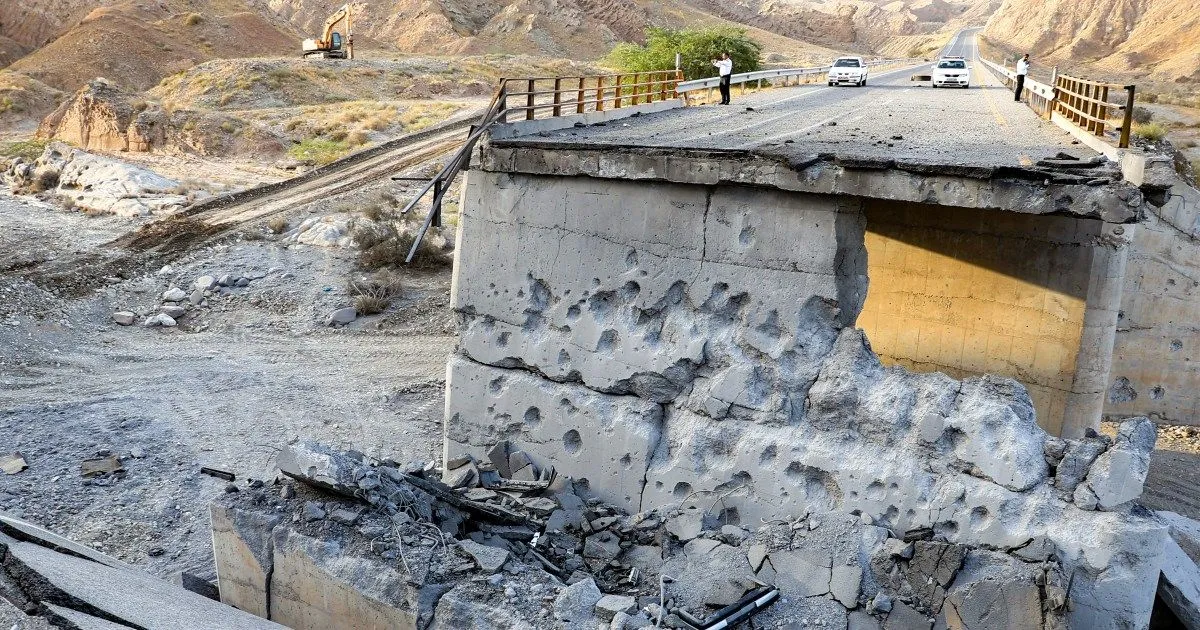
EXPLAINERThe United States has escalated attacks on Iranian roads, bridges and power plants, and Iran too, has responded.A heavily damaged bridge that was hit by a US strike is pictured along the road connecting Roudan and Bandar Abbas in southern Iran on July 18, 2026 [Amir Hossein Khorgooie/ISNA/AFP]Published On 20 Jul 2026The United States and Iran are locked in an increasingly escalatory cycle of strikes that they each claim is aimed at preventing the other from securing military dominance over the Strait of Hormuz.As the US pounds southern Iran and, in recent days, other parts of the country, Tehran too has hit back, striking US military bases in neighbouring nations in the Gulf and Jordan.Recommended Stories list of 4 itemslist 1 of 4What does Iran’s attack on Kuwait infrastructure mean for Gulf?list 2 of 4US releases footage of ninth consecutive night of strikes on Iranlist 3 of 4US renews attacks on Iran after US soldier killed: What’s the latest?list 4 of 4Iranians suffer from power blackouts during war and heatwaveend of listBut projectiles fired by both the US and Iran have also hit civilian infrastructure, raising questions over potential violations of international law, even as the fragile memorandum of understanding (MoU) towards peace that the two countries had signed in June has collapsed.“We’re going to knock out all their power plants. We’re going to knock out all their bridges unless they get to the table and negotiate,” US President Donald Trump threatened in a Fox News interview last week. He made similar threats on civilian infrastructure earlier in April.At least 50 people have died in Iran since the resumption of hostilities, and 500 have been wounded since July 15, according to Iranian authorities. Dozens of locations in southern and northwestern Iran have been hit in the past week, ranging from military command centres to railways and airports.Iran’s Islamic Revolutionary Guard Corps (IRGC) has hit back on neighbouring Gulf countries hosting US military assets, resulting in the deaths of at least two US military personnel.International humanitarian law explicitly forbids the targeting of civilian infrastructure in armed conflict. The US and Israel hit several civilian sites in the first phase of the war that they launched against Iran on February 28, including a girls’ school in Minab where at least 170 people were killed.A spokesperson for United Nations Secretary-General Antonio Guterres said on Friday that he was “particularly concerned about attacks on civilian infrastructure in Iran and across the region”, adding that “such attacks are unacceptable”.So what counts as civilian infrastructure, and what places have been hit so far in the second wave of the US-Israel war on Iran? Here’s what we know:Officials inspect a bridge damaged by a US strike along the road connecting Roudan and Bandar Abbas in Iran, July 18, 2026 [Amir Hossein Khorgooie/ISNA/AFP]What does the law say?The 1949 Geneva Conventions and their Additional Protocols of 1977 forbid armed attacks or reprisals on civilian infrastructure or “objects” during a conflict.Civilian infrastructure includes “all objects which are not military objectives”, the law says, and which are “normally dedicated to civilian purposes, such as a place of worship, a house, or other dwelling or a school”.These also include any facilities that support the day-to-day lives of civilians and that are crucial to how a society functions: roads, bridges, railways, airports, electrical plants, sewage systems, hospitals, and phone and internet systems, for example.The treaty states that drinking water installations and supplies, irrigation works, foodstuffs, crops, livestock as well as dams, dikes, and nuclear power generation plants also cannot be targeted.When in doubt about whether an object is serving a military or civilian purpose, parties must assume it is civilian and thus cannot attack it, the law states.Can civilian infrastructure be targeted?Yes, under specific and carefully determined circumstances.Civilian infrastructure becomes a legitimate target only when it can be proven that it was “used for military purposes at the time of the attack and that its destruction provides a definite military advantage”, according to the treaty.Even so, the law mandates that such attacks ensure that necessary attacks on civilian infrastructure remain “proportionate to the military advantage”.In short, attacks on suspected civilian objects are prohibited if the risks to civilians – deaths, injury, and the proper functioning of civilian life – outweigh military gains.“The basic presumption is that infrastructure is civilian and protected until such time it has become a military objective through the enemy’s use or future use,” Luke Moffett, law professor and civilian harm expert at Queen’s University Belfast, told Al Jazeera.The US and NATO forces used this justification for past attacks on electrical or water plants in Iraq or Libya, although they caused civilian harm, the professor said.Because there’s such a thin line between preventing the enemy from using infrastructure and impacting civilians, militaries have to constantly verify that targets provide a military advantage and that civilian harm is not excessive, he added.“Otherwise it can be an indiscriminate attack,” Moffett said. Such indiscriminate attacks can be prosecuted as war crimes.Iranian media and officials have reported several US strikes on civilian infrastructure as defined by the Geneva treaty, particularly in southern coastline areas close to the Strait of Hormuz. Washington claims it has exclusively targeted “including military logistics infrastructure”.Analysts say lawyers in the US military may be clearing some targets for strikes as “dual-use”, meaning they might potentially be used for military purposes.
SRCAl Jazeera
LANGEN
LEANCenter
WORDS890
ENT12
MON · 2026-07-20 · 14:37 GMTBRIEF NSR-2026-0720-94428
NSR-2026-0720-94428News Report·EN·Conflict
What are ‘civilian’ sites in international law and where have US, Iran hit?
The United States and Iran are engaged in an escalating conflict, with both sides striking targets in an effort to gain military dominance over the Strait of Hormuz. The US has attacked Iranian roads, bridges, and power plants, while Iran has responded by hitting US military bases in neighboring countries.
Shola LawalAl JazeeraFiled 2026-07-20 · 14:37 GMTLean · CenterRead · 4 min
Al JazeeraFIG 01
Reading time
4min
Word count
890words
Sources cited
3cited
Entities identified
12entities
Quality score
100%
§ 01
Briefing Summary
AI-generatedNEWSAR · AI
The United States and Iran are engaged in an escalating conflict, with both sides striking targets in an effort to gain military dominance over the Strait of Hormuz. The US has attacked Iranian roads, bridges, and power plants, while Iran has responded by hitting US military bases in neighboring countries. These strikes have also impacted civilian infrastructure, raising concerns about violations of international law. International humanitarian law, including the Geneva Conventions, prohibits attacks on civilian objects unless they are being used for military purposes and their destruction offers a definite military advantage, with proportionality being a key consideration. The UN Secretary-General has expressed concern over attacks on civilian infrastructure in the region.
Confidence 0.90Sources 3Claims 5Entities 12
§ 02
Article analysis
Model · rule-basedFraming
Conflict
Legal & Judicial
Tone
Mixed Tone
AI-assessed
CalmNeutralAlarmist
Factuality
0.70 / 1.00
Factual
LowHigh
Sources cited
3
Well sourced
FewMany
§ 03
Key claims
5 extracted01
US President Donald Trump threatened in a Fox News interview last week, 'We’re going to knock out all their power plants. We’re going to knock out all their bridges unless they get to the table and negotiate.'
quoteUS President Donald Trump
Confidence
1.00
02
International humanitarian law explicitly forbids the targeting of civilian infrastructure in armed conflict.
factual
Confidence
1.00
03
The United States has escalated attacks on Iranian roads, bridges and power plants, and Iran too, has responded.
factual
Confidence
0.90
04
The US and Israel hit several civilian sites in the first phase of the war that they launched against Iran on February 28, including a girls’ school in Minab where at least 170 people were killed.
factual
Confidence
0.80
05
At least 50 people have died in Iran since the resumption of hostilities, and 500 have been wounded since July 15, according to Iranian authorities.
statisticIranian authorities
Confidence
0.80
§ 04
Full report
4 min read · 890 words§ 05
Entities
12 identifiedKey playerOppositionContextPositiveNeutralNegative
Organizations3
§ 06
Keywords & salience
10 termscivilian sites
1.00
international law
0.90
us iran conflict
0.90
strait of hormuz
0.70
international humanitarian law
0.70
infrastructure
0.60
military dominance
0.50
escalation
0.50
islamic revolutionary guard corps
0.40
united nations
0.40
§ 07
Topic connections
Interactive graph Network visualization showing 51 related topics
View Full Graph Person Organization Location Event|Click node to navigate|Edge numbers = shared articles