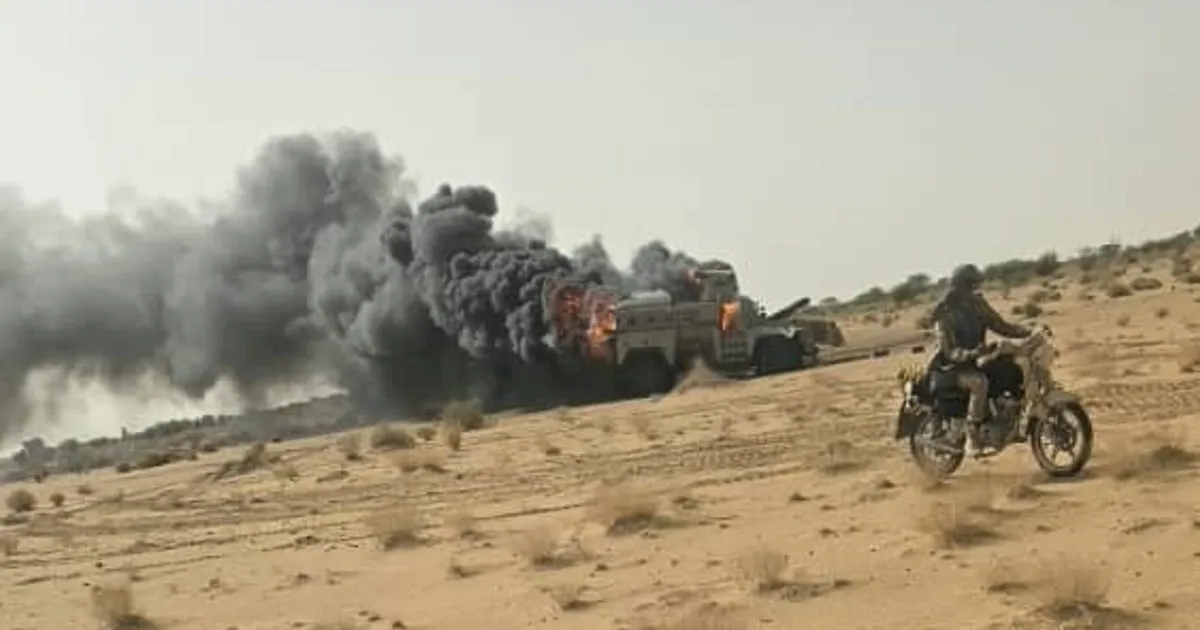
A deadly attack near Anefis exposes the growing challenges facing Mali’s military leaders.A vehicle burns in Mali as the country faces renewed fighting [Azaward Liberation Front via AP]Published On 22 Jul 2026Bamako, Mali – The ambush that killed at least 50 Malian soldiers and struck a joint convoy of the Malian Armed Forces (FAMa) and Russia’s Africa Corps, which replaced the Wagner Group as Moscow’s military presence in Mali, near the northern town of Anefis on July 18 was more than another battlefield setback.It underscored how Mali’s armed groups are becoming increasingly coordinated, exposing the limits of the military government’s security strategy, despite growing Russian military support.The Malian military confirmed the assault and said it had launched counter-operations, while Africa Corps later released footage it said showed drone strikes targeting fighters involved in the ambush.The attack is the latest in a series of coordinated operations across northern Mali since April, raising questions about why armed groups are increasingly cooperating, whether Bamako’s security strategy is working, whether Russia’s military role has – and has not – changed, and what the conflict could mean for the wider Sahel.Why are separatist and Islamic armed groups fighting together?The July 18 ambush was jointly claimed by the Azawad Liberation Front (FLA), a coalition of predominantly Tuareg separatist groups, and Jama’at Nusrat al-Islam wal-Muslimin (JNIM), an al-Qaeda affiliate in the Sahel.Until recently, such cooperation would have seemed unlikely as they have different longterm political aims. The FLA seeks greater autonomy or independence for northern Mali, while JNIM aims to establish governance based on its interpretation of Islamic law across the region.For Héni Nsaibia, a senior West Africa analyst at the Armed Conflict Location & Event Data (ACLED) monitor, the answer lies in a shared battlefield enemy rather than a shared ideology.“The Tuareg-led separatists and JNIM are currently fighting together because they share a common enemy in the Malian Armed Forces and their Russian partners from the Africa Corps,” Nsaibia told Al Jazeera.“In doing so, they act as force multipliers for one another, allowing them to pool resources and mutualise their efforts to confront their adversaries more effectively. These groups also share kinship ties despite their ideological differences and regard one another as sons of the land, defending their ancestral territory against invading forces.”For Mali’s military, that cooperation makes attacks harder to anticipate and more difficult to repel, allowing armed groups to combine local knowledge, manpower and operational experience while pursuing separate objectives.The military government’s decision to abandon the 2015 Algiers Peace Agreement, request the withdrawal of the United Nations Multidimensional Integrated Stabilization Mission in Mali (MINUSMA), and deepen military cooperation with Russia reshaped the conflict. The collapse of the peace framework removed one of the few mechanisms managing relations between Bamako and northern armed groups, while the military’s increasingly confrontational approach encouraged former rivals to coordinate against a common adversary.The shift became increasingly visible during coordinated attacks launched across several parts of the country in April, stretching Malian and Russian forces across multiple fronts. More recently, fighting around Anefis has shown that the alliance is capable not only of launching simultaneous operations but also of sustaining pressure on strategically important military positions.With negotiations abandoned and military confrontation becoming the dominant strategy, armed groups that once competed with one another have found greater incentives to cooperate on the battlefield.Has Russia changed the course of Mali’s war?Since replacing the Wagner Group as Moscow’s principal military presence in Mali, Africa Corps has become an increasingly important partner for the Malian army.Its personnel have provided combat support alongside Malian forces, while Russian drones and aircraft have expanded the military’s surveillance and strike capabilities. Those capabilities have strengthened the army’s ability to respond to attacks and defend key positions.The wreckage of a vehicle in Mali, where years of fighting have taken a heavy toll on communities and security forces [Azaward Liberation Front via AP]“Russia has helped strengthen Mali’s military, which was at risk of being overrun, and has given it more support on the battlefield,” Nimi Princewill, a regional analyst specialising in West Africa and the Sahel, told Al Jazeera.“But this attack, as well as the earlier seizure of Kidal, suggests the Kremlin’s military support has not changed the overall picture. The conflict remains deeply rooted, with geographical and ideological dimensions that are proving difficult for the junta to tackle.” The army seized Kidal, a key town in the country’s north that the Tuareg rebels held for nearly a decade, in November 2023, but Tuareg and allied fighters retook the town in April this year.Rather than transforming the conflict, Moscow’s military backing appears to have strengthened the army’s battlefield capabilities without addressing the political, governance and security conditions that continue to fuel the violence.Recent operations reinforce that assessment. Convoys travelling through northern Mali continue to face frequent ambushes, particularly along routes linking Gao, Anefis and other military positions, exposing the continued vulnerability of military supply lines despite increased Russian support.The shift away from Western security partners also changed the type of assistance available. While Africa Corps has strengthened Mali’s combat capabilities, the withdrawal of the United Nations Multidimensional Integrated Stabilization Mission in Mali (MINUSMA) ended an international presence that provided logistics, monitoring and intelligence support across much of northern Mali.The result is a military that has become more effective in direct combat but continues to struggle to secure vast, remote territory against increasingly adaptable armed groups.Has Bamako’s strategy paid off?The limitations of Bamako’s security strategy raise broader questions about whether it is translating battlefield gains into lasting security.Since seizing power in 2020, Mali’s military government has centred its strategy on military force, ending longstanding cooperation with Western partners while strengthening defence ties with Russia.But the repeated ambushes around Anefis and along northern supply routes suggest the measurable gains of this approach on the battlefield have yet to translate into lasting strategic control.More fundamentally, the growing cooperation between armed groups with different objectives suggests that Bamako’s strategy has not prevented them from adapting and reshaping the conflict.What could this mean for the wider Sahel?The implications of the Anefis ambush extend well beyond Mali.JNIM, the al-Qaeda affiliate, already operates across Mali, Burkina Faso and Niger, while fighting continues to spread across the central Sahel.The evolving battlefield also presents a challenge for the Alliance of Sahel States (AES), whose members all face persistent armed violence despite expanding military cooperation. The alliance was created to strengthen collective security, but increasingly coordinated attacks suggest that cooperation among governments is being matched by equally adaptable cooperation among armed groups.At the same time, Mali’s withdrawal from the Economic Community of West African States (ECOWAS) has reduced opportunities for regional coordination with neighbouring countries confronting many of the same security threats.If the FLA-JNIM partnership proves durable, it could encourage similar tactical cooperation elsewhere in the Sahel, further complicating efforts to contain armed groups whose operations already span national borders.“The AES was supposed to mean that our security was finally our own business. But when Mali bleeds, Niger bleeds with it, because the armed groups attacking those convoys do not recognise the Alliance of Sahel States any more than they recognised ECOWAS. We traded one set of partners we did not trust for another, and the war is still coming south,” a Niger-based security expert, who requested anonymity because he feared potential repercussions, told Al Jazeera.Whether the tactical partnership between the FLA and JNIM proves durable remains uncertain. But the Anefis ambush suggests that as Mali’s security strategy shifts, armed groups are adapting in response, with consequences that could extend far beyond Mali’s borders.
SRCAl Jazeera
LANGEN
LEANCenter
WORDS1 254
ENT12
WED · 2026-07-22 · 02:39 GMTBRIEF NSR-2026-0722-94902
NSR-2026-0722-94902News Report·EN·Conflict
How armed group alliances are reshaping Mali’s conflict and the wider Sahel
A recent deadly ambush near Anefis, Mali, killing at least 50 Malian soldiers and striking a joint convoy with Russia's Africa Corps, highlights growing challenges for Mali's military government. The attack, claimed by the Azawad Liberation Front (FLA) and JNIM, demonstrates increased coordination between separatist and jihadist groups, who are uniting against a common enemy.
By Mubarak AliyuAl JazeeraFiled 2026-07-22 · 02:39 GMTLean · CenterRead · 6 min
Al JazeeraFIG 01
Reading time
6min
Word count
1 254words
Sources cited
1cited
Entities identified
12entities
Quality score
100%
§ 01
Briefing Summary
AI-generatedNEWSAR · AI
A recent deadly ambush near Anefis, Mali, killing at least 50 Malian soldiers and striking a joint convoy with Russia's Africa Corps, highlights growing challenges for Mali's military government. The attack, claimed by the Azawad Liberation Front (FLA) and JNIM, demonstrates increased coordination between separatist and jihadist groups, who are uniting against a common enemy. This cooperation, driven by shared adversaries rather than ideology, allows armed groups to pool resources and leverage local knowledge. The Malian government's abandonment of the Algiers Peace Agreement and deepening ties with Russia have reshaped the conflict, creating incentives for former rivals to coordinate. While Russia's Africa Corps has bolstered Mali's military capabilities, the ongoing conflict's deep roots suggest this support has not fundamentally altered the situation.
Confidence 0.90Sources 1Claims 5Entities 12
§ 02
Article analysis
Model · rule-basedFraming
Conflict
Political Strategy
Tone
Measured
AI-assessed
CalmNeutralAlarmist
Factuality
0.70 / 1.00
Factual
LowHigh
Sources cited
1
Limited
FewMany
§ 03
Key claims
5 extracted01
The July 18 ambush was jointly claimed by the Azawad Liberation Front (FLA) and Jama’at Nusrat al-Islam wal-Muslimin (JNIM).
factual
Confidence
0.95
02
Mali’s military government abandoned the 2015 Algiers Peace Agreement and deepened military cooperation with Russia.
factual
Confidence
0.90
03
An ambush near Anefis killed at least 50 Malian soldiers and struck a joint convoy of the Malian Armed Forces and Russia’s Africa Corps.
factual
Confidence
0.90
04
Armed groups in Mali are becoming increasingly coordinated, exposing limits of the military government’s security strategy.
factual
Confidence
0.85
05
Separatist and Islamic armed groups are cooperating because they share a common enemy in the Malian armed forces and their Russian partners.
quoteHéni Nsaibia
Confidence
0.80
§ 04
Full report
6 min read · 1 254 words§ 05
Entities
12 identifiedKey playerOppositionContextPositiveNeutralNegative
Organizations7
§ 06
Keywords & salience
10 termsmali conflict
1.00
sahel region
0.90
armed group alliances
0.90
africa corps
0.80
jnim
0.70
azawad liberation front
0.70
russian military presence
0.60
security strategy
0.50
coordinated operations
0.50
separatist groups
0.40
§ 07
Topic connections
Interactive graph Network visualization showing 51 related topics
View Full Graph Person Organization Location Event|Click node to navigate|Edge numbers = shared articles