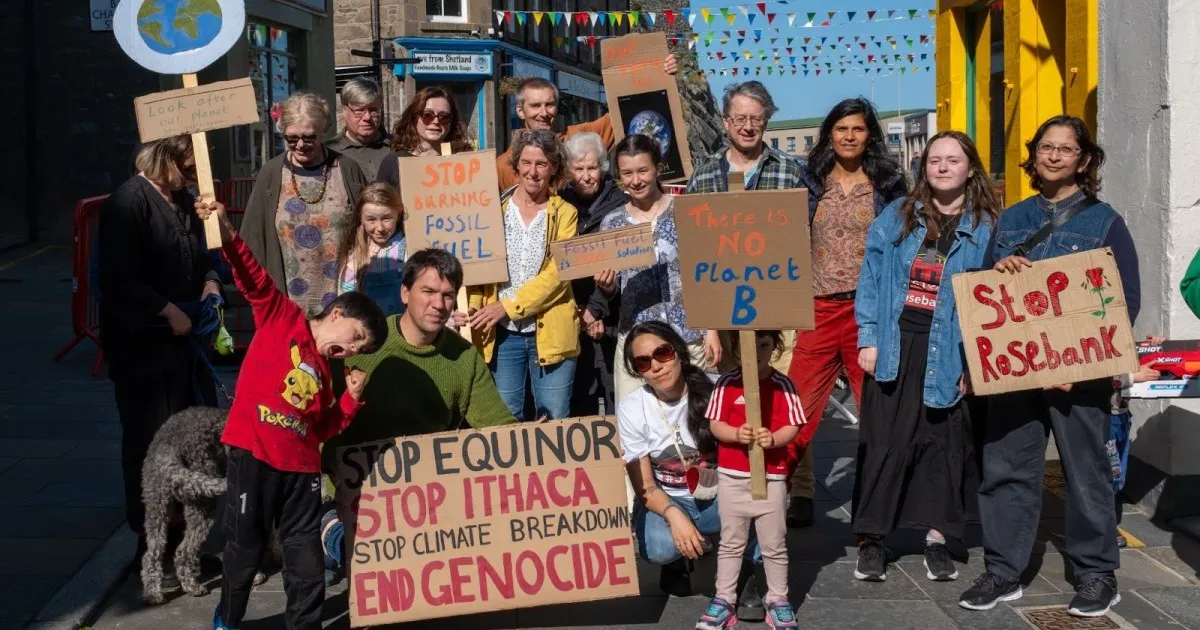
Reports suggesting the new British PM might allow drilling in the North Sea have excited US President Donald Trump, but are dividing local communities.Protesters in Shetland campaigning against the proposed oil drilling project [Photos courtesy of Andrea Sanchez Quiroz]Published On 23 Jul 2026In 2020, Andrea Sanchez Quiroz moved from Edinburgh to her husband’s native Shetland, an archipelago in the North Sea between Scotland and Norway.About 130km (81 miles) from her house lies the United Kingdom’s largest unexploited oil and gas field, known as Rosebank.With Andy Burnham taking office as Britain’s seventh prime minister in a decade, speculation has swirled over whether he might support new North Sea drilling. Reports suggesting he might back exploration — Burnham and his team have not commented on them yet — have led to celebrations from United States President Donald Trump, a longtime advocate of fossil fuel projects.But if Burnham endorses such a move, Sanchez Quiroz is determined to stop it.“I have three children, and I want them to have a stable climate, and fresh water and food available,” she told Al Jazeera.Since 2021, the Shetland resident has been fighting against new oil and gas developments in the North Sea as part of a movement called Shetland-stop-Rosebank" class="entity-link entity-organization" data-entity-id="169974" data-entity-type="organization">Shetland Stop Rosebank. She is concerned about the global climate consequences of burning fossil fuels as well as damage to local marine ecosystems, including the protected Faroe-Shetland sponge belt.“As a planet, we are facing a big ecological crisis,” she explained. “I think at some point we need to say no to this development and find a new way of doing things.”Over the past few years, Rosebank has inspired fierce legal and civil resistance across the United Kingdom due to its climate impact and ties to Israeli apartheid.“Rosebank is the key climate test for this government,” said Robert Palmer, deputy director of environmental organisation Uplift and member of the Stop Rosebank coalition. “The science is really clear that going ahead with Rosebank is just not compatible with the UK’s climate commitments.”Protesters in Shetland opposed to the Rosebank project [Photos courtesy of Andrea Sanchez Quiroz]What is the Rosebank oilfield?In 2023, Norwegian state-owned energy company Equinor was granted permission by the UK government to begin drilling for oil.However, development was stalled by a legal challenge from Uplift and Greenpeace, which led to a ruling in January 2025 that consent for Rosebank and Shell’s Jackdaw field had been granted unlawfully. The judgement meant that both developers had to seek new approval from the government, with downstream emissions produced by burning extracted fossil fuels now considered in the environmental impact assessment.For Rosebank, this process kicked off in September 2025. In June, Shell and Equinor’s joint venture Adura submitted its final reports on downstream emissions. In early July, the UK government launched a public notice period closing on August 17, after which Burnham’s Energy Secretary Miatta Fahnbulleh will deliver the final decision.The Department for Energy Security and Net Zero told Al Jazeera that they “are unable to comment further on individual projects”.Adura claims that Rosebank is consistent with the UK’s goal to reach net-zero by 2050, but energy transition researcher Greg Muttitt explained that Climate Change is a global phenomenon, so what matters is the cumulative impact of fossil fuel extraction around the world.In Muttitt’s opinion, there could be room for Rosebank only if the UK or other countries were to close a significant number of existing oilfields, which he said is “not a very plausible situation”.Protesters in Shetland opposed to the involvement of Ithaca Energy, a subsidiary of Israel’s delek Group, in the Rosebank project [Photos courtesy of the Scottish Palestine Solidarity Campaign]Who stands to profit?While Adura is the main developer, Aberdeen-based Ithaca Energy holds a 20 percent stake in the project. It is a subsidiary of Israeli energy conglomerate Delek Group, which has been blacklisted by the United Nations for its activities in illegal Israeli settlements in the occupied West Bank, and which supplies fuel to the Israeli military and police through subsidiary Delek Israel.Dave Black, energy apartheid campaign lead at the Aberdeen chapter of Scottish Palestine Solidarity Campaign (SPSC), described Delek as a “key actor within the Zionist infrastructure in terms of energy extraction and making significant profits that are flowing to Israel”.Since 2020, Delek has received more than $1bn from Ithaca’s North Sea operations. These profits would increase if Rosebank and the adjacent Cambo field, wholly owned by Ithaca, were approved.In January, SPSC sent a notice to the UK government raising concerns about potential breaches of international law, including failure to meet the obligation to prevent genocide. These concerns were amplified by former Scottish First Minister Humza Yousaf.The Scottish government does not have jurisdiction over offshore oil and gas projects, but a spokesperson told Al Jazeera that “ministers would also expect the UK government to take the UN database seriously into account in its decision-making”.“It’s not just about Israeli-owned companies and the money flowing back to Israel, but it’s also about making it clear that there should be no business as usual with a state like Israel, particularly when there’s an ongoing genocide,” said Black. “Israel is largely dependent on the legitimisation of companies being able to enter contracts with it.”Ithaca told Al Jazeera that it “is governed by the highest standards of corporate governance”. “Ithaca is one of the biggest investors in the North Sea and Scotland, is a responsible employer and is a major contributor to both the UK Treasury through tax payments and to the UK’s energy security,” it added.Adura has not yet responded to a request for comments from Al Jazeera on concerns raised by activists and locals about the project.Protesters in Shetland campaign against the Rosebank project [Courtesy of Andrea Sanchez Quiroz]A just transition away from oil and gasAs the decision on Rosebank approaches, representatives of the fossil fuel industry, including Adura’s chief executive Neil McCulloch, have been urging Burnham to back oil production, claiming that these projects would boost the economy, strengthen energy security, and create jobs in the declining sector.But Muttitt argued that, like 80 percent of existing North Sea crude, most oil produced from Rosebank would be exported to the global market.“At a UK level, it’s wrong to say we need this oil because it’s not oil for the UK,” he explained.“There is absolutely no possibility of the UK ever becoming self-sufficient in oil and gas again because the oil and gas aren’t there. They’ve already been extracted.”Palmer of Uplift argued that instead of more oil and gas, the government should “double down” on the move towards renewable energy, “whether that is through helping with solar panels, heat pumps, [or] public transport”.In Shetland, oil and gas has been the primary industry for decades, and its decline has affected the local economy and livelihoods. Sanchez Quiroz said many people she speaks to are in favour of new development, and emphasises that while she does not want Rosebank to proceed, those supporting new drilling should not be left behind.“It’s about collaboration, it’s about how we move the workers into a different industry, how we find the resources to replace the oil that we use,” she said.Muttitt agreed that efforts must be made to ensure oil and gas workers benefit from the transition to renewable energy.“I think what workers really need to see is that the government is acting to ensure that jobs are created in this new growth sector to replace the jobs that are lost in the declining sector of oil and gas,” he said.
SRCAl Jazeera
LANGEN
LEANCenter
WORDS1 241
ENT12
THU · 2026-07-23 · 11:33 GMTBRIEF NSR-2026-0723-95296
NSR-2026-0723-95296News Report·EN·Environmental
Why a North Sea oilfield is emerging as British PM Burnham’s big test
British Prime Minister Andy Burnham faces a significant test regarding the proposed Rosebank oilfield in the North Sea. Reports suggest he may approve new drilling, a move welcomed by US President Donald Trump but met with strong opposition from environmental groups and local communities like Shetland Stop Rosebank.
By Emma BainbridgeAl JazeeraFiled 2026-07-23 · 11:33 GMTLean · CenterRead · 5 min
Al JazeeraFIG 01
Reading time
5min
Word count
1 241words
Sources cited
3cited
Entities identified
12entities
Quality score
100%
§ 01
Briefing Summary
AI-generatedNEWSAR · AI
British Prime Minister Andy Burnham faces a significant test regarding the proposed Rosebank oilfield in the North Sea. Reports suggest he may approve new drilling, a move welcomed by US President Donald Trump but met with strong opposition from environmental groups and local communities like Shetland Stop Rosebank. The Rosebank field, the UK's largest unexploited oil and gas resource, is central to climate commitments, with environmental organizations arguing its development is incompatible with the UK's net-zero goals. The project's approval process involves considering downstream emissions, and a final decision is expected after a public notice period closing August 17. Concerns also exist regarding Ithaca Energy's stake in the project, a subsidiary of the Delek Group, which has faced international criticism for its activities.
Confidence 0.90Sources 3Claims 5Entities 12
§ 02
Article analysis
Model · rule-basedFraming
Environmental
Political Strategy
Tone
Mixed Tone
AI-assessed
CalmNeutralAlarmist
Factuality
0.60 / 1.00
Mixed
LowHigh
Sources cited
3
Well sourced
FewMany
§ 03
Key claims
5 extracted01
The science is clear that proceeding with Rosebank is incompatible with the UK's climate commitments.
quoteRobert Palmer
Confidence
1.00
02
Andrea Sanchez Quiroz is campaigning against new oil and gas developments in the North Sea due to climate concerns.
quoteAndrea Sanchez Quiroz
Confidence
1.00
03
A January 2025 ruling found that consent for Rosebank and Shell's Jackdaw field was granted unlawfully.
factual
Confidence
0.90
04
US President Donald Trump is excited by reports of potential new North Sea drilling.
factual
Confidence
0.90
05
Reports suggest British PM Andy Burnham might allow drilling in the North Sea's Rosebank oilfield.
factual
Confidence
0.80
§ 04
Full report
5 min read · 1 241 words§ 05
Entities
12 identifiedKey playerOppositionContextPositiveNeutralNegative
People3
Organizations3
Locations4
§ 06
Keywords & salience
10 termsrosebank oilfield
1.00
north sea oilfield
1.00
climate change
0.90
andy burnham
0.80
fossil fuels
0.70
oil and gas drilling
0.60
environmental resistance
0.60
climate commitments
0.50
shetland
0.50
donald trump
0.40
§ 07
Topic connections
Interactive graph Network visualization showing 10 related topics
View Full Graph Person Organization Location Event|Click node to navigate|Edge numbers = shared articles