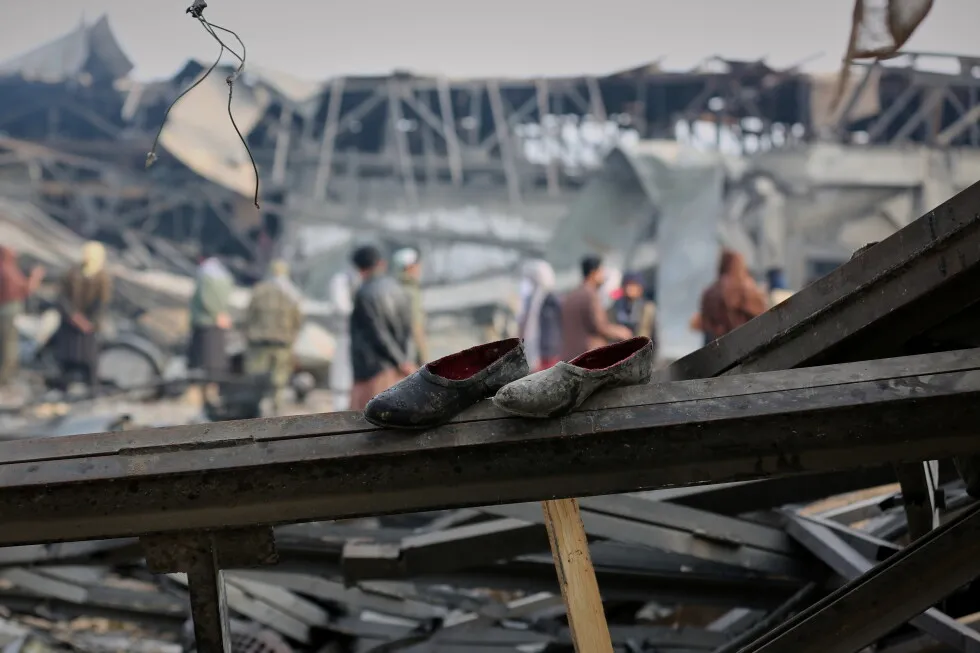
Pakistan rejects Amnesty call for war crimes probe into Kabul airstrike 1 of 3 | Residents and rescue workers inspect the site of a late-Monday airstrike at a drug rehabilitation hospital in Kabul, Afghanistan, Tuesday, March 17, 2026. (AP Photo/Siddiqullah Alizai, File) 2 of 3 | Mourners attend a second mass funeral for victims of an airstrike on a drug rehabilitation center earlier this month, in Kabul, Afghanistan, Thursday, March 26, 2026. (AP Photo/Siddiqullah Alizai, File) 3 of 3 | Taliban rescue team member Allah Mohammad Farooq inspects the site of a late-Monday airstrike at a drug rehabilitation hospital in Kabul, Afghanistan, Tuesday, March 17, 2026. (AP Photo/Siddiqullah Alizai, File) By MUNIR AHMED Updated 3:17 PM MESZ, July 23, 2026 Add AP News on Google Add AP News as your preferred source to see more of our stories on Google. Share Share Facebook Copy Link copied Print Email X LinkedIn Bluesky Flipboard Pinterest Reddit Islamabad (AP) — Pakistan on Thursday rejected Amnesty International’s call for an investigation into a March airstrike on a drug rehabilitation center in the Afghan capital that the rights group said could amount to a war crime, dismissing the allegations as unsupported and describing the operation as a lawful act of self-defense. Foreign Ministry spokesperson Tahir Andrabi told a news briefing in Islamabad that Pakistan “completely rejects the allegations” made by Amnesty International, calling it “unfortunate” that such serious claims had been made “without any credible evidence.” His remarks came a day after Amnesty International said it had found no evidence to support Pakistan’s claim that Kabul’s Omid drug rehabilitation center was being used for military purposes or to store weapons and ammunition when it was struck on March 16. Afghanistan has said the strike killed about 400 civilians. Pakistani officials dispute the death toll and maintain the strike targeted a legitimate military site. Amnesty said it analyzed more than 60 photos and videos, including footage released by Pakistan’s military, reviewed more than 30 satellite images and interviewed witnesses and other sources. It said it asked Pakistan’s Foreign Ministry on July 9 whether an investigation had been launched and requested evidence supporting Pakistan’s justification for the strike but had received no response before publishing its report. The strike came amid months of escalating cross-border hostilities between Pakistan and Afghanistan. Amnesty International says Pakistan strike on Kabul drug treatment center may be a war crime 3 MIN READ Pakistan says ground operation and strikes along Afghan border killed 29 militants 3 MIN READ Pakistani airstrikes kill 36 civilians in Afghanistan and wound 160, officials say 3 MIN READ Pakistan accuses Afghanistan’s Taliban government of harboring militants, particularly the Pakistani Taliban, known as Tehrik-e-Taliban Pakistan, or TTP, who it says carry out deadly attacks inside Pakistan. The TTP is a separate group but a close ally of Afghanistan’s Taliban rulers. Afghanistan denies the allegation. The U.N. mission in Afghanistan, UNAMA, said in May it had independently verified at least 269 civilian deaths and 122 injuries from the strike, while warning the actual toll could be significantly higher. Afghan authorities later held mass funerals for victims. Responding to Amnesty’s findings, Andrabi said Afghanistan’s Taliban authorities continued to provide a permissive environment for militant groups, including the TTP and the banned Baloch Liberation Army, allegations Kabul has previously denied. Thousands of Pakistanis were killed or wounded in attacks planned from Afghan territory, he said. “Any military strikes by Pakistan were undertaken in the exercise of its right to self-defense under the principles of necessity and as a measure of last resort and were directed only and exclusively against terrorists and their logistical support bases in Afghanistan,” Andrabi said. Pakistan rejected Amnesty’s conclusions, he said. He also called on the international community to hold Afghanistan’s Taliban authorities accountable for preventing Afghan territory from being used to launch attacks against Pakistan, saying Islamabad reserved the right to take all necessary measures to safeguard its sovereignty, territorial integrity, and the security of its people.
SRCAssociated Press (AP)
LANGEN
LEANCenter
WORDS661
ENT10
THU · 2026-07-23 · 13:23 GMTBRIEF NSR-2026-0723-95329
NSR-2026-0723-95329News Report·EN·Conflict
Pakistan rejects Amnesty call for war crimes probe into Kabul airstrike
Pakistan has rejected Amnesty International's call for an investigation into a March airstrike on a drug rehabilitation center in Kabul, Afghanistan. Amnesty stated the strike may amount to a war crime, finding no evidence that the center was used for military purposes.
Associated Press (AP)Filed 2026-07-23 · 13:23 GMTLean · CenterRead · 3 min
Associated Press (AP)FIG 01
Reading time
3min
Word count
661words
Sources cited
3cited
Entities identified
10entities
Quality score
100%
§ 01
Briefing Summary
AI-generatedNEWSAR · AI
Pakistan has rejected Amnesty International's call for an investigation into a March airstrike on a drug rehabilitation center in Kabul, Afghanistan. Amnesty stated the strike may amount to a war crime, finding no evidence that the center was used for military purposes. Pakistan's Foreign Ministry spokesperson dismissed these allegations as unsupported and claimed the operation was a lawful act of self-defense against terrorists. Afghanistan reported the strike killed around 400 civilians, a figure Pakistan disputes, maintaining it targeted a legitimate military site. The incident occurred amid escalating cross-border tensions, with Pakistan accusing Afghanistan's Taliban government of harboring militants. Pakistan asserts its strikes are in self-defense and calls for accountability from Afghan authorities regarding militant activity.
Confidence 0.90Sources 3Claims 5Entities 10
§ 02
Article analysis
Model · rule-basedFraming
Conflict
Legal & Judicial
Tone
Measured
AI-assessed
CalmNeutralAlarmist
Factuality
0.70 / 1.00
Factual
LowHigh
Sources cited
3
Well sourced
FewMany
§ 03
Key claims
5 extracted01
Amnesty International found no evidence to support Pakistan's claim that the drug rehabilitation center was used for military purposes.
factualAmnesty International
Confidence
1.00
02
Pakistan claims the airstrike targeted a legitimate military site and was an act of self-defense.
factualPakistan Foreign Ministry
Confidence
1.00
03
Amnesty International stated the airstrike could amount to a war crime.
factualAmnesty International
Confidence
1.00
04
Pakistan rejects Amnesty International's call for an investigation into a March airstrike on a drug rehabilitation center in Kabul.
factualPakistan Foreign Ministry
Confidence
1.00
05
Afghanistan stated the strike killed about 400 civilians.
statisticAfghanistan
Confidence
0.90
§ 04
Full report
3 min read · 661 words§ 05
Entities
10 identifiedKey playerOppositionContextPositiveNeutralNegative
Locations5
§ 06
Keywords & salience
9 termsairstrike
1.00
war crimes probe
0.90
pakistan
0.90
amnesty international
0.90
kabul
0.80
drug rehabilitation center
0.70
self-defense
0.60
cross-border hostilities
0.50
military purposes
0.40
§ 07
Topic connections
Interactive graph Network visualization showing 51 related topics
View Full Graph Person Organization Location Event|Click node to navigate|Edge numbers = shared articles