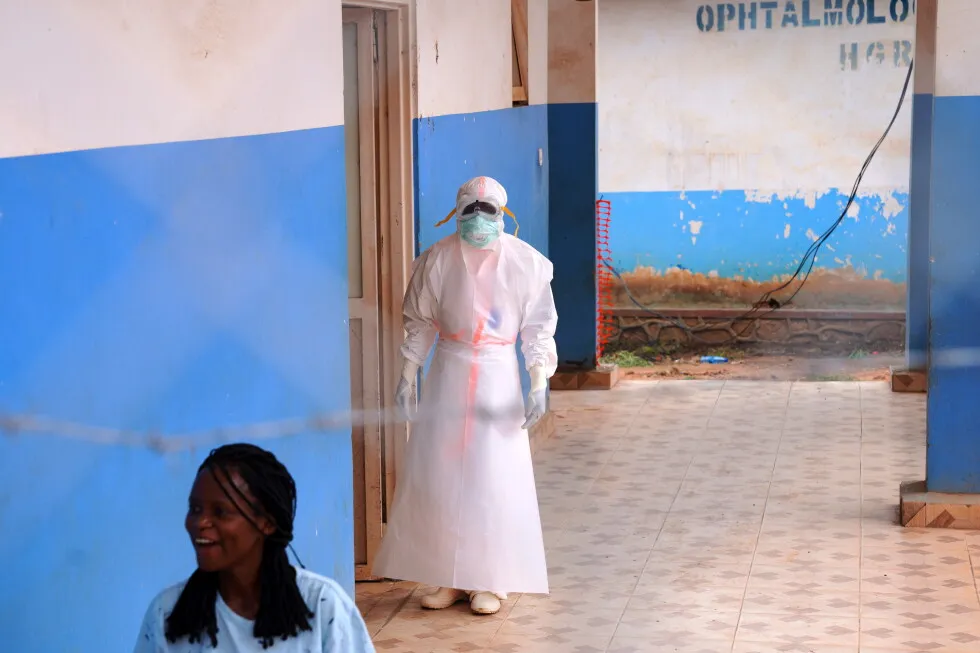
What experts are saying as Ebola outbreak in Congo and Uganda kills more than 1,000 people 1 of 5 | A health worker, wearing protective gear, stands outside the Ebola Treatment Center at the Bunia General Hospital in Ituri, Congo, Wednesday, July 22, 2026. (AP Photo/Dirole Lotsima Dieudonne) 2 of 5 | Health workers disinfects an ambulance at Ebola Treatment Center at Bunia General Hospital in Ituri, Congo, Wednesday, July 22, 2026. (AP Photo/Dirole Lotsima Dieudonne) 3 of 5 | Residence watch as health workers carry a coffin of an Ebola victim at Ebola Treatment Center at Bunia General Hospital in Ituri, Congo, Wednesday, July 22, 2026. (AP Photo/Dirole Lotsima Dieudonne) 4 of 5 | Health workers disinfect a coffin of an Ebola victim at Ebola Treatment Center at Bunia General Hospital in Ituri, Congo, Wednesday, July 22, 2026. (AP Photo/Dirole Lotsima Dieudonne) 5 of 5 | Health workers disinfects an ambulance at Ebola Treatment Center at Bunia General Hospital in Ituri, Congo, Wednesday, July 22, 2026. (AP Photo/Dirole Lotsima Dieudonne) By Mark Banchereau Updated 4:05 PM MESZ, July 23, 2026 Add AP News on Google Add AP News as your preferred source to see more of our stories on Google. Share Share Facebook Copy Link copied Print Email X LinkedIn Bluesky Flipboard Pinterest Reddit DAKAR, Senegal (AP) — The fastest-growing Ebola outbreak in history has killed more than 1,000 people in eastern Congo as health officials race to contain a virus with no approved vaccine or treatment. An update from Congo’s public health institute on Wednesday said there have been 2,536 confirmed Ebola cases and 1,033 deaths, with at least 738 patients in isolation or hospitalized. The outbreak declared on May 15 is unlike most previous instances of Ebola spreading through communities because the Bundibugyo virus responsible has no approved vaccines or treatments. It is mostly concentrated in remote Ituri Province, which accounts for nearly 90% of cases, but there have been others confirmed in five provinces including one of Congo’s largest cities, Kisangani, and in neighboring Uganda. While Congolese officials say the sharp rise in cases appears to be slowing, they caution the outbreak has not yet peaked. The latest report by the country’s public health institute says transmission remains sustained, with recent fluctuations in cases likely influenced by reporting delays and ongoing data consolidation. Contact tracing continues to lag, with only around 77% of known contacts monitored nationwide, well below the 95% target health officials say is needed to interrupt transmission. Ebola is spreading faster in eastern Congo than it can be tracked, as deaths pass 700 4 MIN READ Why the fastest-growing Ebola outbreak in history is becoming more challenging 2 MIN READ US citizen tests positive for Ebola in Congo 2 MIN READ Responders are struggling to understand how far the Ebola outbreak has spread and how much worse it might become. U.S. Centers for Disease Control and Prevention researchers last month used computer modeling and found that in a worst-case scenario, the current Ebola outbreak could approach the worst in history. The West Africa epidemic in 2014-2016 caused more than 11,000 deaths and took about eight months from the first case to reach 1,000 deaths. The new outbreak’s origin is still a medical mystery. The vast majority of cases are emerging from unknown chains of transmission, the World Health Organization said. Risk of the outbreak spreading globally remains low The WHO continues to assess the risk from the outbreak as “very high” inside Congo and “high” in Uganda and neighboring countries, citing cross-border spread, frequent population movement and ongoing transmission in eastern Congo. The agency says the global risk of spread is low, noting Ebola spreads through direct contact with the bodily fluids of an infected person rather than through the air, making it much harder to spread than respiratory viruses. While WHO says additional imported cases are likely as the outbreak grows, those cases have so far been rapidly detected and contained without leading to sustained transmission outside the affected region. The CDC echoed that assessment in its latest situation report, saying Ebola doesn’t spread like respiratory viruses such as flu or COVID-19. “You cannot get Ebola from being near someone,” the agency said. The CDC also notes that people infected with Ebola are not contagious until they develop symptoms, making case identification and contact tracing easier than with diseases that spread before symptoms appear. The vast majority of Ebola cases are concentrated in Congo. In neighboring Uganda, 20 cases have been confirmed, including two deaths. All cases were linked to imported infections from Congo and are concentrated in the capital Kampala. No new Ebola cases have been reported since June 21 and the WHO has discharged its final patient, beginning the 42-day countdown used to declare the end of an outbreak. A positive case of Ebola was identified in France in a doctor traveling from Congo in June. He has since fully recovered and was discharged from the hospital earlier this month. The United States currently bars most recent travelers from Congo from entering the country and requires U.S. citizens to spend 21 days outside Congo before returning, while travelers from neighboring Uganda and South Sudan who are allowed to enter are routed through designated airports for Ebola screening. U.S. plans to build an Ebola quarantine facility in Kenya for Americans evacuated from Congo have been met with legal challenges and a series of protests in Kenya, including some that have turned violent. Community resistance and lack of testing slow response Lack of trust and resistance from locals remain one of the biggest obstacles to containing the outbreak, according to authorities and health workers. Rumors about Ebola treatment centers, fears of isolation and resistance to safe burials have led some people to avoid testing or seek care only after becoming critically ill. The response also has been hampered by conflict. Fighting involving the Rwanda-backed M23 rebels, attacks by the Islamic State-linked Allied Democratic Forces and mass displacement have complicated surveillance, contact tracing and access to affected communities. At least 16 people were killed in an attack Wednesday by suspected ADF rebels in a village in Ituri Province, local authorities said Thursday. Unlike previous Ebola outbreaks, the Bundibugyo virus driving the epidemic has no approved vaccine or treatment. Although testing capacity has expanded since the outbreak began, responders say the virus continues to spread faster than they can contain it. “There’s never been an Ebola outbreak that started with so many cases because it was so late to be identified,” said Trish Newport, emergency program manager for Médecins Sans Frontières (Doctors Without Borders), who has been working in Congo. Earlier this month, researchers began the first clinical trial of potential treatments for the Bundibugyo virus, enrolling patients at an Ebola treatment center in Ituri Province. The WHO said it could take months and as many as 1,000 participants to determine whether either of the two experimental treatments is effective. Associated Press writers Mike Stobbe in New York and Prosper Heri Ngorora in Bunia, Congo, contributed to this report. Mark Banchereau Banchereau covers 22 countries across West and Central Africa for The Associated Press. He is based in Dakar, Senegal. twitter mailto
SRCAssociated Press (AP)
LANGEN
LEANCenter
WORDS1 198
ENT10
THU · 2026-07-23 · 12:23 GMTBRIEF NSR-2026-0723-95334
NSR-2026-0723-95334News Report·EN·Public Health
What experts are saying as Ebola outbreak in Congo and Uganda kills more that 1,000 people
The fastest-growing Ebola outbreak in history has killed over 1,000 people in eastern Congo and spread to neighboring Uganda. Declared on May 15, this outbreak is caused by the Bundibugyo virus, for which there are no approved vaccines or treatments.
Associated Press (AP)Filed 2026-07-23 · 12:23 GMTLean · CenterRead · 5 min
Associated Press (AP)FIG 01
Reading time
5min
Word count
1 198words
Sources cited
1cited
Entities identified
10entities
Quality score
100%
§ 01
Briefing Summary
AI-generatedNEWSAR · AI
The fastest-growing Ebola outbreak in history has killed over 1,000 people in eastern Congo and spread to neighboring Uganda. Declared on May 15, this outbreak is caused by the Bundibugyo virus, for which there are no approved vaccines or treatments. While case numbers appear to be slowing, officials caution the outbreak has not peaked, with contact tracing lagging behind the necessary targets. The World Health Organization assesses the risk as very high within Congo and high in Uganda, but low globally, as Ebola spreads through direct contact, not airborne transmission. Community resistance, conflict, and the lack of treatments are significant challenges to containment, though clinical trials for potential treatments have begun.
Confidence 0.90Sources 1Claims 5Entities 10
§ 02
Article analysis
Model · rule-basedFraming
Public Health
Human Interest
Tone
Mixed Tone
AI-assessed
CalmNeutralAlarmist
Factuality
0.90 / 1.00
Factual
LowHigh
Sources cited
1
Limited
FewMany
§ 03
Key claims
5 extracted01
Contact tracing is lagging, with only around 77% of known contacts monitored nationwide, below the 95% target.
statistic
Confidence
1.00
02
The Bundibugyo virus responsible for this outbreak has no approved vaccines or treatments.
factual
Confidence
1.00
03
There have been 2,536 confirmed Ebola cases and 1,033 deaths in eastern Congo.
statisticCongo’s public health institute
Confidence
1.00
04
The fastest-growing Ebola outbreak in history has killed more than 1,000 people in eastern Congo.
statistic
Confidence
1.00
05
Congolese officials caution the outbreak has not yet peaked, despite a recent slowing of cases.
predictionCongolese officials
Confidence
0.80
§ 04
Full report
5 min read · 1 198 words§ 05
Entities
10 identifiedKey playerOppositionContextPositiveNeutralNegative
Organizations1
Locations5
Events1
§ 06
Keywords & salience
10 termsebola outbreak
1.00
congo
0.90
uganda
0.80
public health
0.70
bundibugyo virus
0.60
containment
0.50
health workers
0.50
treatment
0.40
contact tracing
0.40
vaccine
0.40
§ 07
Topic connections
Interactive graph Network visualization showing 51 related topics
View Full Graph Person Organization Location Event|Click node to navigate|Edge numbers = shared articles