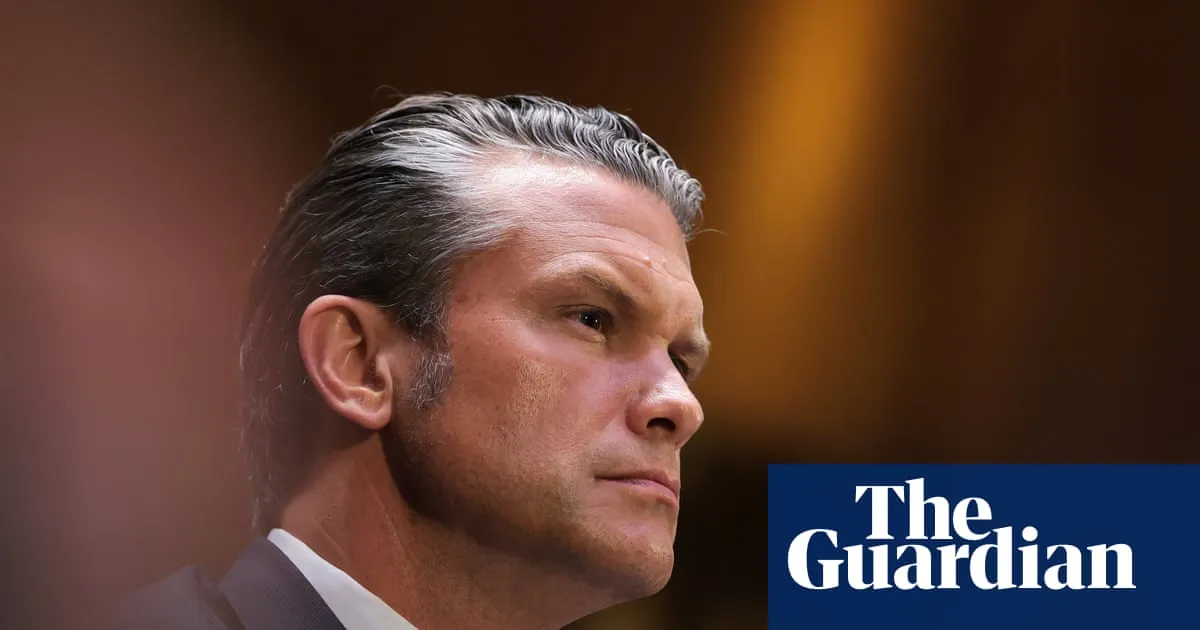
When the ‘“department of government efficiency” was raging unchecked through the federal government in February 2025, the US defense secretary, Pete Hegseth, ordered his subordinates to find cuts of 8% a year for the next five years, theoretically trimming a total of $340m from the Pentagon budget.The disclosure briefly sent Palantir and defense stocks tanking – though soon the plan evaporated, as if it never existed.Instead, Hegseth is now demanding a $454bn increase for 2027 military spending, to a total of almost $1.5tn, in what he describes as a “generational investment”.Adjusted for inflation, that would for the first time match – and even exceed – US military spending at the height of the second world war during national mobilization, according to a chart prepared by the Center for Strategic and International Studies.The US defense budget is in what may be one of its messiest phases in recent memory. That’s because at the same time Donald Trump and Hegseth are making the push for the unprecedented increase in the defense budget – a 44% jump – they are also insisting on extracting emergency funding for the unpopular and disastrous war under way in Iran.The war needs to be funded separately from the main Pentagon budget, which is why Hegseth is running in essence a two-pronged campaign on Capitol Hill: on the one hand, to cajole and bully Republicans to fund, for the relatively short term, the Iran-war" class="entity-link entity-event" data-entity-id="38748" data-entity-type="event">Iran war, and, on the other hand, to pour a historic amount of financing into the already vast military enterprise he presides over with his deputy, the private equity tycoon Stephen Feinberg.$75bn in spare changeHegseth and chair of the joint chiefs of staff, Dan Caine, faced a skeptical Senate appropriations committee on Tuesday in a hearing that was intended to focus on the Iran-war" class="entity-link entity-event" data-entity-id="38748" data-entity-type="event">Iran war part of the military budget push. Hegseth is asking for $67bn in emergency defense funds for his department for 2026. The ranking Democrat on the committee, Patty Murray, pointed out how much of the spending the Trump administration is asking for as an emergency seems uncorrelated to the flailing operations in Iran. “$800m for the national guard to patrol DC even longer,” she listed. “Over $1bn for the army to patrol the southern border, which is [the Department of Homeland Security’s] job. $900m to support the administration’s illegal boat strikes in the Caribbean.”Hegseth answered by blaming his predecessors: “Why this kind of spending is needed is because of the gross negligence and neglect of the Biden administration.”It’s widely known inside and outside the Pentagon that because of the way the Iran-war" class="entity-link entity-event" data-entity-id="38748" data-entity-type="event">Iran war has been run, the US is running desperately short of what it needs in case of a new military crisis. But with extraordinary obstinacy, Hegseth appears to insist any shortages at all can be blamed solely on Joe Biden and past military leaders. The missiles fired and depleted during Iran, in this construct, are not his fault.There’s yet another kink that is making some senators wary: last year the Hegseth Department of Defense already received a $156bn bump under the One Big Beautiful Bill Act. And half of that, about $75bn, is still unobligated – with no detailed plans for how it’s to be spent. By Pentagon standards, it’s spare change, but that’s nearly the value of the entire US Department of Education budget.Questioned about it in the hearing, Hegseth didn’t have any details about that $75bn, though he claimed there was actually a blueprint for where the money will go. “I’d have to get you the exact numbers,” he testified.The Iran-war" class="entity-link entity-event" data-entity-id="38748" data-entity-type="event">Iran war through 30 SeptemberHegseth disclosed a new estimate about the cost of the Iran-war" class="entity-link entity-event" data-entity-id="38748" data-entity-type="event">Iran war – $37.5bn. But he was vague. He said that that would include expenditures up to the present “for certain aspects”, but hedged that the estimate included military pay, operations and maintenance, and other costs “through September 30”. Becca Wasser, a defense expert at the Center for New American Security, said Hegseth’s comments appear to be “a little bit of a signal that the war is still probably going to be going on by September 30”.Messy efforts to fund wars are not new: back during combat operations in Iraq and Afghanistan, the two Bush administrations, the two Obama administrations and the first Trump administration tagged the combat costs on to the defense budget under what were called “overseas contingency operations” (OCO) funds.skip past newsletter promotionafter newsletter promotionBiden, Wasser said, shifted Ukraine spending to emergency supplemental requests rather than OCO funding, and Trump in his second term seems to be following that route on Iran.One huge break from the past: Trump defense department spending is being steered to so-called reconciliation – a legislative mechanism outside normal appropriations which strips the senators of the chance to filibuster a measure. Wasser of the Center for New American Security said: “That’s what makes it incredibly unique.”Late on Wednesday, the House passed a $1.15tn bill for a section of the White House request – which may move it forward, but experts say it’s still nowhere close to something that will clear the Senate.The real money, that $1.5tn, dwarfs the costs of the Iran-war" class="entity-link entity-event" data-entity-id="38748" data-entity-type="event">Iran war. While much of it is for the usual tanks and planes and hardware and training, there’s a good chunk for the pet projects of the tech bros and private equity financiers now running the department.The military’s head of research and engineering is the former Uber executive Emil Michael, who oversees artificial intelligence. As the Guardian reported earlier this year, Michael, while in his first months in office, made millions in profits, between 400% and 4,800%, just on his investment in Elon Musk’s xAI company.The Trump budget plans to steer $58.5bn to AI.About $20bn is targeted for the office of strategic capital, a defense department agency that functions as a private equity arm of the Pentagon. The powerful deputy secretary of defense, Stephen Feinberg, former head of Cerberus Capital, has a former employee of Cerberus presiding over the office. It’s the same agency that committed $620m last year to a mining company backed by a fund tied to Trump’s son Donald Jr.The Trump administration did nod in only one apparent way to fiscal constraints. Without apparent irony, the administration said it had identified $1.6bn in defense reductions related to DEI. “The budget,” the White House said earlier this year, “continues to eliminate millions of dollars in wasteful and egregious spending related to diversity, equity and inclusion and other ‘woke’ programs.”
SRCThe Guardian - World News
LANGEN
LEANCenter-Left
WORDS1 076
ENT12
THU · 2026-07-23 · 17:17 GMTBRIEF NSR-2026-0723-95440
NSR-2026-0723-95440Analysis·EN·National Security
The Hegseth budget: defense secretary’s $1.5tn ask reveals military-industrial chaos
US Defense Secretary Pete Hegseth is requesting a nearly $1.5 trillion defense budget for 2027, a 44% increase that would match World War II spending levels. This comes after an earlier, quickly abandoned plan for annual 8% budget cuts.
Aram Roston in WashingtonThe Guardian - World NewsFiled 2026-07-23 · 17:17 GMTLean · Center-LeftRead · 5 min
The Guardian - World NewsFIG 01
Reading time
5min
Word count
1 076words
Sources cited
3cited
Entities identified
12entities
Quality score
100%
§ 01
Briefing Summary
AI-generatedNEWSAR · AI
US Defense Secretary Pete Hegseth is requesting a nearly $1.5 trillion defense budget for 2027, a 44% increase that would match World War II spending levels. This comes after an earlier, quickly abandoned plan for annual 8% budget cuts. Hegseth is also seeking $67 billion in emergency funds for the ongoing war in Iran, though critics question the allocation of some of these funds. The Pentagon has $75 billion in previously allocated funds that remain unspent and unaccounted for. This push for increased defense spending is being pursued through reconciliation, a legislative process that bypasses typical Senate filibuster rules.
Confidence 0.90Sources 3Claims 5Entities 12
§ 02
Article analysis
Model · rule-basedFraming
National Security
Political Strategy
Tone
Sensational
AI-assessed
CalmNeutralAlarmist
Factuality
0.60 / 1.00
Mixed
LowHigh
Sources cited
3
Well sourced
FewMany
§ 03
Key claims
5 extracted01
Patty Murray pointed out that requested emergency spending includes funds for the National Guard to patrol DC and the Army to patrol the southern border.
quotePatty Murray (via article)
Confidence
0.90
02
Hegseth is asking for $67bn in emergency defense funds for 2026.
factualarticle
Confidence
0.90
03
Adjusted for inflation, the proposed $1.5tn military spending would match or exceed US military spending at the height of WWII.
statisticCenter for Strategic and International Studies (via article)
Confidence
0.90
04
Hegseth is now demanding a $454bn increase for 2027 military spending, totaling almost $1.5tn.
factualarticle
Confidence
0.90
05
Defense Secretary Pete Hegseth initially ordered subordinates to find 8% annual cuts to the Pentagon budget for five years.
factualarticle
Confidence
0.90
§ 04
Full report
5 min read · 1 076 words§ 05
Entities
12 identifiedKey playerOppositionContextPositiveNeutralNegative
People5
Organizations3
§ 06
Keywords & salience
10 termsdefense budget
1.00
military-industrial complex
0.90
pentagon spending
0.90
military spending increase
0.90
iran war funding
0.80
military-industrial chaos
0.80
pete hegseth
0.70
emergency defense funds
0.70
generational investment
0.60
defense stocks
0.50
§ 07
Topic connections
Interactive graph Network visualization showing 51 related topics
View Full Graph Person Organization Location Event|Click node to navigate|Edge numbers = shared articles