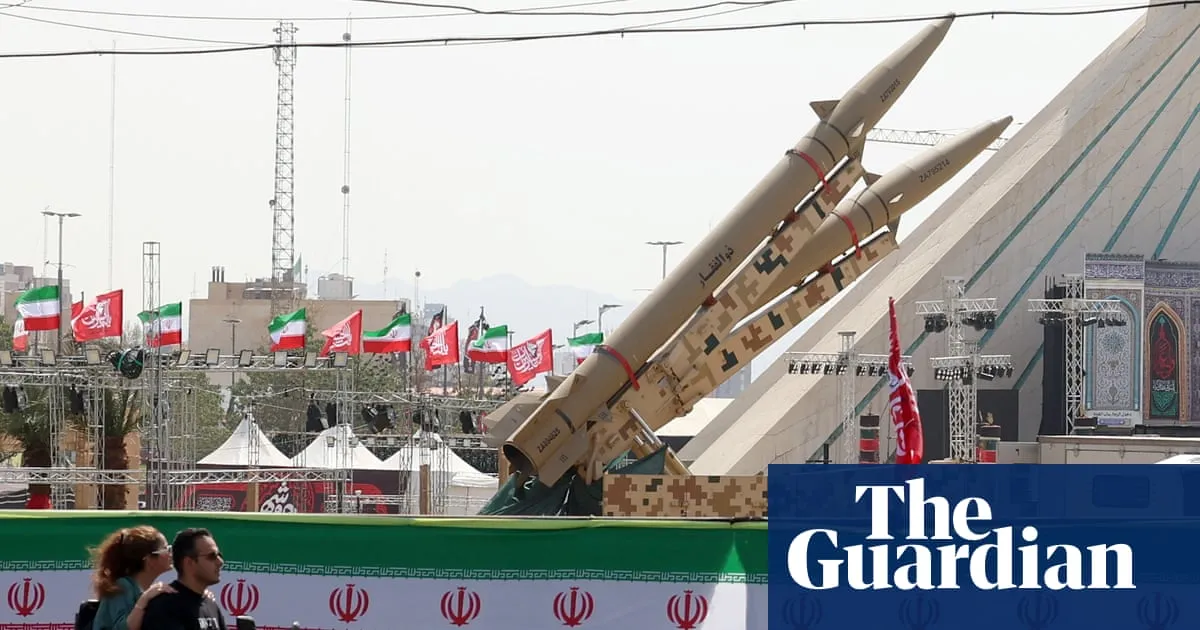
An Iranian couple rides a motorbike past Iranian missiles, Zolfaghar, on display at Azadi Square in Tehran. Photograph: Abedin Taherkenareh/EPA View image in fullscreen An Iranian couple rides a motorbike past Iranian missiles, Zolfaghar, on display at Azadi Square in Tehran. Photograph: Abedin Taherkenareh/EPA Analysis How Chinese tech and Russian tactics are aiding Iran’s bombing of US bases Dan Sabbagh Defence and security editor Increasingly accurate and lethal attacks are revealing weaknesses in stretched defences across the Gulf As the crisis in the Middle East escalates, Iran has been bombing US bases and critical infrastructure in the Gulf with increasing accuracy, helped by Chinese satellite imagery and tactics learned from Russia in Ukraine. Three American soldiers were killed last Friday in an attack on the Muwaffaq Salti airbase in Jordan, which was being protected by a US Thaad air defence system. Satellite imagery later released by Iranian media showed several buildings had been destroyed. It is not clear why the air defence system failed in that incident, which is under Pentagon investigation, but it is a reminder that Iran retains an effective missile capability that its new leadership is willing to deploy. Andreas Krieg, an associate professor at the School of Security Studies, King’s College London, argued that a combination of better intelligence, missile navigation, manoeuvrability and coordinated attack planning amount to “a real transformation”. It was the product, Krieg said, of three years of technological development of Iran’s ballistic missile programme, which remained roughly 70% intact on US intelligence estimates, despite previous US claims that Iran’s military had been obliterated. The first step was using Chinese satellite intelligence to help identify targets at US bases and other sites in the Gulf. Three Chinese companies had sanctions imposed on them by the US in May for providing satellite imagery to enable Iranian missile attacks. One, Mizar Vision, exposed the presence of US military aircraft and Patriot and Thaad air defence systems at bases in Saudi Arabia, Bahrain and at the Jordanian base hit last week, and imagery released on social media was widely picked up. However, experts said they were less sure the Chinese state had been providing intelligence. Sidharth Kaushal, of the Royal United Services Institute, said Iran’s military had focused on static targets at US bases, for which commercial imagery was enough. “I haven’t seen anything where Iran has struck a target so dynamic that I’ve looked at this and gone: ‘This has got to be foreign aid,’” said Kaushal. But, at the same time, questions have been raised about whether US bases, built to withstand attacks from insurgents, are sufficiently hardened against Iranian missile and drone attacks. A string of accurate Iranian attacks on CIA facilities across the Gulf during the bombings had US analysts wondering whether Russia had shared locations with Tehran. But the hypothesis remains tentative. Pete Hegseth, the US defence secretary, told Congress this week that China and Russia were helping Iran to some extent. But he was contradicted by Donald Trump, who said on Friday he had been personally assured by Xi Jinping and Vladimir Putin that they would not sell weapons to Iran. Iran’s ballistic programme relies heavily on Chinese electronics and ammonium perchlorate for rocket fuel, but the finished weapons are considered sophisticated enough to be able to occasionally defeat stretched US and Gulf air defences. Iranian missiles boast complex navigation, using GPS, China’s BeiDou and Russia’s Glonass simultaneously as they launch towards targets, and re-entry speeds, which are several times the speed of sound, always make anti-ballistic defence a challenge. Tehran has also developed “steerable warheads that can adjust their course during descent” on some of its ballistic missiles, Kreig said. Heat-seeking and optical navigation for terminal phase means the ballistics are not vulnerable to electronic jamming because they are not employing radio communication. All this is enough to present a serious challenge for US air defences at a time when stockpiles of Patriot and Thaad interceptors have been run down by about half after the 38-day US-Israel bombing campaign in the spring. Add in energy sites, oil refineries and desalination plants and there becomes a large area to cover. Iran has also evolved tactically in its missile attacks, using methods similar to Russia in Ukraine, where smaller salvoes can be more effective than larger ones, and drones are used to distract air defences, making way for a ballistic attack. Kaushal said he believed it was a case of the two countries’ militaries learning from each other’s experience – “a convergent evolution” – rather than it necessarily being the result of direct teaching of Tehran by Moscow. Though there is a degree of anti-western understanding between Iran, Russia and China, as well as North Korea, the so called “axis of upheaval” is far from a consistent military alliance like Nato. “There is a kind of collaboration there but it doesn’t produce the kind of massive net benefits that Nato produces,” said Matthew Savill, a defence analyst from the Royal United Services Institute. Explore more on these topics Iran US military US-Israel war on Iran Middle East and north Africa China Russia analysis Share Reuse this content
SRCThe Guardian - World News
LANGEN
LEANCenter-Left
WORDS856
ENT12
FRI · 2026-07-24 · 17:13 GMTBRIEF NSR-2026-0724-95784
NSR-2026-0724-95784Analysis·EN·National Security
Iran’s much improved missile systems pose a real threat to the US
Iran's missile systems have become increasingly accurate and lethal, posing a significant threat to US defenses in the Gulf. Recent attacks, including one that killed three US soldiers in Jordan despite a THAAD air defense system, highlight potential weaknesses.
Dan Sabbagh Defence and security editorThe Guardian - World NewsFiled 2026-07-24 · 17:13 GMTLean · Center-LeftRead · 4 min
The Guardian - World NewsFIG 01
Reading time
4min
Word count
856words
Sources cited
2cited
Entities identified
12entities
Quality score
100%
§ 01
Briefing Summary
AI-generatedNEWSAR · AI
Iran's missile systems have become increasingly accurate and lethal, posing a significant threat to US defenses in the Gulf. Recent attacks, including one that killed three US soldiers in Jordan despite a THAAD air defense system, highlight potential weaknesses. Experts suggest Iran's improved capabilities stem from technological advancements in its ballistic missile program, aided by Chinese satellite imagery for target identification and tactics potentially learned from Russia's experiences in Ukraine. Iran's missiles utilize sophisticated navigation systems, including GPS, BeiDou, and Glonass, and feature steerable warheads that can adjust course during descent, making them difficult to intercept. This evolving threat comes as US air defense interceptor stockpiles have been depleted, and Iran's targets have expanded beyond military bases to include critical infrastructure.
Confidence 0.90Sources 2Claims 5Entities 12
§ 02
Article analysis
Model · rule-basedFraming
National Security
Technology
Tone
Mixed Tone
AI-assessed
CalmNeutralAlarmist
Factuality
0.60 / 1.00
Mixed
LowHigh
Sources cited
2
Limited
FewMany
§ 03
Key claims
5 extracted01
A combination of better intelligence, missile navigation, manoeuvrability and coordinated attack planning amount to 'a real transformation' of Iran's missile capabilities.
quoteAndreas Krieg
Confidence
1.00
02
Three American soldiers were killed last Friday in an attack on the Muwaffaq Salti airbase in Jordan.
factual
Confidence
1.00
03
Iran retains an effective missile capability that its new leadership is willing to deploy.
factual
Confidence
0.90
04
Iran has been bombing US bases and critical infrastructure in the Gulf with increasing accuracy.
factual
Confidence
0.90
05
Chinese satellite imagery and tactics learned from Russia in Ukraine are aiding Iran's attacks.
factual
Confidence
0.80
§ 04
Full report
4 min read · 856 words§ 05
Entities
12 identifiedKey playerOppositionContextPositiveNeutralNegative
Organizations1
Locations9
§ 06
Keywords & salience
8 termsiranian missile systems
1.00
us bases
0.90
chinese satellite imagery
0.80
russian tactics
0.70
middle east crisis
0.60
ballistic missile programme
0.50
air defence system
0.50
military technology
0.40
§ 07
Topic connections
Interactive graph Network visualization showing 51 related topics
View Full Graph Person Organization Location Event|Click node to navigate|Edge numbers = shared articles