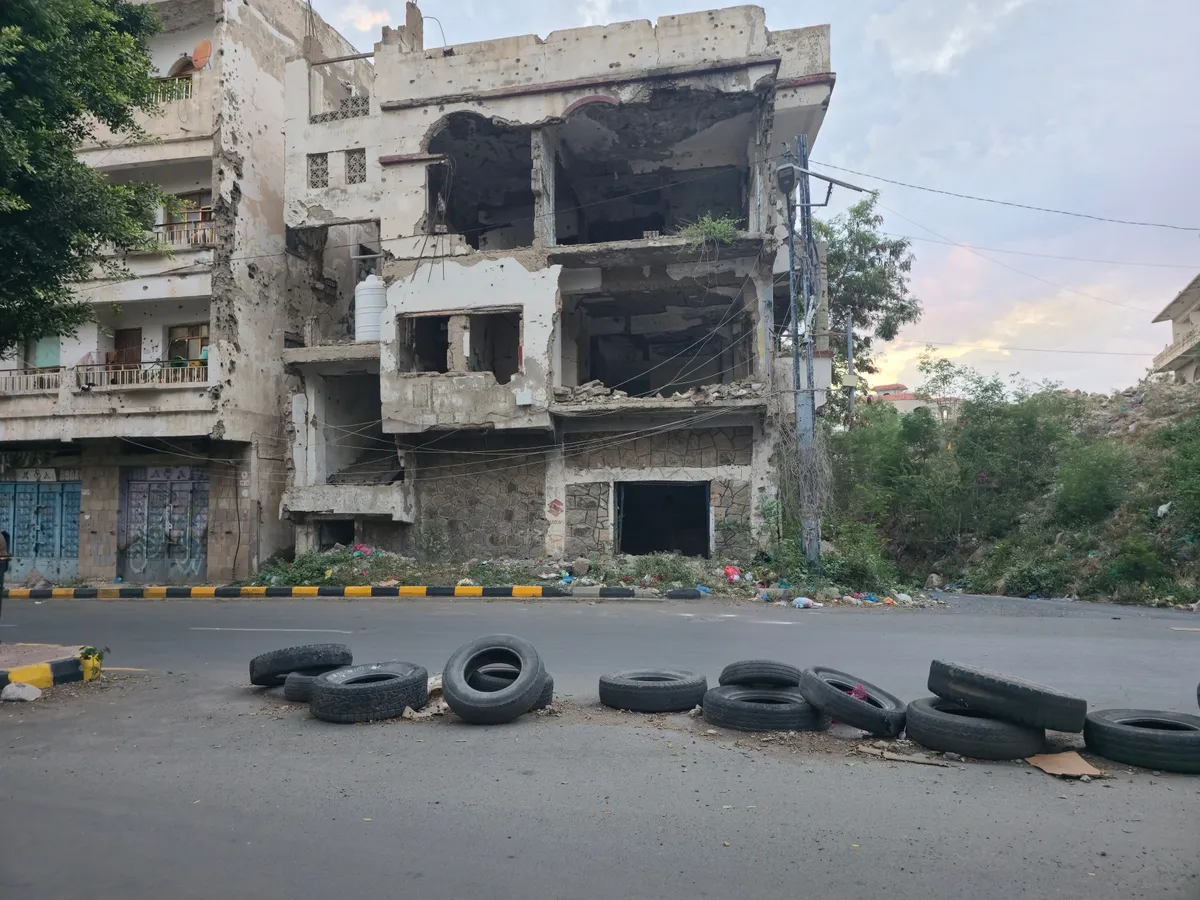
Living near Taiz’s front line forces families to make difficult choices amid Sniper threats and economic hardship.A damaged building near the front line in Taiz city, standing beside one that is still inhabited [Al Jazeera]Published On 25 Jul 2026Taiz, Yemen – Um Yousef knew that living on the front line in Taiz was dangerous. The area had been quieter for the past few years thanks to a general de-escalation of the Yemen" class="entity-link entity-event" data-entity-id="171203" data-entity-type="event">War in Yemen, but it still lay between territory controlled by Yemeni government forces and Houthi rebels.Destroyed buildings mark the city’s front line areas, evidence of the brutal fighting that has lasted for more than a decade.Recommended Stories list of 3 itemslist 1 of 3Oman talking with Tehran on Hormuz as US and Iran continue strikeslist 2 of 3Yemen’s valleys and farms are full of dangerous plastic wastelist 3 of 3US attacks Iran as Houthis allow Chinese ships to pass: What’s the latest?end of listBut Um Yousef felt that she didn’t have a choice. A single mother of four children in her 40s, she couldn’t afford the typical market rate of about $130 for a three-bedroom house in the central Yemeni city. Her husband died years ago while working abroad, so she was the sole breadwinner for the family in a country where poverty has increased sharply since the war began more than a decade ago.“There is a huge demand for houses, and all my efforts failed while I was living in a single room with my children,” recalled Um Yousef, who asked to use a pseudonym for security reasons. “It was very difficult to stay in that one room.”After eight months of moving from one area to another, and even searching on the outskirts of Taiz, she ultimately decided that her only option was a home near the front line. Yes, it was dangerous, but with little money coming in, the home she found for about $13 a month couldn’t be ignored.In January 2025, the family made the move. Two months later, her 11-year-old son came into the house from playing outside with blood pouring out of his mouth – he’d been shot.Sniper danger“I couldn’t understand what happened – I didn’t hear any gunfire,” Um Yousef said.She still doesn’t know the exact cause of the shooting, but many of the casualties near Yemen’s front lines are the result of sniper fire.Taiz is particularly dangerous in this regard. The front line going through the city is one of the few in the country in an urban area. The city’s geography, hilly and with a mountain overlooking it, offers numerous vantage points for snipers.A United Nations monitoring project found that 66 percent of all civilian casualties from sniper shootings in Yemen last year were in Taiz. Of the 21 cases recorded, nine were children.Thankfully, Um Yousef’s son’s injuries were not as serious as first feared. After being immediately taken to hospital, he received medical treatment and was discharged the next day.The incident woke Um Yousef up to the reality of where she had brought her children to. But she still can’t afford to move. Instead, she has had no choice but to stay and learn ways to reduce the risk.“Residents here take precautions I wasn’t aware of, like turning off lights at night in rooms visible from a distance, and keeping children from playing in open areas,” she explained. “They have to play behind the houses instead. I’m aware of these things now and follow them to keep my children safe.”Even in the safe parts of Taiz, damaged homes remain, with the pace of reconstruction in the Yemeni city slow [Al Jazeera]Damaged homesTaiz governorate is the most populous in Yemen, with a population of almost 4.5 million and more than 400,000 internally displaced people, according to Khalid Alwan, director of the local statistics office.“More than 10,000 houses were completely or partially damaged by the conflict in Taiz, and there are many more we couldn’t reach to count,” Alwan told Al Jazeera. “Reconstruction is expensive, and most residents cannot afford to repair their homes even if they are in safe areas. This further worsens the Housing crisis in the city.”He noted that while some humanitarian organisations have repaired partially damaged homes in safe areas, these efforts are a drop in the ocean compared with the sheer number of affected properties.The Nahda Makers Organisation (NMO) is one such group rehabilitating homes in several Yemeni governorates. To date, NMO has repaired 2,389 houses in Taiz, Lahj, Hodeidah, Aden and Abyan governorates – the vast majority of them in Taiz.While this initiative has helped some families return to safe areas, the overall need remains overwhelming, with an estimated 4.8 million displaced people across the country still unable to return.One of the partially damaged houses in Taiz rehabilitated with support from UNHCR and the Nahda Makers Organisation [Courtesy: Nahda Makers Organisation]HousesittingMohammed Saeed has been living in the al-Thawrah neighbourhood of Taiz near the front line since 2023. He believes the war has taken a heavy toll on society, with soaring rents being one of its worst consequences.“I’m not happy living here as we frequently hear the sounds of gunfire at night. Even if we aren’t targeted, just hearing it is enough to terrify us,” the 53-year-old told Al Jazeera. “In the beginning, my children couldn’t sleep when they heard the shooting, but now they’ve adapted. Adapted to what? Adapted to living in a dangerous area.”Mohammed, who is unemployed and cannot afford rent, lives in a house for free in exchange for guarding it. Because the neighbourhood is near the front lines, many residents here do not pay rent.“Nowadays it is calm, but if there is any escalation, we will be trapped in the crossfire,” Mohammed said. “I hope I can find a job that enables me to rent a house in a safe place and leave this one.”Khalid Abdulhadi, 46, is one of the people who could afford to leave. He was born in the al-Kamb neighbourhood of Taiz city and owns a house there. However, he fled during the heavy fighting in 2018 and has not returned, as the proximity to the front line makes it far too unsafe.“It is not the right decision to return and live in a dangerous area,” he told Al Jazeera. “Even though I am paying rent while owning my own home, going back could cost me my life.”Khalid, who works as an accountant for a local company, said some of his neighbours did return and one of them lost their son, shot dead by a sniper.He has allowed a family he knows to live in his house free of charge, knowing that they are impoverished and willing to guard the property. But he has decided to stay far away.“I would prefer to live in a safe camp for displaced families rather than a dangerous house,” he said.“We lost everything during this war; our lives are all we have left, so we must protect them.”
SRCAl Jazeera
LANGEN
LEANCenter
WORDS1 156
ENT12
SAT · 2026-07-25 · 08:09 GMTBRIEF NSR-2026-0725-95897
NSR-2026-0725-95897News Report·EN·Human Interest
Dodging snipers, housing crisis forces Yemenis to live on front line
Families in Taiz, Yemen, are forced to live near the front lines due to a severe housing crisis and economic hardship. Um Yousef, a single mother of four, moved to a home near the front line because she could not afford market rates, paying only $13 a month.
Al Jazeera StaffAl JazeeraFiled 2026-07-25 · 08:09 GMTLean · CenterRead · 5 min
Al JazeeraFIG 01
Reading time
5min
Word count
1 156words
Sources cited
1cited
Entities identified
12entities
Quality score
100%
§ 01
Briefing Summary
AI-generatedNEWSAR · AI
Families in Taiz, Yemen, are forced to live near the front lines due to a severe housing crisis and economic hardship. Um Yousef, a single mother of four, moved to a home near the front line because she could not afford market rates, paying only $13 a month. This proximity to conflict zones exposes residents to sniper fire, with Taiz experiencing a high percentage of civilian casualties from such attacks. Over 10,000 houses in Taiz have been damaged by the conflict, and reconstruction efforts are insufficient to meet the overwhelming need, leaving many displaced Yemenis unable to return home. Residents have adopted safety measures, like avoiding lights visible from a distance and keeping children from playing in open areas, to mitigate the risks of living in these dangerous areas.
Confidence 0.90Sources 1Claims 5Entities 12
§ 02
Article analysis
Model · rule-basedFraming
Human Interest
Economic Impact
Tone
Mixed Tone
AI-assessed
CalmNeutralAlarmist
Factuality
0.70 / 1.00
Factual
LowHigh
Sources cited
1
Limited
FewMany
§ 03
Key claims
5 extracted01
The front line in Taiz is one of the few in Yemen located in an urban area, with hilly geography offering vantage points for snipers.
factual
Confidence
1.00
02
66 percent of all civilian casualties from sniper shootings in Yemen last year were in Taiz, according to a UN monitoring project.
statisticUnited Nations monitoring project
Confidence
1.00
03
Um Yousef's 11-year-old son was shot and injured in January 2025, two months after they moved to the front line.
factualUm Yousef
Confidence
1.00
04
Um Yousef, a single mother of four, could not afford market rates for housing and chose a home near the front line for about $13 a month.
quoteUm Yousef
Confidence
1.00
05
Living on the front line in Taiz, Yemen, forces families to make difficult choices due to sniper threats and economic hardship.
factual
Confidence
1.00
§ 04
Full report
5 min read · 1 156 words§ 05
Entities
12 identifiedKey playerOppositionContextPositiveNeutralNegative
Locations6
§ 06
Keywords & salience
10 termshousing crisis
1.00
yemen war
0.90
front line
0.90
taiz
0.80
sniper threats
0.80
economic hardship
0.70
poverty
0.60
houthi rebels
0.50
yemeni government forces
0.50
urban warfare
0.40
§ 07
Topic connections
Interactive graph Network visualization showing 51 related topics
View Full Graph Person Organization Location Event|Click node to navigate|Edge numbers = shared articles