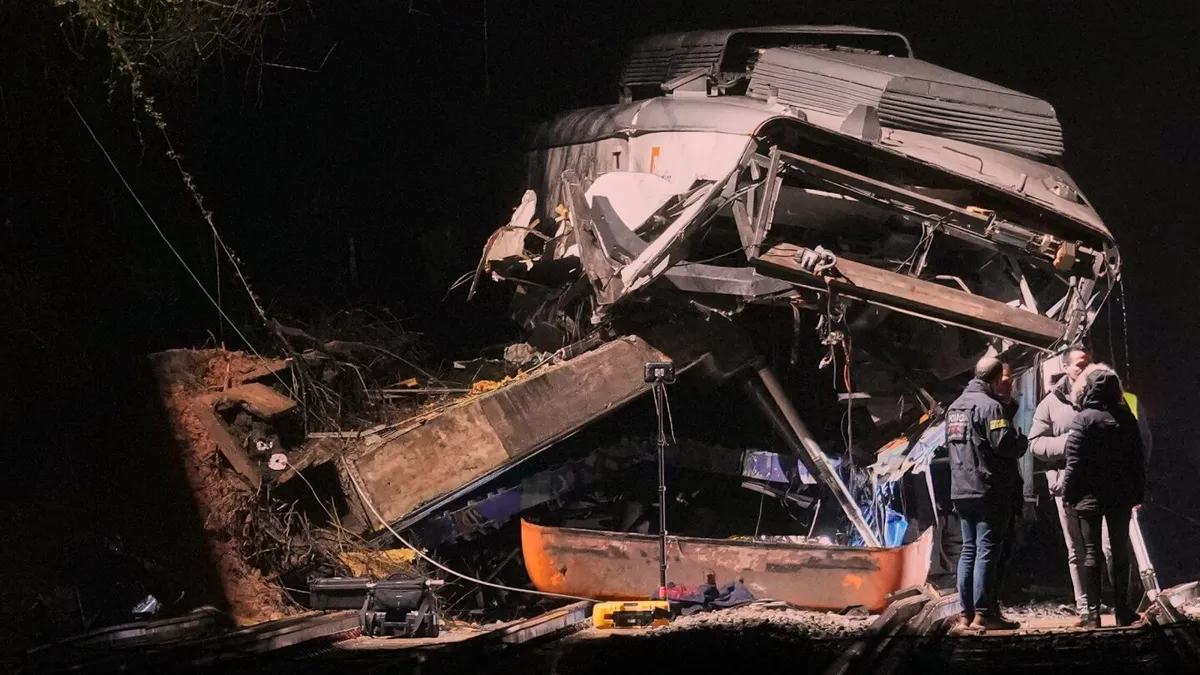
What to know about two fatal train crashes in Spain 1 of 5 | Emergency crews respond after a commuter train derailed when a retaining wall collapsed onto the tracks in Gelida, near Barcelona, Spain, Tuesday, Jan. 20, 2026. (AP Photo/Joan Mateu Parra) 2 of 5 | View of the site of a train collision in Adamuz, southern Spain, Tuesday, Jan. 20, 2026. (AP Photo/Manu Fernandez) 3 of 5 | View of the site of a train collision in Adamuz, southern Spain, Tuesday, Jan. 20, 2026. (AP Photo/Manu Fernandez) 4 of 5 | Emergency crews respond after a commuter train derailed when a retaining wall collapsed onto the tracks in Gelida, near Barcelona, Spain, Tuesday, Jan. 20, 2026. (AP Photo/Joan Mateu Parra) 5 of 5 | In this grab taken from video provided by Guardia Civil, rescue workers at the scene following a high-speed train collision, in Adamuz, Spain, Monday, Jan. 19, 2026. (Guardia Civil via AP) 1 of 5 Emergency crews respond after a commuter train derailed when a retaining wall collapsed onto the tracks in Gelida, near Barcelona, Spain, Tuesday, Jan. 20, 2026. (AP Photo/Joan Mateu Parra) Add AP News on Google Add AP News as your preferred source to see more of our stories on Google. 2 of 5 View of the site of a train collision in Adamuz, southern Spain, Tuesday, Jan. 20, 2026. (AP Photo/Manu Fernandez) Add AP News on Google Add AP News as your preferred source to see more of our stories on Google. 3 of 5 View of the site of a train collision in Adamuz, southern Spain, Tuesday, Jan. 20, 2026. (AP Photo/Manu Fernandez) Add AP News on Google Add AP News as your preferred source to see more of our stories on Google. 4 of 5 Emergency crews respond after a commuter train derailed when a retaining wall collapsed onto the tracks in Gelida, near Barcelona, Spain, Tuesday, Jan. 20, 2026. (AP Photo/Joan Mateu Parra) Add AP News on Google Add AP News as your preferred source to see more of our stories on Google. 5 of 5 In this grab taken from video provided by Guardia Civil, rescue workers at the scene following a high-speed train collision, in Adamuz, Spain, Monday, Jan. 19, 2026. (Guardia Civil via AP) Add AP News on Google Add AP News as your preferred source to see more of our stories on Google. Updated [hour]:[minute] [AMPM] [timezone], [monthFull] [day], [year] MADRID (AP) — Two fatal train crashes in two days have rocked Spain and the tragedies have led to questions about safety on the country’s railway system. The first crash involved a high-speed train in southern Spain that derailed on Sunday evening, colliding with another fast train, killing at least 43 people and injuring more than 150. The crash was the deadliest in Spain since a 2013 crash that killed 80 people when a commuter train in the northern region of Galicia hurtled off the rails as it came around a bend going too fast.On Tuesday night, another train crash happened in northeastern Spain on a commuter line near Barcelona. One person was killed.Here’s what to know about the two crashes. Derailment and collision The Sunday derailment happened at 7:45 p.m. when the tail end of a train carrying 289 passengers from Malaga to the capital, Madrid, went off the rails and slammed into an oncoming train traveling from Madrid to Huelva with around 200 people, according to rail operator Adif.The head of the second train took the brunt of the impact, Transport Minister Óscar Puente said. That collision knocked its first two carriages off the track and sent them plummeting down a four-meter (13-foot) slope. The collision took place near Adamuz, a town in the province of Cordoba, about 370 kilometers (about 230 miles) south of Madrid. “The impact was so incredibly violent that we have found bodies hundreds of meters away,” Andalusia’s regional President Juan Manuel Moreno said.Authorities said Wednesday they had identified almost all the victims from Sunday’s crash. Cause under investigationExplanations about what caused the crash were scant, with an official investigation underway.Álvaro Fernández, the president of national railway company Renfe, told Spanish public radio RNE that both trains were traveling well under the speed limit of 250 kph (155 mph) and “human error could be ruled out.”Transport Minister Puente called the crash “truly strange” since it happened on a flat stretch of track that had been renovated in May. But Puente said late Monday that officials had found a broken section of track.“Now we have to determine if that is a cause or a consequence (of the derailment),” Puente told Spanish radio station Cadena Ser.The train that jumped the track belonged to the private company Iryo, while the second train, which took the brunt of the impact, belonged to Renfe.Iryo said in a statement Monday that its train was manufactured in 2022 and passed its latest safety check on Jan. 15. The Spanish Union of Railway Drivers sent a letter last August asking Spain’s rail operator to investigate flaws on high-speed train lines across the country caused by increased traffic. It warned of potholes, bumps and imbalances in overhead power lines, as well as frequent breakdowns and damage to trains, according to a copy of the letter seen by The Associated Press.The union called for a general strike in the coming weeks to demand more safety assurances.High-speed expansionSpain has spent decades investing heavily in high-speed trains. It currently has the largest rail network in Europe for trains traveling more than 250 kph (155 mph), with more than 3,900 kilometers (2,400 miles) of track, according to the International Union of Railways.The network is a popular, competitively priced and safe mode of transport. Officials said that Sunday’s collision was the first with deaths on Spain’s high-speed rail network since it opened its first line in 1992. A Barcelona commuter train crashed Tuesday after a retaining wall fell onto the tracks, Spanish regional authorities said, killing one person and injuring at least 37 others.While Spain’s high-speed rail network generally runs smoothly, the commuter rail service is plagued by reliability issues. However, crashes causing injury or death are not common. Naishadham is an Associated Press reporter covering Spain and Portugal. She is based in Madrid.
SRCAssociated Press (AP)
LANGEN
LEANCenter
WORDS1 042
ENT8
THU · 2026-01-22 · 10:53 GMTBRIEF NSR-2026-0122-9597
NSR-2026-0122-9597News Report·EN·Human Interest
What to know about two fatal train crashes in Spain
Two train crashes in Spain on January 19th and 20th, 2026, are raising concerns about railway safety. The first incident involved a high-speed train collision in Adamuz, southern Spain.
By
SUMAN NAISHADHAMAssociated Press (AP)Filed 2026-01-22 · 10:53 GMTLean · CenterRead · 5 min
Associated Press (AP)FIG 01
Reading time
5min
Word count
1 042words
Sources cited
1cited
Entities identified
8entities
Quality score
100%
§ 01
Briefing Summary
AI-generatedNEWSAR · AI
Two train crashes in Spain on January 19th and 20th, 2026, are raising concerns about railway safety. The first incident involved a high-speed train collision in Adamuz, southern Spain. The second crash occurred in Gelida, near Barcelona, when a commuter train derailed after a retaining wall collapsed onto the tracks. Emergency crews responded to both scenes. The accidents have prompted questions about the safety protocols and infrastructure of Spain's railway system. Investigations are likely underway to determine the causes of both tragedies.
Confidence 0.90Sources 1Claims 5Entities 8
§ 02
Article analysis
Model · rule-basedFraming
Human Interest
Political Strategy
Tone
Measured
AI-assessed
CalmNeutralAlarmist
Factuality
0.80 / 1.00
Factual
LowHigh
Sources cited
1
Limited
FewMany
§ 03
Key claims
5 extracted01
One person was killed in the second train crash.
factualAP
Confidence
1.00
02
On Tuesday night, another train crash happened in northeastern Spain on a commuter line near Barcelona.
factualAP
Confidence
1.00
03
The first crash killed at least 43 people and injured more than 150.
factualAP
Confidence
1.00
04
The first crash involved a high-speed train in southern Spain that derailed on Sunday evening, colliding with another fast train.
factualAP
Confidence
1.00
05
Two fatal train crashes in two days have rocked Spain.
factualAP
Confidence
1.00
§ 04
Full report
5 min read · 1 042 words§ 05
Entities
8 identifiedKey playerOppositionContextPositiveNeutralNegative
§ 06
Keywords & salience
8 termstrain crashes
1.00
spain
0.90
fatal
0.70
derailment
0.60
high-speed train
0.60
retaining wall collapse
0.50
railway system
0.50
commuter train
0.40
§ 07
Topic connections
Interactive graph No topic relationship data available yet. This graph will appear once topic relationships have been computed.