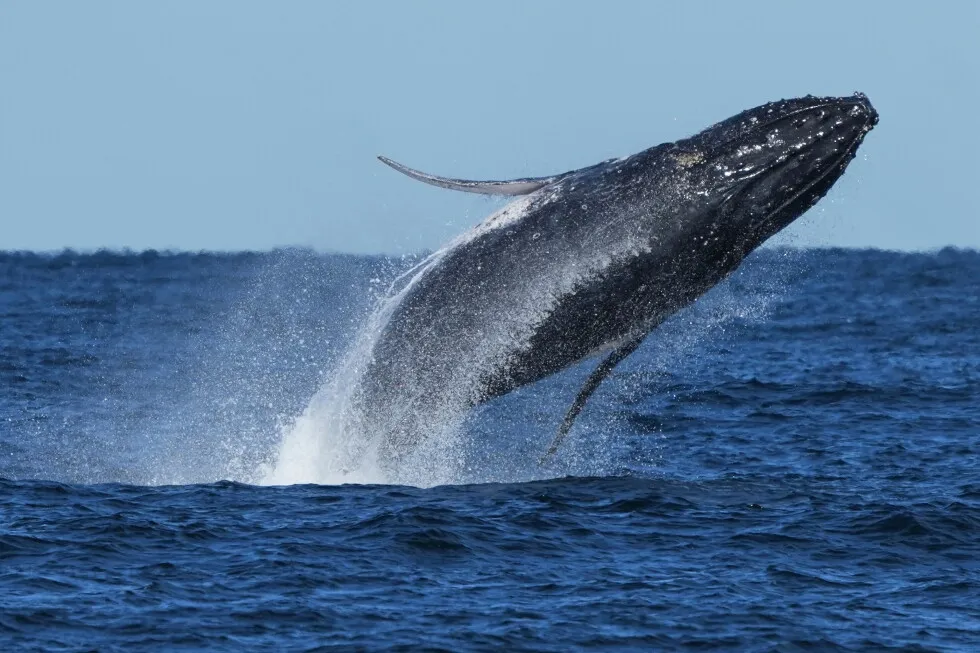
Whale ‘supergroups’ show numbers are rebounding from hunting. But Iran war holds dangers for them 1 of 6 | Caught on camera: a 300 strong Humpback whale supergroup gathering to feed 2 of 6 | A Humpback whale breaches off the coast of Port Stephens north of Sydney, Australia, June 18, 2025. (AP Photo/Mark Baker, File) 3 of 6 | Fine art wildlife photographer Chris Fallows looks out to sea from his boat near Hout Bay, in Cape Town, South Africa, July 12, 2026. (AP Photo/Neil Shaw) 4 of 6 | Humpback whales surface near a Humpback whale Project boat during monitoring off the coast of Rio de Janeiro, Brazil, Tuesday, June 30, 2026. (AP Photo/Dhavid Normando) 5 of 6 | A Humpback whale dives off the coast of Rio de Janeiro, Brazil, Tuesday, June 30, 2026. (AP Photo/Dhavid Normando) 6 of 6 | Humpback whales surface together in Bahia Solano, Colombia, Sunday, Aug. 27, 2023. (AP Photo/Ivan Valencia, File) 1 of 6 Caught on camera: a 300 strong Humpback whale supergroup gathering to feed Add AP News on Google Add AP News as your preferred source to see more of our stories on Google. Share 2 of 6 | A Humpback whale breaches off the coast of Port Stephens north of Sydney, Australia, June 18, 2025. (AP Photo/Mark Baker, File) 2 of 6 A Humpback whale breaches off the coast of Port Stephens north of Sydney, Australia, June 18, 2025. (AP Photo/Mark Baker, File) Add AP News on Google Add AP News as your preferred source to see more of our stories on Google. Share 3 of 6 | Fine art wildlife photographer Chris Fallows looks out to sea from his boat near Hout Bay, in Cape Town, South Africa, July 12, 2026. (AP Photo/Neil Shaw) 3 of 6 Fine art wildlife photographer Chris Fallows looks out to sea from his boat near Hout Bay, in Cape Town, South Africa, July 12, 2026. (AP Photo/Neil Shaw) Add AP News on Google Add AP News as your preferred source to see more of our stories on Google. Share 4 of 6 | Humpback whales surface near a Humpback whale Project boat during monitoring off the coast of Rio de Janeiro, Brazil, Tuesday, June 30, 2026. (AP Photo/Dhavid Normando) 4 of 6 Humpback whales surface near a Humpback whale Project boat during monitoring off the coast of Rio de Janeiro, Brazil, Tuesday, June 30, 2026. (AP Photo/Dhavid Normando) Add AP News on Google Add AP News as your preferred source to see more of our stories on Google. Share 5 of 6 | A Humpback whale dives off the coast of Rio de Janeiro, Brazil, Tuesday, June 30, 2026. (AP Photo/Dhavid Normando) 5 of 6 A Humpback whale dives off the coast of Rio de Janeiro, Brazil, Tuesday, June 30, 2026. (AP Photo/Dhavid Normando) Add AP News on Google Add AP News as your preferred source to see more of our stories on Google. Share 6 of 6 | Humpback whales surface together in Bahia Solano, Colombia, Sunday, Aug. 27, 2023. (AP Photo/Ivan Valencia, File) 6 of 6 Humpback whales surface together in Bahia Solano, Colombia, Sunday, Aug. 27, 2023. (AP Photo/Ivan Valencia, File) Add AP News on Google Add AP News as your preferred source to see more of our stories on Google. Share Updated [hour]:[minute] [AMPM] [timezone], [monthFull] [day], [year] Cape Town, South Africa (AP) — A South African couple found themselves in a rare situation when they witnessed a Humpback whale “supergroup” consisting of nearly 300 of the giant marine mammals gathering together.It’s an indication, scientists say, of how some whale species numbers have strongly rebounded in the southern hemisphere oceans decades after an international whale hunting ban came into effect in 1986.Chris and Monique Fallows said they were used to seeing bigger and bigger groups of humpback whales off the west coast of South Africa but weren’t prepared for what they saw one morning last December. Plumes of whale breath and spray burst into the air one after the other from blowholes, and the husband and wife found their boat in the midst of what’s known as a supergroup.“It was extraordinary,” said Chris Fallows, a renowned fine art wildlife photographer who has documented marine animals for 35 years. “Quite quickly we realized that there must be several hundred whales coming together in one particular area.” He said what they saw can best be described as a “Manhattan skyline” of whale breath plumes.Chris and Monique documented 299 humpback whales in the group, they said. They count whales by taking a photograph of their tail, which is called a fluke, said Monique Fallows, an author and naturalist. 1 MIN READ 1 MIN READ 3 MIN READ Each whale’s tail is different and it’s a common tactic used by scientists to identify individuals.It appears to be the biggest group of humpback whales sighted, according to Alex Vogel, the Africa coordinator for Happywhale. That organization has a global database of whales built off photos and information sent in largely by what it calls “citizen scientists” — ordinary people who capture images of whales that are then verified. The organization did a count of the group that the Fallows came across.Humpback numbers have strongly recovered in the southern hemisphere from less than 10,000 at the height of whaling to more than 100,000 whales now, according to assessments by scientists and the International Whaling Commission, which monitors whale numbers.Only a few countries still hunt whales commercially. Humpbacks are generally solitary or move in small pods, but they sometimes gather in supergroups in food-rich areas. They feed on krill or small fish.Sightings of humpbacks are also increasing in other parts of the Southern Hemisphere.Els Vermeulen, the chief scientist at the University of Pretoria’s Whale Unit in South Africa, said humpback supergroups started to be seen again around 2012 and it’s likely a result of their recovery from whaling.“In general, the moratorium on whaling can be classified as one of the strongest conservation success stories in the marine environment,” said Vermeulen, who has a doctorate in zoology.Vermeulen said that humpbacks feeding in supergroups make underwater sounds that attract other whales.While humpbacks have seen the biggest comeback from whaling, the World Wildlife Fund says the recovery has been mixed for other whale species and that various threats remain, like entanglement in commercial fishing equipment, collisions with ships and climate change. Seven out of the 14 great whale species are classified as endangered or vulnerable by the International Union for Conservation of Nature, including the critically endangered North Atlantic right whales, which number only around 380 now. Vermeulen also raised a new threat for whales around South Africa: the conflict in the Middle East. She said a recent preliminary assessment she co-authored showed that shipping around the southern point of Africa had quadrupled since December 2023 — after the Israel-Hamas war broke out and Yemen’s Houthi rebels began attacking ships in the Red Sea.That is being made worse by the Iran war and the security crisis over the Strait of Hormuz, diverting more ships around Africa.Because most whales killed by ships sink in the ocean there are no detailed statistics. But Gregg Oelofse, the coastal and environmental manager for the city of Cape Town, said more whales and more shipping clearly increase the risk.He said some whale carcasses wash ashore with evidence they’ve been killed by vessels. “We’ll see the propellor strike often through the whale’s body,” Oelofse said. “So, it’s like these big cuts in the whale’s body.”Vermeulen said she and others are lobbying for official speed limits for ships near the South African coast to give them time to spot any whales in their path.___Associated Press writer Gerald Imray contributed to this story.___AP Africa news: https://apnews.com/hub/africa
SRCAssociated Press (AP)
LANGEN
LEANCenter
WORDS1 291
ENT12
SUN · 2026-07-26 · 02:53 GMTBRIEF NSR-2026-0726-96019
NSR-2026-0726-96019News Report·EN·Environmental
Whale ‘supergroups’ show numbers are rebounding from hunting. But Iran war holds dangers for them
A recent sighting of a humpback whale "supergroup" of nearly 300 individuals off the coast of South Africa indicates a significant rebound in whale populations in the southern hemisphere, decades after a 1986 international hunting ban. Scientists attribute these large gatherings to the recovery of humpback numbers, which have increased from under 10,000 to over 100,000.
By
NEIL SHAWAssociated Press (AP)Filed 2026-07-26 · 02:53 GMTLean · CenterRead · 6 min
Associated Press (AP)FIG 01
Reading time
6min
Word count
1 291words
Sources cited
3cited
Entities identified
12entities
Quality score
100%
§ 01
Briefing Summary
AI-generatedNEWSAR · AI
A recent sighting of a humpback whale "supergroup" of nearly 300 individuals off the coast of South Africa indicates a significant rebound in whale populations in the southern hemisphere, decades after a 1986 international hunting ban. Scientists attribute these large gatherings to the recovery of humpback numbers, which have increased from under 10,000 to over 100,000. While this recovery is a conservation success, other whale species face mixed results and ongoing threats like entanglement and ship strikes. A new danger has emerged due to increased shipping traffic around Africa, driven by conflicts in the Middle East, raising the risk of collisions with whales.
Confidence 0.90Sources 3Claims 5Entities 12
§ 02
Article analysis
Model · rule-basedFraming
Environmental
Human Interest
Tone
Measured
AI-assessed
CalmNeutralAlarmist
Factuality
0.70 / 1.00
Factual
LowHigh
Sources cited
3
Well sourced
FewMany
§ 03
Key claims
5 extracted01
Humpback whales were observed in a 300-strong supergroup gathering to feed.
statistic
Confidence
0.95
02
Humpback whales are seen breaching off the coast of Port Stephens, Australia.
factual
Confidence
0.90
03
Whale 'supergroups' are observed, indicating a rebound from historical hunting.
factual
Confidence
0.90
04
The presence of whale 'supergroups' suggests a recovery in whale populations.
factual
Confidence
0.85
05
The Iran war poses dangers to these whale populations.
factual
Confidence
0.80
§ 04
Full report
6 min read · 1 291 words§ 05
Entities
12 identifiedKey playerOppositionContextPositiveNeutralNegative
People1
Locations10
§ 06
Keywords & salience
8 termswhale supergroups
1.00
humpback whales
0.90
rebounding populations
0.80
whaling impact
0.70
iran war
0.60
wildlife conservation
0.50
marine feeding
0.40
wildlife photography
0.40
§ 07
Topic connections
Interactive graph No topic relationship data available yet. This graph will appear once topic relationships have been computed.