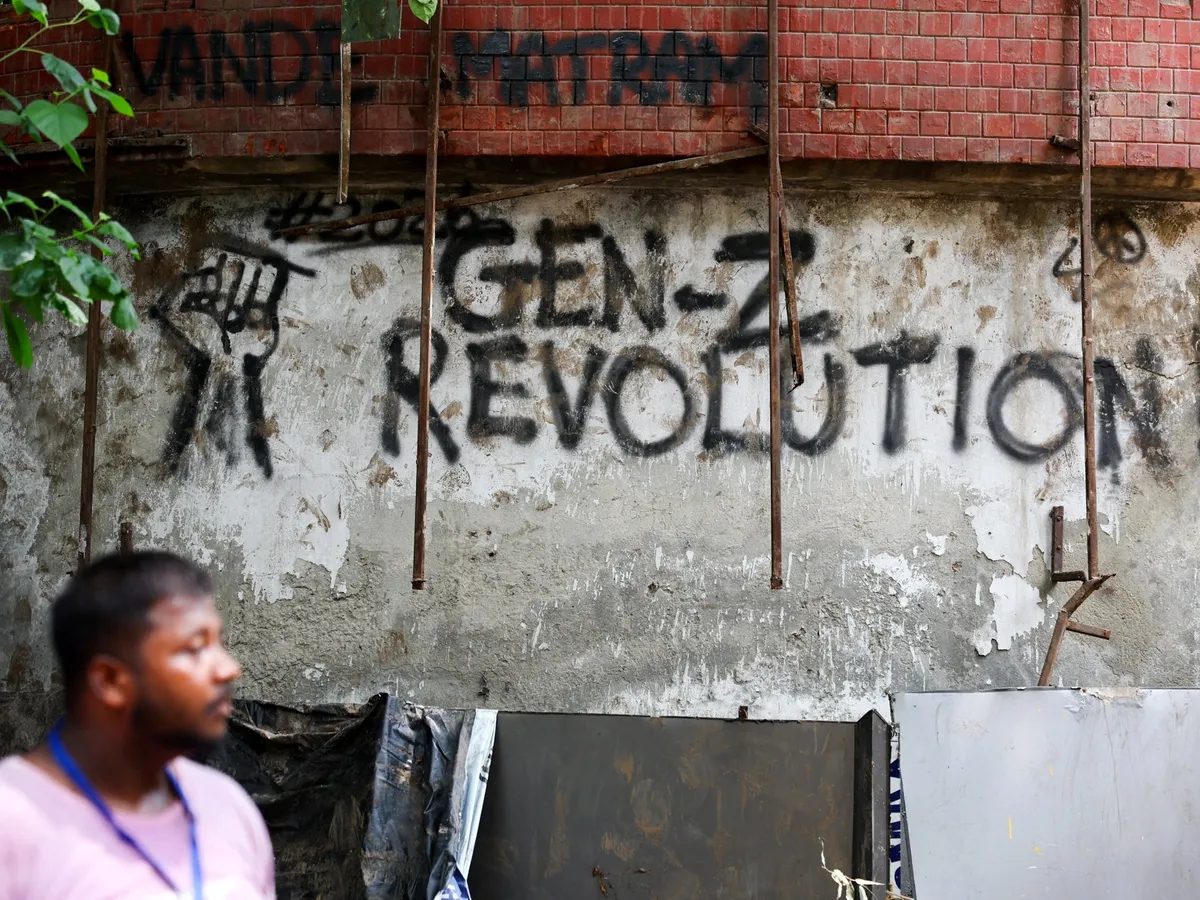
EXPLAINERThe weeks-long Gen Z-led protests forced a key Modi minister to resign. Where does the movement go from here?A graffiti on the wall as supporters of India's Cockroach Janta Party demonstrate, demanding the resignation of Education Minister Dharmendra Pradhan over exam paper leaks, in New Delhi, India, July 25, 2026 [Anushree Fadnavis/Reuters]Published On 26 Jul 2026New Delhi, India – Silence descended over Jantar Mantar and the adjoining Parliament Street in central New Delhi at midnight, hours after the Cockroach Janta Party (CJP) called off its agitation following the resignation of Education Minister Dharmendra Pradhan.Thousands of students and youth protesters had occupied the protest site near the Parliament of India, demanding education reforms, and posing one of the biggest challenges to Prime Minister Narendra Modi’s right-wing government.Recommended Stories list of 4 itemslist 1 of 4India’s ‘Cockroach’ youth call off protests after education minister quitslist 2 of 4‘We have done it’: Joy as ‘Cockroach’ protests push India minister outlist 3 of 4India’s youth protesters are fighting Modi with irreverent humour and memeslist 4 of 4The Cockroach Effect: Modi vs India’s Gen Zend of listPradhan’s resignation is being seen as a serious setback for the Bharatiya Janata Party (BJP)-led government and has further dented Modi’s strongman image, analysts told Al Jazeera.After the streets emptied, authorities moved in with paint rollers and buckets, scrubbing away the remnants of the Gen Z revolt from the walls around the Jantar Mantar.In his last words at the site on Saturday, Abhijeet Dipke, the CJP founder, said: “This is not the end. We will meet again soon.”So, what’s next for India’s youth protesters?CJP supporters celebrate after Education Minister Dharmendra Pradhan resigned following days of protests, in New Delhi, India, July 25, 2026 [Adnan Abidi/Reuters]What’s the status of protesters’ demands?While some demands from the protests came about and fizzled out in the last few weeks, two central demands remained: the resignation of Pradhan and compensation to the families of students who died by suicide due to paper leaks and exam cancellations that affected millions of students across India.CompensationIn a joint news conference on Saturday, where CJP spokespeople sat next to senior ministers, the government agreed to provide compensation, “whatever maximum possible” under the rules.The protesters have demanded 10 million rupees (approximately $105,000) each for about 20 such families.Criminal casesAfter the police cracked down on protesters marching to the Parliament on July 20, injuring more than 100 demonstrators, the CJP movement garnered an outpouring of countrywide support.The CJP then added two more demands: no criminal case to be pursued against any protester or organiser of the agitation; and an apology from Delhi Police and the Rapid Action Force, a paramilitary force, for the crackdown.The government assured the CJP that no criminal cases would be pursued against the protesters in states governed by the BJP and that all existing cases would be withdrawn.However, there has been a spate of arrests in several BJP-ruled states in eastern India.At least 11 people, 10 of them Muslim, have been arrested and seven criminal cases filed against them in West Bengal, according to media reports. In northeast India’s Assam, six people, most of them Muslims, have been arrested for trying to hold a demonstration in solidarity with Jantar Mantar protesters. In Bihar, three protesters were injured after police opened fire on demonstrators on Saturday.Police apologyThere were no comments on the CJP’s demands for public apology from the government forces as the government ministers and the CJP leaders shook hands to call off the protests.However, in the days following the reported police excess on July 20, CJP leaders have repeatedly said they would “drag all the policemen to the court for attacking students like goons”, after identifying them from the video footage from the crackdown, recorded by the protesters.Left to right, federal ministers Jitendra Singh and JP Nadda, with CJP leaders Saurav Das and Ashutosh Ranka at a news conference in New Delhi, July 25, 2026 [Bhawika Chhabra/Reuters]Where does the Cockroach movement go from here?The CJP has been avoiding a clear answer to how the movement intends to chart its future path.The group emerged in May this year after Dipke casually asked on X: “What if all cockroaches come together?” It was a dig at India’s top judge who remarked that unemployed youth were like “cockroaches” and “parasites”.Analysts point to Dipke being a Dalit – a community of the former “untouchables” who have been historically persecuted under India’s complex caste hierarchy – as a crucial arc to follow in the coming months.After anchoring the protests to oust the education minister, CJP leaders told the demonstrators in New Delhi “they shall meet again soon”.The group’s spokespeople say there is no clarity yet on whether the movement wants to get into electoral politics.“We are resting and regrouping on what’s next for us,” Sudhir Sangwan, a CJP member, told Al Jazeera on Sunday. “The idea going forward is to put our weight behind one issue at a time. We want to take this movement to the grassroots.”Celebrations after Pradhan’s resignation at Jantar Mantar, New Delhi, July 25, 2026 [Priyanshu Singh/Reuters]CJP spokeswoman Vaishnavi Gaur said the group would move beyond education as its focus. “We’re going to be broader in our agenda.”She said the group will meet common people and members of civil society to understand crucial issues and explore their solutions. “We want to have townhall-like situations,” she told Al Jazeera. “This is a rough direction chalked out for ourselves.”The 29-year-old said the Cockroach movement is barely two months old, and “none of us has gotten adequate time to make agendas with deadlines”.“But we know this is not the end of it,” she said. “To convert the CJP into a political party is a big decision. We want to build on our capabilities and take it slow.”Asim Ali, a New Delhi-based political analyst, said the CJP has “not been very transparent about their roadmap, and it could be because they might not have one”.“These leaders do not have a political background and are rather from communications. I do not see any confrontation [with the government] in the offing immediately,” he told Al Jazeera.What is India’s opposition saying?Rahul Gandhi, the leader of India’s main opposition Indian National Congress, says his party will push Modi for an apology for the use of force on the protesting students on July 20 in New Delhi in Parliament.In a social media post, he called for “action against those guilty of violence against [the] students”.The opposition parties have also cornered Home Minister Amit Shah, Modi’s closest aide who commands the police in New Delhi. They even called for the resignations of both the leaders.“Our students were demanding a fair and accountable education system. Instead of being heard, security forces assaulted them with indiscriminate force, including lethal weapons and tear gas,” Gandhi wrote in a letter to Shah on Sunday.On Saturday, Gandhi addressed a news conference with Neha Bora, a doctoral student and president of the All India Students Association (AISA), the student wing of the Communist Party of India (Marxist-Leninist).She sat on a hunger strike with activist Sonam Wangchuk at the Jantar Mantar, where she received widespread attention for her fiery speeches.Bora said Pradhan moving to another ministry “will be acceptable”.“There must also be accountability for the violence that took place on [July] 20th. The [Delhi] commissioner of police and the home minister must also be held accountable.”Akhilesh Yadav, a parliamentarian from the opposition Samajwadi Party, called Pradhan’s resignation a “major victory for the new generation” and hailed the youth protesters for taking on the Modi government.“People from all political parties should learn from this that in the future, the examinations will have to be strengthened so that no papers are leaked and avenues for employment and jobs will have to be opened for the youth,” he said.
SRCAl Jazeera
LANGEN
LEANCenter
WORDS1 293
ENT10
SUN · 2026-07-26 · 13:15 GMTBRIEF NSR-2026-0726-96104
NSR-2026-0726-96104News Report·EN·Social Justice
What next for India’s ‘Cockroach’ movement after education minister sacked
India's "Cockroach" youth movement, led by the Cockroach Janta Party (CJP), has called off its weeks-long protests in New Delhi following the resignation of Education Minister Dharmendra Pradhan. The protests, which began in May, were primarily driven by student anger over exam paper leaks and cancellations that affected millions.
Yashraj SharmaAl JazeeraFiled 2026-07-26 · 13:15 GMTLean · CenterRead · 6 min
Al JazeeraFIG 01
Reading time
6min
Word count
1 293words
Sources cited
2cited
Entities identified
10entities
Quality score
100%
§ 01
Briefing Summary
AI-generatedNEWSAR · AI
India's "Cockroach" youth movement, led by the Cockroach Janta Party (CJP), has called off its weeks-long protests in New Delhi following the resignation of Education Minister Dharmendra Pradhan. The protests, which began in May, were primarily driven by student anger over exam paper leaks and cancellations that affected millions. Key demands included Pradhan's resignation, compensation for affected families, and the withdrawal of criminal cases against protesters. While the government agreed to compensation and assured that cases would be withdrawn in BJP-ruled states, reports indicate arrests and new cases have occurred in some regions. The CJP, founded by Abhijeet Dipke, emerged as a significant challenge to the Modi government, using irreverent humor and memes. The movement's future remains uncertain, though leaders have stated they will "meet again soon."
Confidence 0.90Sources 2Claims 5Entities 10
§ 02
Article analysis
Model · rule-basedFraming
Social Justice
Political Strategy
Tone
Mixed Tone
AI-assessed
CalmNeutralAlarmist
Factuality
0.70 / 1.00
Factual
LowHigh
Sources cited
2
Limited
FewMany
§ 03
Key claims
5 extracted01
The Cockroach Janta Party (CJP) called off its agitation after the minister's resignation.
factualarticle
Confidence
0.90
02
Gen Z-led protests forced India's Education Minister Dharmendra Pradhan to resign.
factualarticle
Confidence
0.90
03
The CJP demanded no criminal cases be pursued against protesters and an apology from police forces.
factualarticle
Confidence
0.80
04
The government agreed to provide compensation to families of students who died by suicide due to paper leaks.
factualarticle
Confidence
0.80
05
Pradhan’s resignation is seen as a setback for the BJP-led government and dents Modi’s strongman image.
quoteanalysts
Confidence
0.70
§ 04
Full report
6 min read · 1 293 words§ 05
Entities
10 identifiedKey playerOppositionContextPositiveNeutralNegative
People3
Organizations4
§ 06
Keywords & salience
9 termsgen z protests
1.00
education reforms
0.90
exam paper leaks
0.90
student suicides
0.80
minister resignation
0.80
youth movement
0.70
modi government
0.60
protest movement
0.50
compensation
0.40
§ 07
Topic connections
Interactive graph Network visualization showing 39 related topics
View Full Graph Person Organization Location Event|Click node to navigate|Edge numbers = shared articles