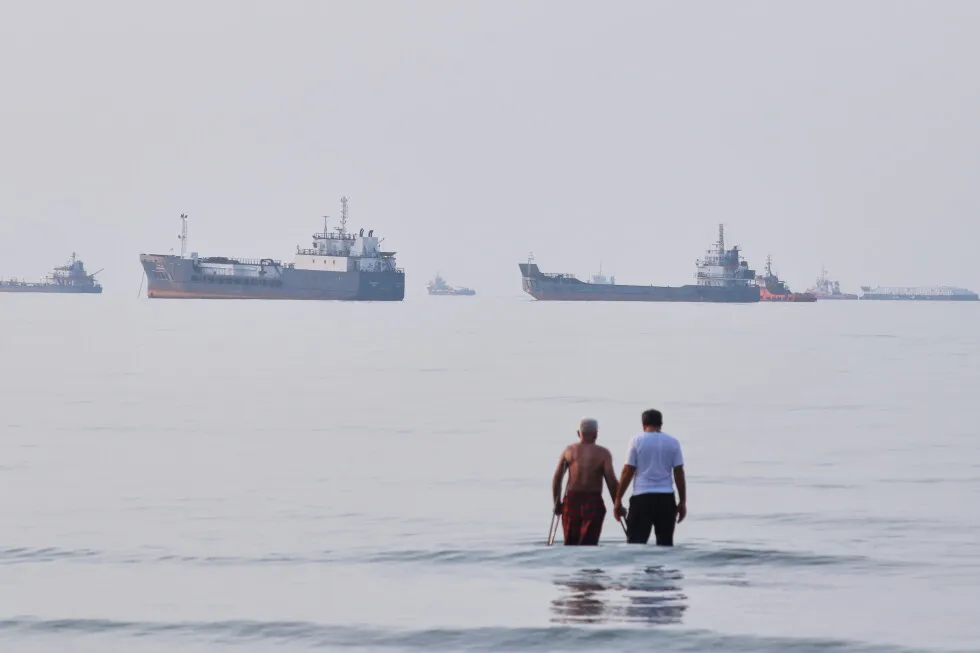
US pauses attacks on Iran for a second straight day and Tehran does too 0 seconds of 38 secondsVolume 0% Press shift question mark to access a list of keyboard shortcuts Keyboard ShortcutsEnabledDisabled Shortcuts Open/Close/ or ? Play/PauseSPACE Increase Volume↑ Decrease Volume↓ Seek Forward→ Seek Backward← Captions On/Offc Fullscreen/Exit Fullscreenf Mute/Unmutem Decrease Caption Size- Increase Caption Size+ or = Seek %0-9 00:00 00:38 00:38 More Videos 01:07 OpenAI says its AI technology acted on its own in an ‘unprecedented’ hack of another company 01:05 EU slaps Google with US$1 billion fine for breaches of digital rule book over Google Play and search 01:12 SpaceX launches Starship on another test flight, this time with the most advanced Starlinks 01:19 Larry the cat to welcome another PM to Downing Street 01:03 UN warns Middle East tensions threaten vital regional trade routes 00:35 ASEAN ministers joined by high-profile visitors in Manila 01:00 AP top stories July 23 00:30 Italian border police celebrate seizure of massive haul of high-purity cocaine Close 1 of 5 | The U.S. military says it has fired on a merchant vessel attempting to breach its blockade of Iranian ports. It’s the second commercial ship to be disabled since the military reimposed its blockade in the Strait of Hormuz. 2 of 5 | Two men wade in the waters of the Strait of Hormuz with vessels anchored in the background, off Bandar Abbas, Iran, Sunday, July 12, 2026. (Razieh Poudat/ISNA via AP) 3 of 5 | People walk through the village of Zawtar al-Gharbiyeh after the Lebanese army deployed to the village in southern Lebanon, Sunday, July 26, 2026. (AP Photo/Ahmad Mantash) 4 of 5 | A Lebanese soldier looks through the binoculars of an anti-tank launcher in front of a destroyed mosque after deploying in the village of Zawtar al-Gharbiyeh, southern Lebanon, Sunday, July 26, 2026. (AP Photo/Ahmad Mantash) 5 of 5 | A Lebanese woman clears debris of her destroyed house in the village of Zawtar al-Gharbiyeh, southern Lebanon, Sunday, July 26, 2026. (AP Photo/Ahmad Mantash) By Samy Magdy and Cara Anna Updated 4:57 PM MESZ, July 26, 2026 Add AP News on Google Add AP News as your preferred source to see more of our stories on Google. Share Share Facebook Copy Link copied Print Email X LinkedIn Bluesky Flipboard Pinterest Reddit CAIRO (AP) — The United States paused its attacks on Iran for a second straight day Sunday and Tehran said it had done so too, as efforts continued to bring the countries back to negotiations on an interim ceasefire deal largely undermined by recent exchanges of fire. It was not clear why the U.S. has paused after targeting Iranian coastal areas and infrastructure in a nearly two-week escalation sparked by Iran’s firing at ships trying to transit the Strait of Hormuz. The Pentagon did not immediately respond to questions Sunday. “President (Donald) Trump has always been consistent in saying he prefers a diplomatic solution, but he continues to retain all options if Iran continues terrorist activities in the Strait of Hormuz or against allies,” White House communications director Steven Cheung said, adding: “It would be wise for Iran to work toward a negotiated deal. Otherwise, they know what will happen.” Since the U.S. has halted attacks for the past two nights, Iran has as well, its army spokesperson told Iran’s state TV on Sunday. Tehran in recent days has counterattacked against countries in the region hosting U.S. military forces, killing at least three at a base in Jordan. A regional official calls the pause a ‘positive signal’ The 60-day period that began when the interim deal was signed by both countries in mid-June is now well into its second half, and major issues that were meant to be negotiated -– notably Iran’s nuclear program at the heart of tensions -– remain set aside as mediators try to keep both sides talking. A regional official involved in mediation efforts said diplomacy was underway and that a pause in U.S. and Iranian strikes was a “positive signal that helps their efforts to de-escalate.” US and Iran exchange intensifying fire across Mideast, threatening ceasefire deal 2 MIN READ US demands Iran publicly state that Strait of Hormuz is open and Tehran won’t attack ships anymore 3 MIN READ 40 US military says it is striking Iran in response to attack on civilian vessel in Strait of Hormuz 3 MIN READ 40 The official said both countries want to return to the interim ceasefire deal and that a compromise being negotiated centers on having Iran run vessel transit through the Strait of Hormuz with fewer restrictions on ships. The official was not authorized to discuss the matter and spoke on condition of anonymity. Concerns continued about shipping on the strait and now on another crucial waterway in the region, the Bab al-Mandeb strait to the Red Sea. Iranian-backed Houthi rebels in Yemen last week threatened a blockade of Saudi shipping there. Global energy supplies and the economy remain in the balance as gasoline prices have risen again. Iran on Sunday said it continued to speak with Oman about managing the safe passage of ships on the Strait of Hormuz, which passes between the countries. Iran’s Foreign Ministry spokesperson, Esmail Baghaei, said talks had made progress and continued. Baghaei also said the strait’s status remained unchanged. Tehran has asserted that the interim deal with the U.S. allows it to manage shipping on the waterway for now, and it has objected to U.S. efforts to support a route through the strait that passes close to Oman instead. The U.S. military on Saturday said its recently reimposed naval blockade against Iran continued, with a dozen commercial ships redirected, two disabled and two boarded. U.S. forces “remain highly vigilant, focused, lethal, and ready,” it added. Meanwhile, Israeli Prime Minister Benjamin Netanyahu plans to travel to the United States and meet with Trump in Washington on Tuesday, his office has said. They last met in Washington in February, weeks before they launched the war on Iran that killed senior leaders including Supreme Leader Ayatollah Ali Khamenei. The Iranian-backed Hezbollah fired at Israel two days after the war began, and Israel responded with airstrikes and ground forces in southern Lebanon. Since then, the U.S. has supported landmark direct talks between Lebanon and Israel to try to calm that front and find a way to disarm Hezbollah. Netanyahu on Sunday told Fox News he “fully” backs Trump’s efforts to weaken Iran and press it to end its nuclear program, adding: “If he can do so without returning to intense military fighting, that’s fine. Why not?” The prime minister indicated he would not present new information to “our good friend” Trump and instead would listen to “what he has in mind, because I think in many ways, it’s his decision.” But Netanyahu warned that if Iran again attacks Israel, directly or with armed proxies, “it will make a terrible mistake.” Anna reported from Lowville, New York. Associated Press writers Darlene Superville and Ben Finley in Washington contributed. Samy Magdy Magdy is a Middle East reporter for The Associated Press, based in Cairo. He focuses on conflict, migration and human rights abuses. twitter facebook mailto Cara Anna Anna is an editor on the AP’s Global Desk. She has reported from Africa, China, Ukraine, Afghanistan and the United Nations. mailto
SRCAssociated Press (AP)
LANGEN
LEANCenter
WORDS1 221
ENT12
SUN · 2026-07-26 · 14:53 GMTBRIEF NSR-2026-0726-96133
NSR-2026-0726-96133News Report·EN·Diplomatic
US pauses attacks on Iran for a second straight day and Tehran pauses, too
The United States has paused its attacks on Iran for a second consecutive day, and Iran has reciprocated, as diplomatic efforts continue to revive an interim ceasefire deal. This de-escalation follows a nearly two-week escalation triggered by Iran firing on ships in the Strait of Hormuz.
Associated Press (AP)Filed 2026-07-26 · 14:53 GMTLean · CenterRead · 5 min
Associated Press (AP)FIG 01
Reading time
5min
Word count
1 221words
Sources cited
2cited
Entities identified
12entities
Quality score
100%
§ 01
Briefing Summary
AI-generatedNEWSAR · AI
The United States has paused its attacks on Iran for a second consecutive day, and Iran has reciprocated, as diplomatic efforts continue to revive an interim ceasefire deal. This de-escalation follows a nearly two-week escalation triggered by Iran firing on ships in the Strait of Hormuz. The White House stated President Trump prefers a diplomatic solution but retains other options if Iran continues hostile activities. Iran's army spokesperson confirmed their pause in attacks, noting recent counterattacks against countries hosting U.S. forces, including an incident in Jordan. Mediators are working to bring both nations back to negotiations, with concerns remaining over shipping safety in the Strait of Hormuz and the Bab al-Mandeb strait.
Confidence 0.90Sources 2Claims 4Entities 12
§ 02
Article analysis
Model · rule-basedFraming
Diplomatic
Conflict
Tone
Measured
AI-assessed
CalmNeutralAlarmist
Factuality
0.70 / 1.00
Factual
LowHigh
Sources cited
2
Limited
FewMany
§ 03
Key claims
4 extracted01
President Trump has always been consistent in saying he prefers a diplomatic solution.
quotePresident Trump (quoted)
Confidence
0.95
02
The United States paused its attacks on Iran for a second straight day Sunday.
factualAP News
Confidence
0.90
03
The U.S. military says it has fired on a merchant vessel attempting to breach its blockade of Iranian ports.
factualU.S. military
Confidence
0.85
04
Tehran also stated it had paused its attacks on the second day.
factualAP News
Confidence
0.80
§ 04
Full report
5 min read · 1 221 words§ 05
Entities
12 identifiedKey playerOppositionContextPositiveNeutralNegative
Organizations3
Locations6
§ 06
Keywords & salience
7 termsus attacks on iran
1.00
strait of hormuz
0.90
blockade
0.80
merchant vessel
0.70
tehran
0.60
middle east tensions
0.50
regional trade routes
0.40
§ 07
Topic connections
Interactive graph Network visualization showing 51 related topics
View Full Graph Person Organization Location Event|Click node to navigate|Edge numbers = shared articles