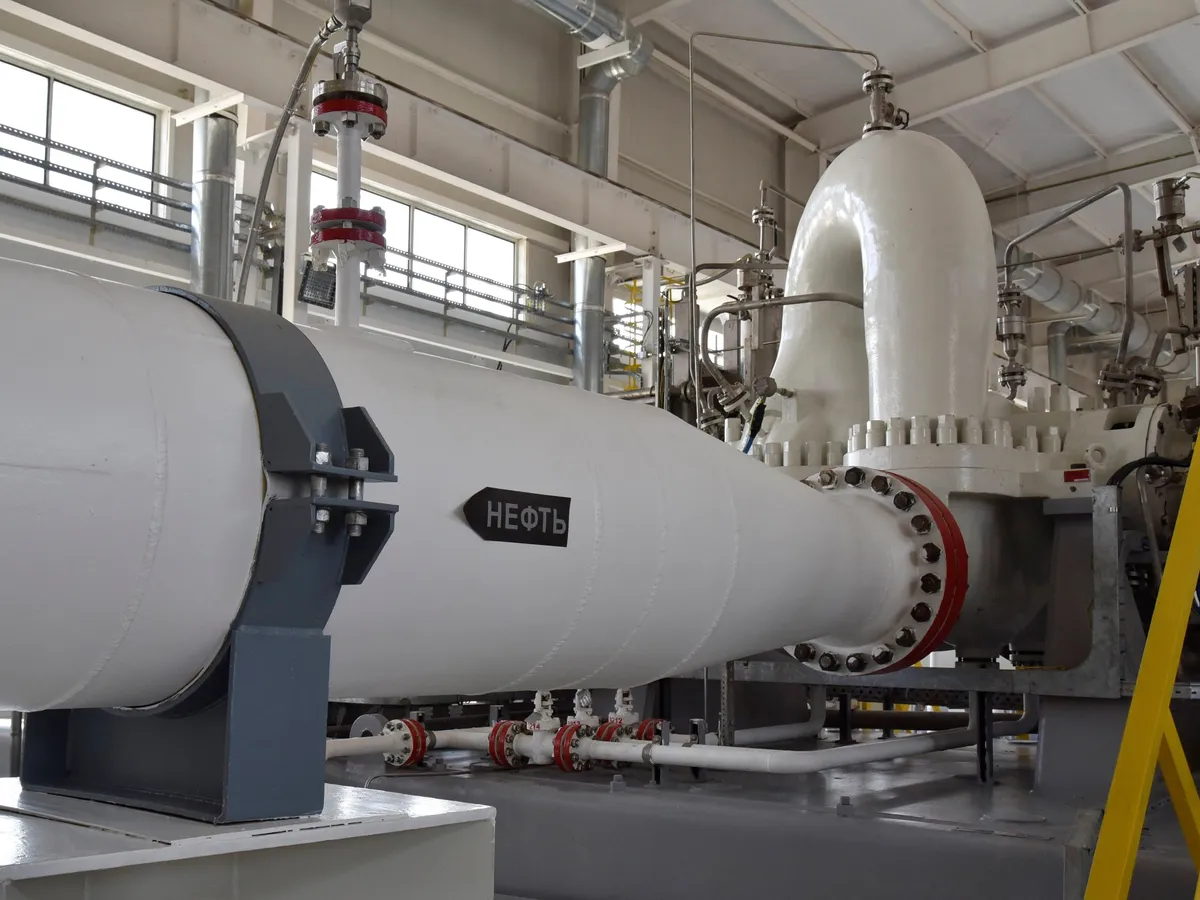
Kazakh oil exports halt after drone attacks disrupt supplies, posing risks to the economy and energy markets.An interior view shows a pumping station of the Caspian Pipeline Consortium, which accounts for about 80 percent of Kazakhstan's oil exports [File: Mariya Gordeyeva/Reuters]Published On 26 Jul 2026Sitting next to Russian leader Vladimir Putin, Kazakhstan’s President Kassym-Jomart Tokayev on Saturday cautiously weighed in on the Russia-Ukraine-war" class="entity-link entity-event" data-entity-id="1200" data-entity-type="event">Russia-Ukraine war, now in its fifth year.“If I may offer my humble opinion … perhaps it is time to freeze this conflict and return to the Istanbul formula 2.0,” he told reporters in the Siberian city of Omsk.Recommended Stories list of 3 itemslist 1 of 3At least 15 killed in Ukrainian and Russian strikes as holiday camp hitlist 2 of 3Ukraine war: Is Kazakhstan going cool on Russia?list 3 of 3Iran accuses Ukraine of deadly attack on Caspian commercial vesselend of listTokayev was referring to a botched agreement that envisaged an immediate suspension of hostilities along the existing front line and further talks brokered by Western powers.After Russia’s full-scale invasion of Ukraine in 2022, Moscow ally Tokayev dared to contradict Putin by emphasising that Kazakhstan would not recognise occupied Ukrainian regions as part of Russia.But this time, he praised Putin’s “diplomatic flexibility” and named Russia among the “great powers” that could guarantee peace in Ukraine.“All of this should be stopped, because what’s happening plays into the hands of the enemies of Russia and the Ukrainian people,” said Tokayev.Kazakhstan’s President Kassym-Jomart Tokayev. left, and Russian counterpartVladimir Putin speak at they attend the 22nd Russia-Kazakhstan Forum of Interregional Cooperation in Omsk on July 25 [AFP]His comments came as Kazakhstan, a country boasting several “supergiant” oil fields that serve as the European Union’s second-largest source of crude, said on Thursday that it had slashed oil production after drone attacks blamed on Ukraine forced its main export terminal on the Black Sea to shut down.Light but “sour”, or hard to process, Kazakhstan’s crude is known as the CPC brand, named after the Caspian Pipeline Consortium that includes Western energy giants such as Chevron, ExxonMobil and Shell.The pipeline that pumps the crude westwards across the bone-dry steppes is 1,500km (932 miles) long and ends in the Russian Black Sea port of Novorossiysk.The port is said to have become the new hideout for Russia’s Black Sea Fleet that fled the annexed Crimea Peninsula after hundreds of Ukrainian attacks by aerial and sea drones and missiles following the start of the war.Novorossiisk is also the target of Ukraine’s new policy of striking Moscow’s “shadow fleet” of tankers that ship Russian oil despite Western sanctions.In recent weeks, Ukrainian drones have hit almost 200 “shadow fleet” vessels, including tankers and dry cargo ships, in the Sea of Azov and the Black Sea.Drone attacks that Kazakhstan blames on Ukraine have also struck several tankers with CPC oil and damaged the consortium’s marine terminal in Novorossiysk.‘Unacceptable encroachment’The attacks, which began in November 2025 but intensified this month, prompted an angry response from officials in Kazakhstan’s capital, Astana.In a statement on July 19, the Foreign Ministry called them an “unacceptable encroachment” on Kazakhstan’s economic interests, saying they were designed to “destabilise legitimate international trade, world energy markets, and the security of global transport and logistics supply chains”.A day later, Ukraine’s Ambassador to Kazakhstan Viktor Mayko retorted by saying that there was “no proof” that the drones were Ukrainian and that Astana should refrain from “hasty and ungrounded accusations”.By Thursday, the CPC “temporarily suspended” oil shipments – and would only renew them after “the situation is normalised”, the Kazakh Energy Ministry said.With oil and gas accounting for about a fifth of its gross domestic product, Kazakhstan is rightly concerned as 80 percent of its oil exports are at risk.“This is a direct strike on the economy and budget,” regional expert Daniil Kislov told Al Jazeera.To some average Kazakhs worried about galloping inflation and rising prices, the disruption of oil exports seems like the least of their worries – just like the Russia-Ukraine-war" class="entity-link entity-event" data-entity-id="1200" data-entity-type="event">Russia-Ukraine war that triggered it.“I don’t care, because the money doesn’t reach me anyway,” Alzhas, a bank clerk in Almaty, Kazakhstan’s business capital, told Al Jazeera, withholding his last name because of security concerns.He said that people around him “stopped talking, arguing about the war, since there’s only one question about how to earn money for food, and the rest about Russia and Ukraine is irrelevant”.EU member states that largely depend on Kazakh crude are also concerned.Romania tops the list, getting more than 60 percent of its crude from Kazakhstan and then processing it domestically.Interim Prime Minister Ilie Bolojan on Thursday tried to dissuade Romanians from panicking, saying the government did not expect “there to be any supply problems”. He added, however, that a drop in gasoline production of up to 15 percent is expected if Kazakhstan does not resume shipments.Experts say the long-term outlook, especially for Kazakhstan, is bleak.Kyiv-based analyst Aleksey Kusch said that if the disruptions go on, more Kazakh oil will have to be directed at a higher cost to a pipeline that crosses the Caspian into Azerbaijan – and this could eventually lead to the “loss of oil revenues”.Volodymyr Fesenko, head of the Kyiv-based Penta think tank, described the situation as “uneasy and controversial”, noting that there might be “informal pressure” on Ukraine from the White House since US oil companies have stakes in the Kazakh oil fields.There could be “persistent recommendations to Ukrainian President [Volodomyr] Zelenskyy not to touch this very terminal in Novorossiisk,” he said, predicting, however, that there would not be “any cardinal, fatal, negative consequences” for Kyiv.“They will try to solve it behind closed doors, unofficially,” he said.And by some accounts, the US did step in.Chevron Chief Executive Mike Wirth approached White House officials earlier this week to solve the matter, the Wall Street Journal reported on Friday.An unnamed US official told the Journal that the administration of US President Donald Trump warned Ukraine against attacking non-Russian ships in the Black Sea.
SRCAl Jazeera
LANGEN
LEANCenter
WORDS990
ENT12
SUN · 2026-07-26 · 17:13 GMTBRIEF NSR-2026-0726-96168
NSR-2026-0726-96168News Report·EN·Economic Impact
‘Freeze the conflict’: Drones slow Kazakh oil flow amid Russia-Ukraine war
Kazakhstan has temporarily suspended oil exports after drone attacks disrupted supplies at its main Black Sea terminal in Novorossiysk. These attacks, which Kazakhstan blames on Ukraine, have halted about 80 percent of the country's oil exports, impacting its economy and global energy markets.
Mansur MirovalevAl JazeeraFiled 2026-07-26 · 17:13 GMTLean · CenterRead · 4 min
Al JazeeraFIG 01
Reading time
4min
Word count
990words
Sources cited
3cited
Entities identified
12entities
Quality score
100%
§ 01
Briefing Summary
AI-generatedNEWSAR · AI
Kazakhstan has temporarily suspended oil exports after drone attacks disrupted supplies at its main Black Sea terminal in Novorossiysk. These attacks, which Kazakhstan blames on Ukraine, have halted about 80 percent of the country's oil exports, impacting its economy and global energy markets. President Kassym-Jomart Tokayev, while calling for a ceasefire in the Russia-Ukraine war, also expressed concern over the disruptions. Ukraine denies responsibility for the drone attacks. The Caspian Pipeline Consortium, responsible for transporting Kazakh crude, has ceased shipments until the situation normalizes, affecting countries like Romania that rely on Kazakh oil.
Confidence 0.90Sources 3Claims 5Entities 12
§ 02
Article analysis
Model · rule-basedFraming
Economic Impact
Diplomatic
Tone
Mixed Tone
AI-assessed
CalmNeutralAlarmist
Factuality
0.70 / 1.00
Factual
LowHigh
Sources cited
3
Well sourced
FewMany
§ 03
Key claims
5 extracted01
Kazakhstan's President Kassym-Jomart Tokayev suggested freezing the Russia-Ukraine conflict and returning to the 'Istanbul formula 2.0'.
quoteKazakhstan's President Kassym-Jomart Tokayev
Confidence
1.00
02
The Caspian Pipeline Consortium accounts for about 80 percent of Kazakhstan's oil exports.
statistic
Confidence
0.95
03
Kazakh oil exports have halted due to drone attacks disrupting supplies.
factual
Confidence
0.90
04
Kazakhstan blames Ukraine for drone attacks that forced its main export terminal on the Black Sea to shut down.
factualKazakhstan
Confidence
0.85
05
Ukraine has adopted a new policy of striking Moscow’s “shadow fleet” of tankers.
factual
Confidence
0.80
§ 04
Full report
4 min read · 990 words§ 05
Entities
12 identifiedKey playerOppositionContextPositiveNeutralNegative
Organizations4
Locations5
§ 06
Keywords & salience
9 termskazakh oil exports
1.00
russia-ukraine war
1.00
drone attacks
0.90
energy markets
0.80
caspian pipeline consortium
0.70
freeze the conflict
0.60
istanbul formula 2.0
0.50
kazakhstan's president
0.50
crude oil
0.40
§ 07
Topic connections
Interactive graph Network visualization showing 51 related topics
View Full Graph Person Organization Location Event|Click node to navigate|Edge numbers = shared articles