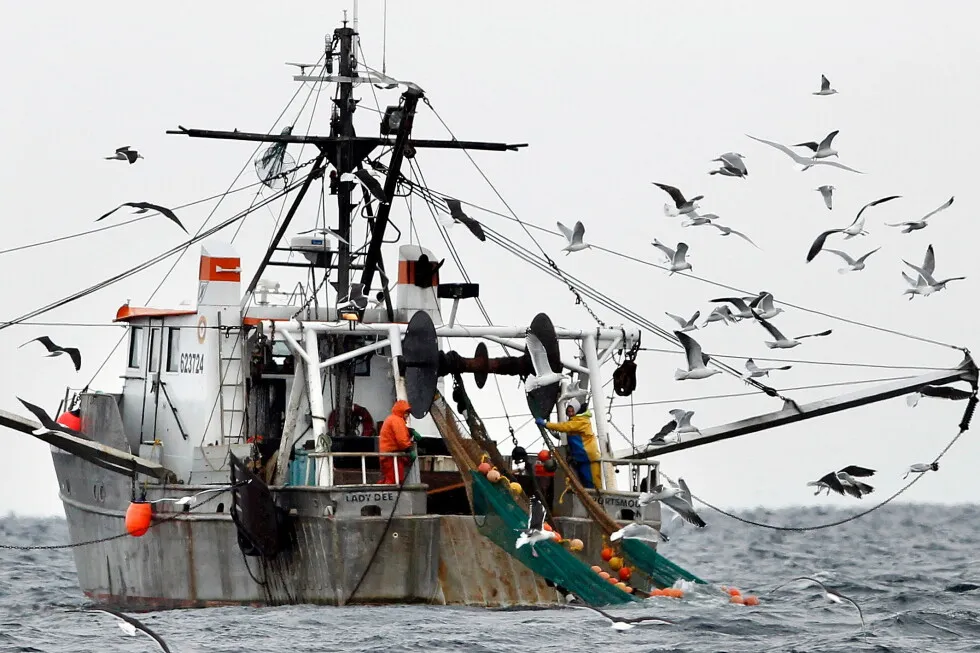
Gulls follow a shrimp fishing boat as crewmen haul in their catch in the Maine" class="entity-link entity-location" data-entity-id="42003" data-entity-type="location">Gulf of Maine, Jan. 6, 2012 file photo. (AP Photo/Robert F. Bukaty, File) Updated [hour]:[minute] [AMPM] [timezone], [monthFull] [day], [year] Maine’s fishing ports are doing well for now, but Climate Change is destabilizing the Maine" class="entity-link entity-location" data-entity-id="42003" data-entity-type="location">Gulf of Maine, according to the National Oceanic and Atmospheric Administration’s latest “State of the Ecosystem” report for New England waters. Federal scientists presented the report to the New England Fishery Management Council in April, and published it online last week.They found that some Maine fishing ports are growing busier, likely driven by the high price of lobster. Stonington, Harpswell and Friendship all see more activity now than they did roughly 20 years ago.And 2025, like 2024, offered slightly cooler water temperatures after more than a decade of rapid and record-breaking warming in the Maine" class="entity-link entity-location" data-entity-id="42003" data-entity-type="location">Gulf of Maine. But the scientists predict that temperatures will warm again this fall, and will continue to rise long-term as the burning of Fossil Fuels releases greenhouse gases into the atmosphere. To weather these ongoing changes, fishermen and their communities need to diversify their businesses, experts say.“Things don’t look particularly stable either in terms of the fishery or the ecosystem,” said Joseph Caracappa, a research biologist at NOAA’s Northeast Fisheries Science Center who edited the report. “We’re seeing big changes that are sweeping across the ecology of the system and fisheries. Even socially, culturally — how communities are structured, where people are fishing, who’s actually doing the fishing.”This annual report includes contributions from more than 100 scientists across the Northeast. NOAA has had to make do with fewer resources as the federal government’s priorities have changed under the second Trump administration, but otherwise the report has been prepared and published as usual, Caracappa said. And in fact, this latest report debuted a new section dedicated to forecasting ocean conditions in the year ahead. That could help the report’s intended audience of fisheries managers navigate an uncertain future, said Michelle Bachman, a senior fishery analyst at the New England Fishery Management Council, which gives federal officials recommended management plans for fisheries in the region’s federal waters. Bachman said that when she began working at the council in 2008, she and her colleagues did not talk about Climate Change. That’s now changed, in part thanks to these reports from NOAA, which have been published annually for about 10 years.“Everything is changing, and in ways that we don’t totally understand,” she said. “And we need to be ready to respond to a dynamic system, as opposed to acting like we’re managing something that’s static.” A changing oceanThat volatility is apparent in the ocean temperatures off of Maine’s coast. Around 2012, the region suffered a major marine heatwave. In 2015, researchers published a now-famous study showing that the Maine" class="entity-link entity-location" data-entity-id="42003" data-entity-type="location">Gulf of Maine was warming faster than 99 percent of the ocean.But since about 2021, those temperatures have cooled down somewhat. The Maine" class="entity-link entity-location" data-entity-id="42003" data-entity-type="location">Gulf of Maine is still warmer than it was historically, but compared to the most recent very warm years, now is “kind of a nice reprieve” for marine species that prefer cooler water, Bachman said.Scientists attribute these temperature swings in large part to the competing influences of the warm Gulf Stream ocean current coming from the south and the Labrador Current coming from the north. Over the past two years, the Gulf Stream has had less of an influence on New England waters, but it appears to be coming back, according to the State of the Ecosystem report. Temperature changes are scrambling where different species live. Warming temperatures have contributed to the decline of cod in this region. The 2012 marine heatwave led to the collapse of the Northern shrimp fishery. Southern New England has largely lost its lobsters, while Maine gained more until very recently.Across New England as a whole, commercial fisheries have consolidated mostly into lobster and scallop. “Both have high climate vulnerability risks,” said Caracappa. “You’re really at the whim of the environment on whether or not you can sustain that. So, things might be good as long as the conditions hold out.”Scientists expect the lobster population even in Maine waters to decline from now on. But that doesn’t mean the fishery will be lost entirely, said Katherine Mills, a senior scientist at the Maine" class="entity-link entity-location" data-entity-id="42003" data-entity-type="location">Gulf of Maine Research Institute. Mills was not involved in NOAA’s State of the Ecosystem report, but studies similar topics. “I don’t want to present false hope about the future of the fishery, but I also don’t want to convey that it is about to collapse, because I think that it’s not either of those situations,” she said. “We should have a lobster resource that continues to sustain a fishery here in Maine, but we may have to adjust to lower volume.” And so far, decreases in volume have been counterbalanced by increases in value, she added.Still, she and other scientists say it’s worth diversifying Maine’s commercial fisheries in order to make the industry more resilient in a changing climate. That diversification could take different forms, according to Mills.Fishermen might adapt their gear to better target individual species, for example to catch haddock while avoiding cod. Southern species moving north into the Maine" class="entity-link entity-location" data-entity-id="42003" data-entity-type="location">Gulf of Maine, such as black sea bass, could present opportunities for new fisheries. And diversification could also mean embracing aquaculture, which some Maine fishermen are already beginning to do, especially with oysters and kelp. An information gapAt the same time, the federal government is collecting less of the data that scientists depend on to try and understand the changing marine ecosystem.The number and frequency of stock assessments that NOAA conducts to monitor the populations of fish and other marine species has dropped under the current administration.In 2025, seven out of 24 stock assessments that NOAA’s Northeast Fisheries Science Center had planned to conduct were canceled and replaced with less comprehensive data updates. In 2026, the science center had planned to conduct more than 20 stock assessments; most have been canceled or replaced with less comprehensive updates and only six full assessments are going forward.“Having strong assessments, frequent assessments, lots of data — it’s crucial,” said Alex Dunn, a public affairs officer at the New England Fishery Management Council.To help fill this data gap, NOAA scientists are inviting the public to contribute their observations of the ocean.“We’ve been collecting observations from anyone that lives on the coast, anyone that works on the water, and trying to fit that into the bigger picture,” Caracappa said. “We’re trying to get more information that we might not be able to get from some formal scientific resource-intensive processes like big surveys, and try to actually ask the people that are out there all the time what they’re seeing.”Members of the public can report unusual or notable ocean observations to [email protected].___This story was originally published by The Maine Monitor and distributed through a partnership with The Associated Press.
SRCAssociated Press (AP)
LANGEN
LEANCenter
WORDS1 152
ENT12
MON · 2026-07-27 · 20:23 GMTBRIEF NSR-2026-0727-96547
NSR-2026-0727-96547News Report·EN·Environmental
NOAA report finds Gulf of Maine warming slowed for now, but ecosystem remains unstable
A NOAA report on the Gulf of Maine's ecosystem indicates that while some Maine fishing ports are currently experiencing increased activity, largely due to high lobster prices, the overall ecosystem remains unstable due to climate change. Although recent years have seen a slight cooling trend after a decade of rapid warming, scientists predict temperatures will rise again long-term.
By
DELGER ERDENESANAA/The Maine MonitorAssociated Press (AP)Filed 2026-07-27 · 20:23 GMTLean · CenterRead · 5 min
Associated Press (AP)FIG 01
Reading time
5min
Word count
1 152words
Sources cited
3cited
Entities identified
12entities
Quality score
100%
§ 01
Briefing Summary
AI-generatedNEWSAR · AI
A NOAA report on the Gulf of Maine's ecosystem indicates that while some Maine fishing ports are currently experiencing increased activity, largely due to high lobster prices, the overall ecosystem remains unstable due to climate change. Although recent years have seen a slight cooling trend after a decade of rapid warming, scientists predict temperatures will rise again long-term. This warming is altering species distribution, impacting fisheries like cod and shrimp, and leading to a consolidation of commercial fishing into lobster and scallop, both of which are vulnerable to climate change. Experts advise fishermen and communities to diversify their businesses to adapt to these ongoing environmental shifts. The report also highlights a reduction in federal data collection for stock assessments, prompting NOAA to seek public observations of ocean conditions.
Confidence 0.90Sources 3Claims 5Entities 12
§ 02
Article analysis
Model · rule-basedFraming
Environmental
Economic Impact
Tone
Measured
AI-assessed
CalmNeutralAlarmist
Factuality
0.70 / 1.00
Factual
LowHigh
Sources cited
3
Well sourced
FewMany
§ 03
Key claims
5 extracted01
Climate change is destabilizing the Gulf of Maine ecosystem and fisheries.
quoteJoseph Caracappa (NOAA)
Confidence
0.95
02
Gulf of Maine warming slowed for now, but ecosystem remains unstable.
factualNOAA
Confidence
0.90
03
Scientists predict that ocean temperatures will warm again this fall and continue to rise long-term due to fossil fuel emissions.
predictionNOAA scientists
Confidence
0.85
04
Some Maine fishing ports are growing busier, likely driven by the high price of lobster.
factualNOAA
Confidence
0.80
05
Fishermen and communities need to diversify businesses to weather ongoing changes.
factualExperts
Confidence
0.75
§ 04
Full report
5 min read · 1 152 words§ 05
Entities
12 identifiedKey playerOppositionContextPositiveNeutralNegative
Organizations4
Locations5
§ 06
Keywords & salience
9 termsclimate change
1.00
gulf of maine
1.00
ecosystem
0.90
warming
0.80
fisheries
0.70
noaa
0.60
ocean conditions
0.50
fossil fuels
0.40
greenhouse gases
0.40
§ 07
Topic connections
Interactive graph No topic relationship data available yet. This graph will appear once topic relationships have been computed.