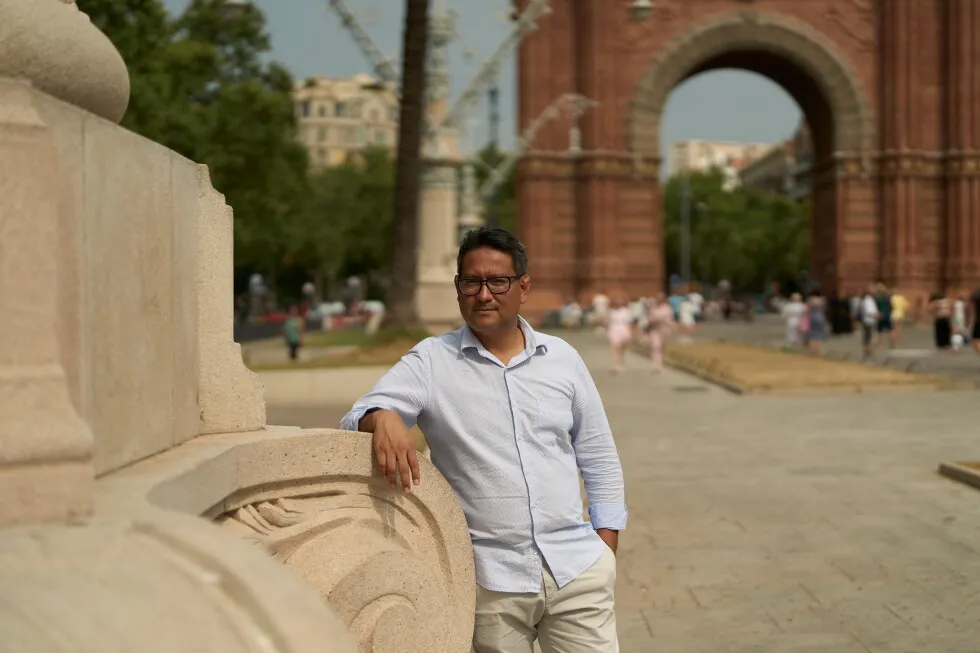
6 refugees speak out as UN-backed treaty to help people fleeing war and persecution marks 75 years 1 of 3 | Juan Carlos Arce, human rights defender and refugee from Nicaragua, poses for a photo in Barcelona, Spain, Friday, July 24, 2026. (AP Photo/Renata Brito) 2 of 3 | Hershel Greenblat, a World War II refugee born in Ukraine poses for a photo in Atlanta, Thursday, July 23, 2026. (AP Photo/Emilie Mednien) 3 of 3 | Yusra Mardini, a swimming for the Refugee Olympic Team, speaks during the Leaders Summit on Refugees during the 71st session of the United Nations General Assembly at UN headquarters, Tuesday, Sept. 20, 2016. (AP Photo/Carolyn Kaster, File) By JAMEY KEATEN and RENATA BRITO Updated 7:10 AM MESZ, July 28, 2026 Leer en español Add AP News on Google Add AP News as your preferred source to see more of our stories on Google. Share Share Facebook Copy Link copied Print Email X LinkedIn Bluesky Flipboard Pinterest Reddit GENEVA (AP) — Tuesday marks the 75th anniversary of the 1951 Refugee Convention, which was born after the ravages of World War II to help people fleeing war, violence and persecution. Proponents say the treaty has saved millions of lives. Respect for it, though, has come under strain: Some countries have denied entry to asylum seekers. Under U.S. President Donald Trump, the United States has led a policy of sending asylum seekers to third countries — upending years of U.S. policy. More than 41 million refugees remain forcibly displaced: Nearly 70% are hosted by low- and middle-income countries. The ranks could grow: The International Committee of the Red Cross counts more than 130 armed conflicts around the globe. The convention took key steps toward defining what a refugee is, laying out their rights, and establishing standards of treatment. Nearly 150 countries are parties to the convention. “It codified a simple but powerful principle that people forced to flee persecution, conflict or violence must be able to find safety and protection,” said Elizabeth Tan, U.N. High Commissioner for Refugees’ director of international protection and solutions. Its core principle is “non-refoulement,” prohibiting the return of people to a place where they would face persecution, torture or other serious harm. It all rests on the idea that no society is immune to war, persecution or sudden upheaval. Here’s what six refugees say about their experiences and the importance of the convention. UN agency investigating reports of 2 boats capsizing with Rohingya refugees 6 MIN READ Landslides in Bangladesh kill at least 8 Rohingya refugees while monsoon rains batter India 4 MIN READ At least 5 children die in monsoon landslide at a Rohingya camp in Bangladesh 4 MIN READ Rohingya fleeing Myanmar Sayed Alom, a humanitarian aid worker and one of the 700,000 Rohingya who fled Myanmar into neighboring Bangladesh in 2017, has been languishing in refugee camps there ever since. Myanmar’s military forces “raped our mothers and sisters, burned down our homes, threw our children into the river and set them on fire,” he recalled in an interview in refugee camps outside Cox’s Bazar, Bangladesh. “We were persecuted until we could no longer live there.” Alom, who expected to return home quickly, says the limbo situation has become “imaginably worse,” with kidnapping for ransom, as well as threats from nature, including extreme heat, flooding and landslides destroying the camps. Human rights lawyer Juan Carlos Arce considers himself among millions of people whose lives have been saved by the convention: He fled Nicaragua by foot in 2018 after a bloody government crackdown against protesters killed hundreds. The Nicaraguan Center for Human Rights, for which Arce worked, had documented the violence and was deemed a “terrorist organization” by President Daniel Ortega’s government. He fled to Costa Rica where he was granted asylum. In Costa Rica, rights defenders and Nicaraguan opposition leaders were attacked and even assassinated, so he moved to Barcelona, Spain, last year under a resettlement program organized by UNHCR and the U.N.’s International Organization for Migration. “Feeling safe and protected, that is priceless,” he said under Barcelona’s Arc de Triomf, as tourists and residents walked by. More than seven decades after fleeing her village, 88-year-old Hussniyah Ahmad Ghozlan still remembers the journey that brought her family to Lebanon. Ghozlan was a child when they fled during the 1948 war after their village — Yajur, southeast of Haifa, Israel — was depopulated. “We got by because we worked, raised our children and built our lives,” she said in an alley near her home in Shatila camp for Palestinian refugees in Beirut. Asked whether she knew of the 1951 Refugee Convention, Ghozlan laughed and said she had not, explaining that she never learned to read or write. Hershel Greenblat was born during World War II, in 1941, inside a cave in Ukraine as his Jewish family hid from the Nazis. After the war, his family sneaked into Austria, where they lived in U.S. Army camps for displaced persons. After initially considering moving to Israel, they opted for the U.S. after receiving approval in 1949 to immigrate there. He recalled how his father woke him in the middle of the night as the Army transport ship approached the Statue of Liberty. The kids received welcome boxes packed by American middle-schoolers. In Atlanta, where his family has lived for decades, Greenblat said refugees today often get a different welcome. He said he wasn’t previously familiar with the convention — but said refugees deserve protections and opportunities for work and education. “Refugees in the ’50s worked their butts off to get what they wanted, what they needed,” said Greenblat, now 85. Wenyen Gabriel said his parents worked hard too. He was born in the Sudanese capital, Khartoum, in 1997 after his parents fled civil war in southern Sudan. They later moved to Egypt as refugees, before being resettled in New Hampshire. Little Wenyen was 2 at the time. Big Wenyen — he’s 2.08 meters (nearly 6 feet, 10 inches) tall — earned a basketball scholarship at the University of Kentucky and played in the NBA. In 2024, he played for the young country of South Sudan at the Olympic Games in Paris. While he at times felt “a little bit different from the people in the community” in New Hampshire, there were other refugee families around. “We had to struggle and figure out how to become something inside of the United States,” he said at the headquarters of the refugee agency UNHCR, for which he became its newest goodwill ambassador on Monday. “It’s not easy to make something of yourself in a foreign country.” Swimmers Yusra and Sarah Mardini fled war-torn Syria in 2015, joining the wave of refugees from their home country that year, in a saga that has been turned into a highly-regarded movie. They went first to Lebanon, then Turkey, where they paid smugglers to take them by sea to Greece: They jumped out of an overloaded boat to keep it from sinking. After an arduous trek across southeast Europe, they received refuge in Germany. She was named a UNHCR goodwill ambassador in 2017. Now that Syria’s war is over, Mardini is hopeful: Some 1.3 million Syrians have returned. But after such an ordeal, change doesn’t just happen overnight. “You can’t just snap your fingers,” she said. “I do believe that my country and its people are very strong and that I’m going to contribute in the best way possible.” Brito reported from Barcelona, Spain. Associated Press journalists Ali Sharafeddine in Beirut; and R.J. Rico and Emilie Megnien in Atlanta contributed to this report. Freelance journalists Habi Zullah and Ro Yassin Abdumonab contributed from Cox’s Bazar, Bangladesh. JAMEY KEATEN Keaten is the chief Associated Press reporter in Geneva, focusing on Switzerland, diplomacy and U.N. institutions. He previously was posted in Paris and has reported from Afghanistan, Ukraine, the Middle East, North Africa and across Europe. twitter mailto RENATA BRITO Brito leads international migration coverage for The Associated Press. She is based out of Barcelona, Spain. twitter instagram mailto
SRCAssociated Press (AP)
LANGEN
LEANCenter
WORDS1 337
ENT12
TUE · 2026-07-28 · 05:53 GMTBRIEF NSR-2026-0728-96646
NSR-2026-0728-96646News Report·EN·Human Rights
6 refugees speak out as UN-backed treaty to help people fleeing war and persecution marks 75 years
The 1951 Refugee Convention, established after World War II to protect those fleeing war and persecution, marks its 75th anniversary. While credited with saving millions of lives, its principles are under strain as some countries deny entry to asylum seekers, and the U.S.
Associated Press (AP)Filed 2026-07-28 · 05:53 GMTLean · CenterRead · 6 min
Associated Press (AP)FIG 01
Reading time
6min
Word count
1 337words
Sources cited
3cited
Entities identified
12entities
Quality score
100%
§ 01
Briefing Summary
AI-generatedNEWSAR · AI
The 1951 Refugee Convention, established after World War II to protect those fleeing war and persecution, marks its 75th anniversary. While credited with saving millions of lives, its principles are under strain as some countries deny entry to asylum seekers, and the U.S. has implemented policies sending asylum seekers to third countries. Currently, over 41 million people are forcibly displaced, with most hosted by low- and middle-income nations, and the number could rise due to ongoing global conflicts. The convention defines refugees, outlines their rights, and prohibits returning them to danger. Six refugees shared their experiences, highlighting the convention's importance and the ongoing challenges faced by displaced individuals.
Confidence 0.90Sources 3Claims 5Entities 12
§ 02
Article analysis
Model · rule-basedFraming
Human Rights
Human Interest
Tone
Measured
AI-assessed
CalmNeutralAlarmist
Factuality
0.70 / 1.00
Factual
LowHigh
Sources cited
3
Well sourced
FewMany
§ 03
Key claims
5 extracted01
The core principle of the convention is 'non-refoulement,' prohibiting the return of individuals to places where they face persecution, torture, or serious harm.
factual
Confidence
1.00
02
More than 41 million refugees are currently forcibly displaced, with nearly 70% hosted by low- and middle-income countries.
statistic
Confidence
1.00
03
The 1951 Refugee Convention, designed to aid those fleeing war, violence, and persecution, marks its 75th anniversary.
factual
Confidence
1.00
04
Some countries have denied entry to asylum seekers, straining respect for the convention.
factual
Confidence
0.95
05
Proponents state the treaty has saved millions of lives.
quoteProponents
Confidence
0.90
§ 04
Full report
6 min read · 1 337 words§ 05
Entities
12 identifiedKey playerOppositionContextPositiveNeutralNegative
People3
Organizations3
Locations4
§ 06
Keywords & salience
10 termsrefugees
1.00
refugee convention
1.00
war and persecution
0.90
asylum seekers
0.80
non-refoulement
0.70
forcibly displaced
0.60
human rights
0.50
united nations
0.50
world war ii
0.40
international protection
0.40
§ 07
Topic connections
Interactive graph No topic relationship data available yet. This graph will appear once topic relationships have been computed.