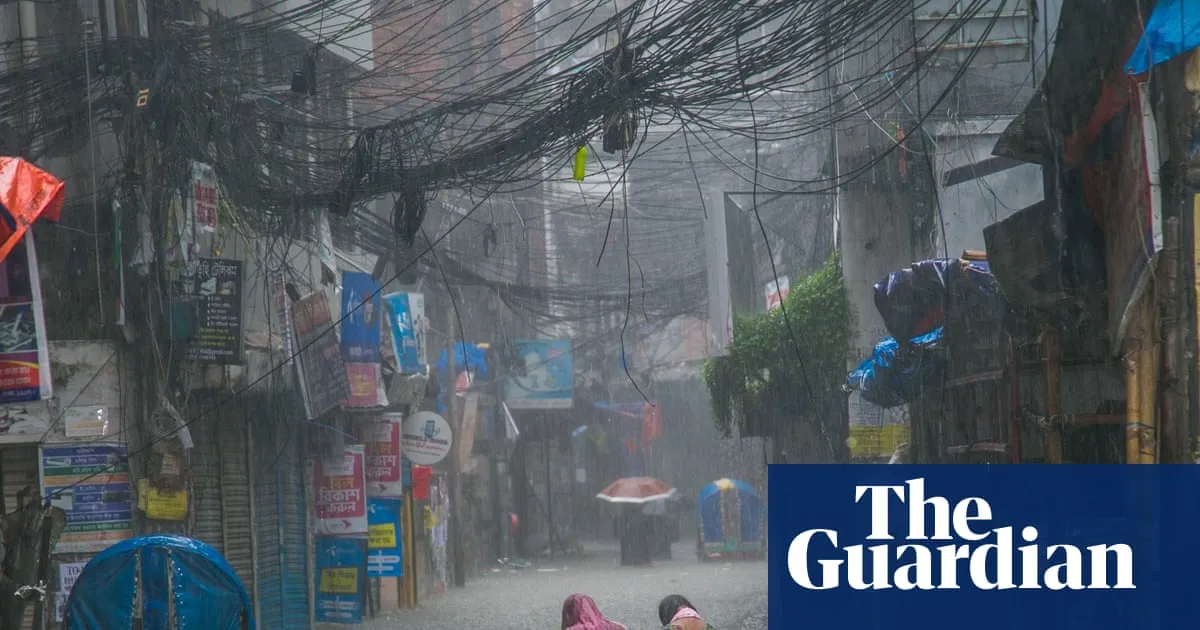
“It rained for 10 days and 10 nights, non-stop – I’d never seen anything like it,” says Anar Gul, a construction worker who lives in the remote district of Dur Baba in eastern Afghanistan.The houses in his village are built from stone and mud, which makes them extremely vulnerable to heavy rains. After days of rain, Gul’s kitchen collapsed and his neighbour, Sayed Afsar Sadat, saw a large part of his house completely destroyed. “Rains like this are coming heavier and earlier each year,” says Sadat. “They are destroying the roads and washing away our crops. It’s impacting us directly.”Anar Gul, who lives in a remote mountain village in the Dur Baba district of eastern Afghanistan, says he has never seen rain like it. Photograph: IFRC/Mark South.Last week, torrential rains and flash floods wiped out villages and towns in Afghanistan, leaving at least 31 people dead and hundreds missing. It’s been a similar picture in neighbouring countries, with the monsoon rains sparking chaos across the region. India, Bangladesh and Pakistan have all seen erratic, sudden heavy dumps of water.Jesmin Akter lived in the city of Chattogram, on the south-eastern coast of Bangladesh, which received a record 412.3mm of rainfall in 24 hours in early July, leading to the flash flood that swept through the Banshkhali district where they live. She says her children “understand that we are in a very bad situation”.Overnight the rains took the little they had; their poultry died, their paddy field flooded, their house collapsed and all their belongings in it – children’s books, school bags, toys, clothes, kitchen items – ruined.Akter carried her six children through chest-deep water to her mother’s house. There they stayed in the crowded conditions for over a week until the water receded.Residents and rescue workers inspect buildings damaged by heavy flooding in the eastern province of Nuristan, Afghanistan. Photograph: Wahidullah Kakar/AP“We have lost everything,” Akter said. Their house beside the canal was not in a good condition, but a few months ago the family had repaired it. “Now the flood has destroyed it again. We have no money. We are surviving on the food assistance we receive from different organisations.” They have gone back to the ruins of their home, but her children sleep on plastic sheets laid on the wet floor and she worries for their safety, especially that the unsanitary conditions will lead to disease. Her daughter has developed a fever.As wildfires rage across Europe and North America, the unprecedented rains continue elsewhere. While South Korea swings between heatwave and downpour, in Japan and Vietnam torrential rain has led to landslides. China, meanwhile, has seen bouts of extreme rainfall since the flood season began in April, according to the water resources ministry in mid-July, marking the start of a month-long peak flood control window. More than 600 rivers have since risen above warning levels – a 35% jump from the average for the same period over the past five years.Sayed Afsar Sadat in Dur Baba says rains are destroying the roads and washing away crops. Photograph: IFRC/Meer Abdullah Rasikh.In the south-western city of Chongqing, a huge landslide after torrential rain killed at least 11 people and left 50 missing, with rescue efforts still ongoing. Separately, a flash flood at a scenic camping spot in the north-central province of Gansu left 10 people dead and injured 23 others.The flood season across the region has been exacerbated by successive storms. Typhoon Noul, the strongest to make landfall in China so far this year, prompted the evacuation of more than 890,000 people in Guangdong as of Sunday evening, according to provincial authorities. In early July, Typhoon Maysak inundated parts of Guangxi and swept through commercial snake farms, allowing hundreds of snakes to escape.Forecasters have warned that more wet weather is on the way. Much of northern China, including Beijing, is expected to receive 20% to 50% more rain than usual, while four to six typhoons are forecast to make landfall in or affect the country this summer, above the average of 4.2, according to the China Meteorological Administration.Taiwan, an island that lies in the path of typhoons in the north-west Pacific, has also seen a rise in extreme rainfall. In June, repeated downpours caused more than NT$330m (about US$10.2m) in agricultural losses across Taiwan, according to the agriculture ministry, while the capital Taipei recorded its highest monthly rainfall in more than a century.Torrential rain flooded the streets of Dhaka in Bangladesh. Photograph: Mohammad Ponir Hossain/ReutersThe extreme weather across the region can clearly be linked to climate change. Climate scientists have long predicted that large areas of Asia will disproportionately suffer from more intense heat, humidity and drought as a result of climate disruption caused by the burning of gas, oil and coal. The most recent report by the United Nations’ Intergovernmental Panel on Climate Change said rising temperatures raise the threat of “floods in monsoon regions in south, south-east and east Asia, and glacier melting in the Hindu Kush Himalaya region”.skip past newsletter promotionafter newsletter promotionAnd World Weather Attribution scientists have warned that extreme rainfall from cyclones is being “supercharged” in south-east Asia, with a clear pattern of increasingly heavy rain over recent decades.In early July, Typhoon Maysak inundated parts of Guangxi in south China. Photograph: Cao Yiming/Xinhua/APThe year 2025 saw devastating storms and rainfall across the region. It also saw ocean temperatures rise to record heights. So far, this year has brought record-breaking heatwaves. extreme rainfall is more common and more intense because of human-caused climate breakdown across most of the world, particularly in Europe, most of Asia, central and eastern North America, and parts of South America, Africa and Australia. This is because warmer air can hold more water vapour and flooding has most likely become more frequent and severe in these locations as a result.“More intense rainfall is an expected consequence of us heating the planet by burning fossil fuels and building up more carbon dioxide in the atmosphere. A warmer atmosphere can carry more water, so when it rains, it rains harder. Also hotter conditions cause air to rise faster and drive more intense thunderstorms,” said Richard Betts, head of the climate impacts strategic area at the Met Office Hadley Centre.The International Federation of Red Cross and Red Crescent Societies (IFRC) in providing aid helped the Guardian obtain interviews with those affected.Typhoon Noul (pictured in Hong Kong) prompted the evacuation of more than 890,000 people in Guangdong. Photograph: Venron Yuen/Nexpher/ZUMA Press Wire/ShutterstockDr Hosam Faysal, the head of IFRC’s country delegation in Afghanistan, said “these are the very real, humanitarian effects of a changing climate … becoming increasingly volatile”.Faysal urged governments to ensure there was more investment in locally-led preparedness and mitigation in order to reduce the loss of life and suffering before climate-related disasters happened.“The coming forecast El Niño is a clear example – waiting to respond to the extreme needs we can see coming only once they arrive will cost lives.” Research by Yu-chen Li
SRCThe Guardian - World News
LANGEN
LEANCenter-Left
WORDS1 159
ENT12
TUE · 2026-07-28 · 04:00 GMTBRIEF NSR-2026-0728-96654
NSR-2026-0728-96654News Report·EN·Human Interest
‘We have lost everything’: extreme rainfall across Asia brings flash floods and typhoons
Asia is experiencing unprecedented extreme rainfall, flash floods, and typhoons, impacting countries from Afghanistan to Taiwan. In Afghanistan, heavy rains have caused villages to collapse, resulting in deaths and missing persons, with residents reporting increasingly severe and frequent weather events.
Natasha May and Jonathan WattsThe Guardian - World NewsFiled 2026-07-28 · 04:00 GMTLean · Center-LeftRead · 5 min
The Guardian - World NewsFIG 01
Reading time
5min
Word count
1 159words
Sources cited
3cited
Entities identified
12entities
Quality score
100%
§ 01
Briefing Summary
AI-generatedNEWSAR · AI
Asia is experiencing unprecedented extreme rainfall, flash floods, and typhoons, impacting countries from Afghanistan to Taiwan. In Afghanistan, heavy rains have caused villages to collapse, resulting in deaths and missing persons, with residents reporting increasingly severe and frequent weather events. Bangladesh has seen record rainfall, leading to flash floods that destroyed homes and belongings, leaving families reliant on aid. Other regions, including India, Pakistan, South Korea, Japan, Vietnam, and China, are also facing severe weather, with China anticipating above-average rainfall and typhoons. These events, characterized by devastating impacts on infrastructure, agriculture, and daily life, are linked by scientists to climate breakdown.
Confidence 0.90Sources 3Claims 5Entities 12
§ 02
Article analysis
Model · rule-basedFraming
Human Interest
Environmental
Tone
Mixed Tone
AI-assessed
CalmNeutralAlarmist
Factuality
0.70 / 1.00
Factual
LowHigh
Sources cited
3
Well sourced
FewMany
§ 03
Key claims
5 extracted01
Jesmin Akter, a resident of Chattogram, Bangladesh, reported losing her home, belongings, and livelihood due to record rainfall and flooding.
quoteJesmin Akter
Confidence
1.00
02
Anar Gul, a construction worker in Afghanistan, described unprecedented rainfall and significant damage to his home and village.
quoteAnar Gul
Confidence
1.00
03
More than 600 rivers in China have risen above warning levels, a 35% jump from the average for the same period.
statisticChina's water resources ministry
Confidence
0.90
04
Torrential rains and flash floods have caused widespread destruction and loss of life across Asia, including Afghanistan, India, Bangladesh, Pakistan, South Korea, Japan, Vietnam, and China.
factual
Confidence
0.90
05
In Afghanistan, at least 31 people were reported dead and hundreds missing due to recent floods.
statistic
Confidence
0.80
§ 04
Full report
5 min read · 1 159 words§ 05
Entities
12 identifiedKey playerOppositionContextPositiveNeutralNegative
Locations8
§ 06
Keywords & salience
10 termsflash floods
1.00
extreme rainfall
1.00
asia
0.90
natural disasters
0.90
typhoons
0.80
bangladesh
0.70
monsoon rains
0.70
afghanistan
0.70
climate change
0.60
india
0.50
§ 07
Topic connections
Interactive graph Network visualization showing 51 related topics
View Full Graph Person Organization Location Event|Click node to navigate|Edge numbers = shared articles