Five months after the United States and Israel started a historically unpopular Iran" class="entity-link entity-event" data-entity-id="144468" data-entity-type="event">war against Iran that was going to supposedly last weeks, the fighting has refused to resolve in victory, defeat or peace. Iran’s Supreme Leader had been killed in the opening strikes, ceasefires broke down, and the Strait of Hormuz has been closed and re-opened.For voters interviewed across the country, while the damage may be distant, the residual effects have shown up at the pump, on the grocery bill and in a phone call telling a spouse they have a day to report for deployment. And for a country still absorbing the aftermath of Israel’s war on Gaza – funded to the tune of billions of dollars by the United States – the war in Iran lands on top of an already raw argument about what American power is for.In North York, Maine, Lydia Stone, 31, works in the logging industry and is raising an 18-month-old daughter. She describes an industry being squeezed from both directions: fuel costs rising while the price customers pay for wood staying flat. “It’s been a huge jump in prices, and makes life a lot harder,” she said.That squeeze shows up in the data, with the average price of gasoline pushing above $4 a gallon for the first time in years, according to AAA. Analysts have also noted the pain is not evenly shared: lower- and middle-income households spend a larger share of their budgets on fuel, meaning the same price spike lands harder on them than on wealthier consumers.Stone’s frustration isn’t only economic. “A huge part of what has been so frustrating ... is like the fact my tax dollars are going to fund murdering people, at the same time that it’s cutting social services, it’s cutting Snap benefits for my neighbors.” She said the line at her local food pantry has grown noticeably longer and her best friend’s husband, she said, was deployed on little notice.That sense of a war without justification reverberated among voters who described themselves as independent or progressive. Terrence Dahmen, 73, a retired, independent-leaning voter from Cable, Wisconsin, who said he usually ends up voting Democrat, called American involvement “a huge mistake”. “We weren’t provoked into that fight, and we weren’t attacked,” he said. “I saw no reason to go there other than possibly controlling oil somehow.”He argued the country should be investing in solar, wind and geothermal power instead, and said he wished the US had taken a different path on climate policy years ago.Robert Edelstein, 62, who runs a window-tinting business in Douglas county, Wisconsin, was more blunt. “In the general election, I would automatically vote for anybody that was against the war,” he said. “I think it’s the stupidest thing that could ever possibly have happened.” Comparing the decision to strike Iran unfavorably with the Iraq war launched under George W Bush, he added: “It’s screwed everything up, as we all know ... it’s absolutely stupid.”In Georgia, Jimmy Carter – a retired teacher with no relation to the former president – watched Donald Trump’s motorcade arrive near his old school last week with similar disbelief. “It’s a dumbass idea,” he said. “I don’t know who fed him that idea.” He noted that even his own brother, a Trump voter, agreed.Voters with personal connections to the military comprised a wide range of views.Nick Marine, a retired sailor at a Trump rally in Marietta, offered full-throated endorsement of the Trump administration’s approach. “I think what President Trump is doing is good,” he said. “I think it took a long time for us to get to this point ... I’m glad it’s finally being resolved.”He argued for gradualism over overwhelming force – “you don’t want to behead your neighbor, because in a month or so, you’re going to be doing commerce with them” – while voicing concern for Iranian civilians cut off from water, sanitation and electricity by the fighting.Richard Bradley, a retired army major and combat engineer from Mabelton, Georgia, whose son and daughter currently serve, supports the broader rationale for confronting Iran but wants a clear exit. “I’d rather fight bad guys in their land instead of mine,” he said.Richard Bradley, a retired army major, supported the Iran war. Photograph: George Chidi/The GuardianStill, he said: “I kind of take a little bit of an issue with where we’re at now ... we need to be figuring out how to finish it up, so it doesn’t turn into another ... enduring war.” His own father fought in the Gulf war, he noted, and he didn’t “want my kids to fight unfinished business that my generation left.”Not all of the war’s critics oppose the war itself. Salman Majidi, an Iranian immigrant and software developer from Atlanta, stood among anti-Trump protesters holding a “Free Iran” sign – but for the opposite reason. A supporter of Iran’s exiled former crown prince, Reza Pahlavi, Majidi argued the American campaign was a rescue rather than a war of choice.“Tens of thousands of Iranian civilians have been murdered by the Islamic regime in just two days,” he said, arguing the toll predates and outweighs the American strikes. “We deserve a better life in Iran.”But given the proximity and relationship of the conflicts, the Iran war has not displaced the argument over Gaza so much as compounded it, blurring into a single grievance about where American money and moral authority are being spent.Clay Harvison, a mixed martial artist from Marietta who voted for the president, said the conflict should have ended months ago. “He should have left it when he had already bombed them,” Harvison said, blaming pressure from Israeli leaders for dragging the US deeper in. He said the war threatens the legacy Trump seems to prize most: “being remembered as being great ... he’s messing with that really bad right now.”Younger voters in particular, he said, are asking why a president who campaigned against foreign wars is now presiding over one, arguing that “the military-industrial complex is laundering our tax dollars instead of going into fixing our streets”.Whether a ceasefire holds, and whether Tehran and Washington ever sit down for something more than a pause, is still an open question.What is not in doubt, from Wisconsin lake towns to the Georgia suburbs, is that voters of nearly every political persuasion are doing the same math: adding up gas receipts, deployment orders and casualty counts, and asking what, precisely, the war was for.
SRCThe Guardian - World News
LANGEN
LEANCenter-Left
WORDS1 070
ENT12
TUE · 2026-07-28 · 10:00 GMTBRIEF NSR-2026-0728-96754
NSR-2026-0728-96754News Report·EN·Economic Impact
Americans feel pinch of continued Iran war: ‘It’s screwed everything up’
Five months after the United States and Israel initiated a war against Iran, the conflict remains unresolved, impacting Americans through increased fuel and grocery costs, and military deployments. Voters interviewed across the country express frustration with the war's duration and perceived lack of clear justification, with some linking it to economic hardship and cuts in social services.
George Chidi in Marietta, Georgia, Shrai Popat in North York, Maine, Rachel Leingang in Cable, Wisconsin, and Joseph Gedeon in Washington. Graphics by Andrew WitherspoonThe Guardian - World NewsFiled 2026-07-28 · 10:00 GMTLean · Center-LeftRead · 5 min
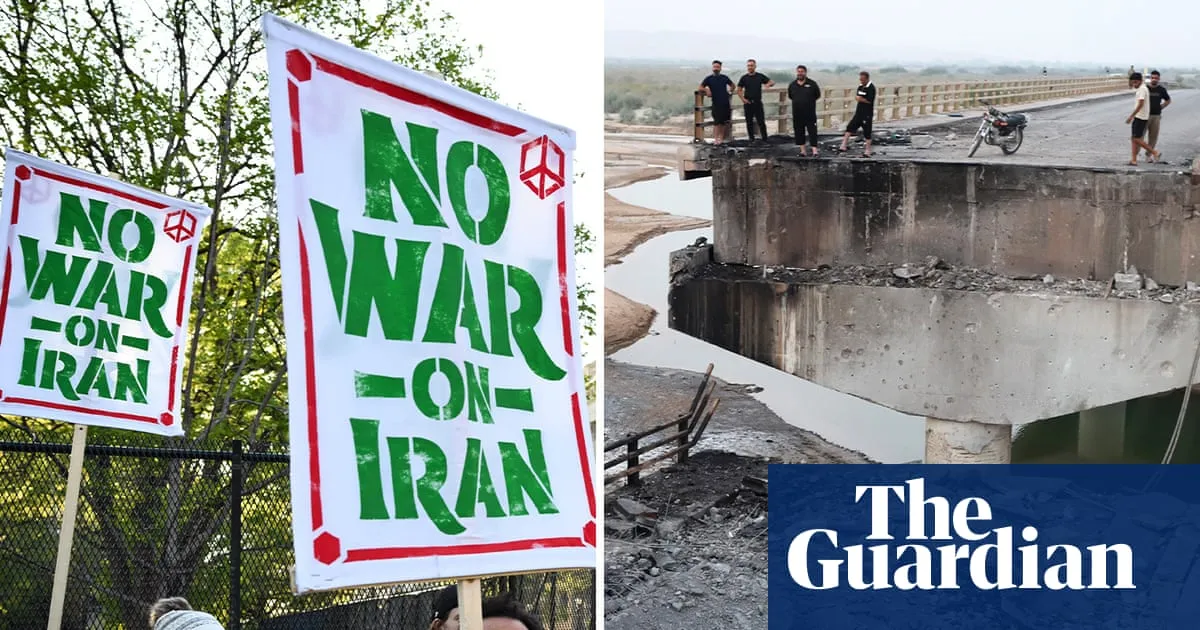
The Guardian - World NewsFIG 01
Reading time
5min
Word count
1 070words
Sources cited
4cited
Entities identified
12entities
Quality score
100%
§ 01
Briefing Summary
AI-generatedNEWSAR · AI
Five months after the United States and Israel initiated a war against Iran, the conflict remains unresolved, impacting Americans through increased fuel and grocery costs, and military deployments. Voters interviewed across the country express frustration with the war's duration and perceived lack of clear justification, with some linking it to economic hardship and cuts in social services. While some support the confrontation, others view it as a costly mistake, advocating for alternative energy investments. The war's financial burden is compounded by ongoing US funding for Israel's war in Gaza, fueling debate about the purpose of American power.
Confidence 0.90Sources 4Claims 5Entities 12
§ 02
Article analysis
Model · rule-basedFraming
Economic Impact
Human Interest
Tone
Mixed Tone
AI-assessed
CalmNeutralAlarmist
Factuality
0.40 / 1.00
Mixed
LowHigh
Sources cited
4
Well sourced
FewMany
§ 03
Key claims
5 extracted01
American involvement in the war with Iran is 'a huge mistake' and 'the stupidest thing that could ever possibly have happened'.
quoteTerrence Dahmen, Robert Edelstein
Confidence
1.00
02
The average price of gasoline has pushed above $4 a gallon.
statisticAAA
Confidence
0.95
03
The war in Iran has impacted Americans through increased gas prices and grocery bills.
factual
Confidence
0.90
04
Lower- and middle-income households are disproportionately affected by fuel price spikes.
factualAnalysts
Confidence
0.85
05
The United States and Israel started a war against Iran five months ago.
factual
Confidence
0.80
§ 04
Full report
5 min read · 1 070 words§ 05
Entities
12 identifiedKey playerOppositionContextPositiveNeutralNegative
Organizations1
Locations5
§ 06
Keywords & salience
10 termsiran war
1.00
economic impact
0.90
gasoline prices
0.80
grocery bill
0.70
deployment
0.70
tax dollars
0.60
food pantry
0.50
social services
0.50
us foreign policy
0.40
renewable energy
0.40
§ 07
Topic connections
Interactive graph Network visualization showing 51 related topics
View Full Graph Person Organization Location Event|Click node to navigate|Edge numbers = shared articles