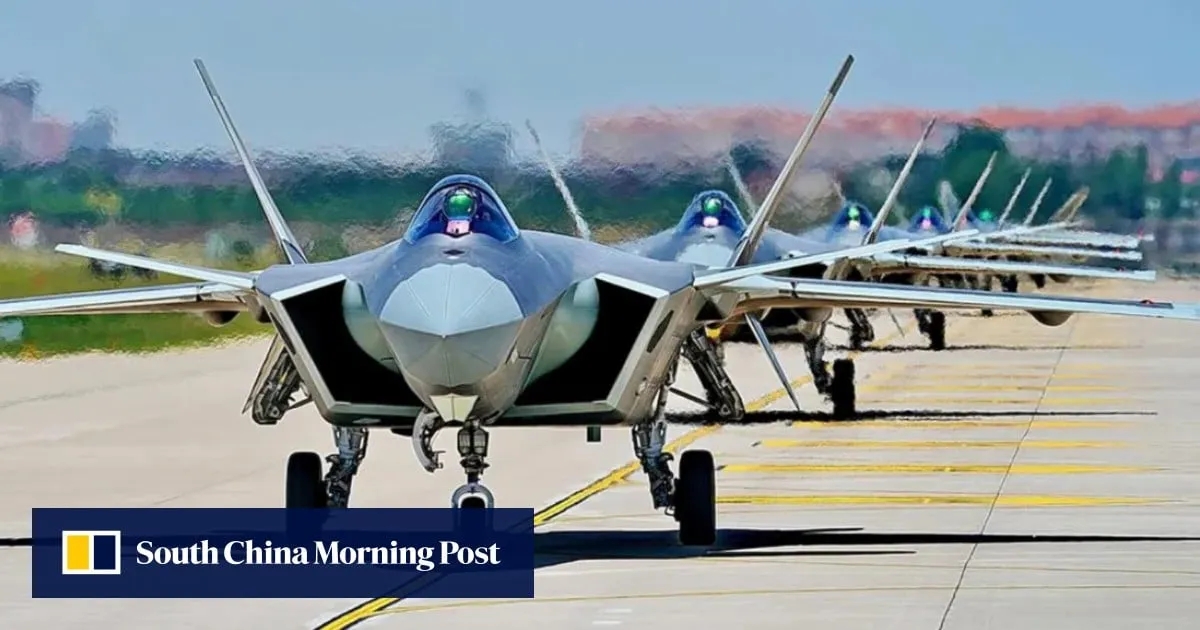
By 2030, China could operate about 1,000 units of the J-20 fifth-generation fighter jet, possibly challenging the US and its allies’ air power projection near the first island chain, according to a British think tank.A report this month by the London-based Royal United Services Institute (RUSI) found a “dramatic increase” in the past five years in China’s capacity to contest Western air power, citing the production of “modern and highly capable” fourth- and fifth-generation fighters.While the RUSI’s last estimate of Chinese combat air strength in 2020 suggested that the People’s Liberation Army was operating about 50 J-20 fighters at the time, its assessment in mid-2025 showed that the PLA Air Force was fielding about 300 J-20s.According to RUSI, in the past five years the number of J-16 4.5-generation fighter jets has also increased sharply from about 90-100 units in 2020 to roughly 450 by the end of 2025.“What these figures indicate, in practice, is that the proportion of fifth-generation and advanced fourth-generation fighters operated by the PLAAF has greatly increased since 2020 and will continue to do so,” it added.The report said the production rates for the upgraded and technologically mature J-20A and the twin-seat J-20S variant reached about 120 aircraft per year.
SRCSouth China Morning Post
LANGEN
LEANCenter-Right
WORDS203
ENT8
THU · 2026-01-22 · 13:00 GMTBRIEF NSR-2026-0122-9677
NSR-2026-0122-9677News Report·EN·National Security
How 1,000 Chinese J-20s could challenge US dominance in the Indo-Pacific
A Royal United Services Institute (RUSI) report indicates China's air power is rapidly expanding. By 2030, China could possess approximately 1,000 J-20 fifth-generation fighter jets, potentially challenging US air dominance in the Indo-Pacific region, particularly near the first island chain.
Seong Hyeon ChoiSouth China Morning PostFiled 2026-01-22 · 13:00 GMTLean · Center-RightRead · 1 min
South China Morning PostFIG 01
Reading time
1min
Word count
203words
Sources cited
1cited
Entities identified
8entities
Quality score
100%
§ 01
Briefing Summary
AI-generatedNEWSAR · AI
A Royal United Services Institute (RUSI) report indicates China's air power is rapidly expanding. By 2030, China could possess approximately 1,000 J-20 fifth-generation fighter jets, potentially challenging US air dominance in the Indo-Pacific region, particularly near the first island chain. The report highlights a significant increase in China's production of advanced fourth and fifth-generation fighters over the past five years. Specifically, the number of J-20s has grown from around 50 in 2020 to approximately 300 by mid-2025, while J-16 4.5-generation fighters have increased from roughly 90-100 to about 450 in the same period. This expansion is attributed to high production rates of the J-20A and J-20S variants, reaching approximately 120 aircraft per year.
Confidence 0.90Sources 1Claims 5Entities 8
§ 02
Article analysis
Model · rule-basedFraming
National Security
Political Strategy
Tone
Mixed Tone
AI-assessed
CalmNeutralAlarmist
Factuality
0.80 / 1.00
Factual
LowHigh
Sources cited
1
Limited
FewMany
§ 03
Key claims
5 extracted01
The number of J-16 4.5-generation fighter jets increased from about 90-100 units in 2020 to roughly 450 by the end of 2025.
statisticRUSI
Confidence
0.90
02
The PLA Air Force was fielding about 300 J-20s in mid-2025.
statisticRUSI
Confidence
0.90
03
RUSI found a “dramatic increase” in China’s capacity to contest Western air power in the past five years.
quoteRoyal United Services Institute (RUSI)
Confidence
0.90
04
Production rates for the J-20A and J-20S reached about 120 aircraft per year.
statisticThe report
Confidence
0.80
05
China could operate about 1,000 units of the J-20 fifth-generation fighter jet by 2030.
predictionBritish think tank
Confidence
0.70
§ 04
Full report
1 min read · 203 words§ 05
Entities
8 identifiedKey playerOppositionContextPositiveNeutralNegative
Organizations5
§ 06
Keywords & salience
9 termsj-20 fighter
1.00
air power
0.80
military capability
0.70
fifth-generation fighters
0.70
us dominance
0.60
china
0.60
people's liberation army air force
0.50
indo-pacific
0.50
j-16 fighter
0.40
§ 07
Topic connections
Interactive graph Network visualization showing 3 related topics
View Full Graph Person Organization Location Event|Click node to navigate|Edge numbers = shared articles