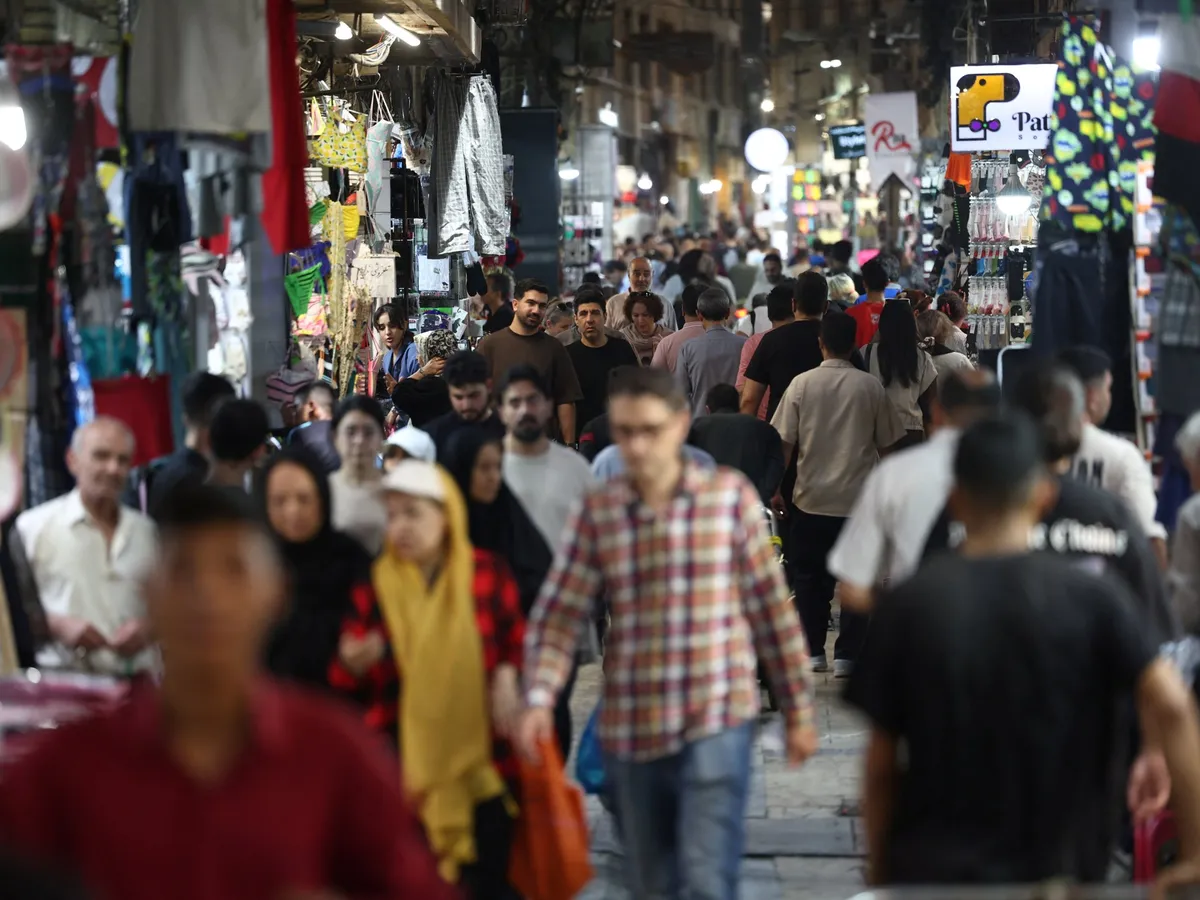
Millions of people and businesses in sanctions-hit country keep absorbing economic shockwaves, with analysts saying the trend looks set to continue.Shoppers in the Grand Bazaar in Tehran [File: Majid Asgaripour/WANA (West Asia News Agency) via Reuters]Published On 28 Jul 2026Tehran, Iran – Millions of people across Iran are struggling for livelihood and survival, but the country’s embattled economy is still far from a state of collapse despite five months of war with the United States.The vast and resource-rich country of more than 92 million people has developed a relatively diversified domestic economy for a major oil exporter, as the authorities over decades leaned on self-sufficiency in the face of harsh economic embargoes and confrontation with the US, Israel and The West.Water-intensive agriculture, manufacturing and services have reduced total reliance on oil, while shadowy oil transfers, cross-border trade, maritime networks and a large informal labour market have helped keep the economy resilient.Still, the population has paid a huge price by having to absorb much of the strain. More than a decade of all-encompassing sanctions, as well as two wars since June last year, nationwide protests during which thousands were killed and several state-imposed internet shutdowns in the past year, have only made it more difficult to earn a living wage and have a future outlook.‘An expensive way to survive’Welfare economist Hadi Kahalzadeh said he defines collapse as famine and the state losing the ability to pay its employees and deliver basic services. In that sense, the economy has not collapsed.“And I don’t think the combination of war, blockade and sanctions, as painful as it’s been, gets us there anytime soon,” the non-resident fellow at the Quincy Institute and research fellow at Brandeis University’s Center for Global Development and Sustainability in Massachusetts told Al Jazeera.That combination has pushed up inflation to about 90 percent, with one of the highest food inflation rates in the world more than tripling prices of many staples such as meat, eggs and cooking oil over the past year while wages quickly fall behind.Imported goods constantly become more expensive too as the national currency continues to sink to new lows against the US dollar, while the closure of the Strait of Hormuz following the launch of the US-Israel war in late February blocks fresh supplies.Kahalzadeh said the fact that economic shocks are often absorbed through inflation and currency depreciation preserves some incentive to import and produce, which keeps goods on the shelves but makes them increasingly unaffordable.“That keeps the system functioning, but it dumps the cost directly onto households,” said Kahalzadeh. “Then the state tries to soften that with cash transfers and subsidies. It’s an expensive way to survive, but it does avoid collapse.”The monthly minimum wage is less than $100 and the government offers a monthly cash subsidy and electronic coupons for essential goods, amounting to a few more dollars.Government spokeswoman Fatemeh Mohajerani said during a news conference on Tuesday that the government has belatedly managed to pay designated shops in the coupons scheme. But stores have not received the money because several major banks remain disrupted more than a month after authorities said they faced major cyberattacks.She also highlighted infrastructure damage inflicted by the US during the latest round of bombing this month, saying 12 bridges and two tunnels were struck and parts of Iran’s natural gas production and electricity generation capacity were lost. Mohajerani said it was a “valuable achievement” showing government resolve that manufacturing industries are set to have two days of blackouts per week, instead of the previously projected three days.Billions unreturnedA 2025 report by the Saba Pension Strategies Institute, a think tank affiliated with Iran’s state-run pension fund, said that while a little more than 30 percent of Iranians lived below the poverty line five years ago, that rate was projected to have reached 45 percent this year – and was still rising.Mohammad Reza Farzanegan, a professor of the Economics of the Middle East at Germany’s Philipps-Universitat Marburg, said “endemic corruption” that reduces productivity, weakens institutions and rewards political connections rather than efficiency is the most serious internal threat to the Iranian economy.Oil incomes have allowed the government to conceal some of the deficiencies and postpone consequences. But they have also encouraged rent-seeking and overdependence on the state, which has weakened the private sector and reduced incentives for innovation and long-term investment, he told Al Jazeera.“Households reduce consumption, firms postpone investment and educated workers consider emigration. The economy continues to function, but at the cost of a shrinking middle class, lower capital formation, weaker public services and declining confidence in the future,” said Farzanegan.Zabihollah Khodaeian, head of the General Inspection Organisation of Iran, told state television on Sunday that some of the “trustees” designated by Iran’s top authorities, including the Supreme National Security Council, to bring back proceeds from selling crude oil and other products under sanctions, “betrayed” the country and took the money for themselves.He said the so-called trustees currently hold at least $11bn, of which $1.6bn has been “misused”.He said some are still in Iran under arrest, while others fled, including one person who stole more than $200m. But the official did not name any offenders or say anything about whether there will be legal ramifications for those who appointed the offenders as trustees.Khodaeian also said there are more than 20,000 exporters who have to repatriate 94 billion euros (nearly $107bn) in export yields to the country by law, but have failed to do so. They include 225 unnamed individuals with more than 50 million euros (nearly $57m) in foreign currency commitments each.Iranians get poorerKahalzadeh, the welfare economist, said prolonged sanctions have completely reshaped Iran’s socioeconomic pyramid.“In 2011, the middle class made up the majority of the population. Today, it has become a minority. At the same time, people who were once a minority, the poor and those vulnerable to poverty, now account for roughly 70 percent of the population,” he said, adding that this trend will continue.In the capital, Tehran, and many cities and villages across the country, that means meat and dairy disappearing from household diets, medical treatments postponed, rents paid late and many salaries failing to last days, let alone weeks.“Even if inflation later comes down or economic growth returns, the damage will not disappear quickly. Once families lose their savings, assets, health, educational opportunities and sense of middle-class security, rebuilding them takes many years,” said Kahalzadeh.Iran and the US continue to communicate messages through mediators, and have largely suspended military action, but the conflict has now spread to the Red Sea and the Caspian Sea while tensions remain high in the Strait of Hormuz.Philipps-Universitat Marburg’s Farzanegan said with the sanctions and the threat of conflict remaining in place, domestic economic reforms alone cannot generate a sustained recovery.“Even if the political system survives, the economy may remain chronically sick,” he said, adding that economic relations with China, Russia and neighbouring countries may provide temporary breathing space but cannot fully replace international ties,” said Farzanegan.“The most important economic policy is therefore the reduction of geopolitical risk through diplomacy. Without a stable environment, the Iranian economy may continue to survive, but it will have little chance of genuine recovery.”
SRCAl Jazeera
LANGEN
LEANCenter
WORDS1 190
ENT12
TUE · 2026-07-28 · 12:30 GMTBRIEF NSR-2026-0728-96774
NSR-2026-0728-96774Analysis·EN·Economic Impact
Why has Iran’s economy not collapsed under US war pressure?
Despite five months of war with the United States and extensive sanctions, Iran's economy has not collapsed due to a diversified domestic economy, self-sufficiency efforts, and mechanisms like shadowy oil transfers and informal trade. While millions of Iranians struggle with high inflation and a depreciating currency, the government's cash transfers and subsidies, alongside the absorption of economic shocks through inflation and currency depreciation, keep the system functioning.
Maziar MotamediAl JazeeraFiled 2026-07-28 · 12:30 GMTLean · CenterRead · 5 min
Al JazeeraFIG 01
Reading time
5min
Word count
1 190words
Sources cited
1cited
Entities identified
12entities
Quality score
100%
§ 01
Briefing Summary
AI-generatedNEWSAR · AI
Despite five months of war with the United States and extensive sanctions, Iran's economy has not collapsed due to a diversified domestic economy, self-sufficiency efforts, and mechanisms like shadowy oil transfers and informal trade. While millions of Iranians struggle with high inflation and a depreciating currency, the government's cash transfers and subsidies, alongside the absorption of economic shocks through inflation and currency depreciation, keep the system functioning. However, this survival comes at a significant cost to households, leading to reduced consumption, postponed investment, and emigration. Internal factors like endemic corruption also pose a serious threat, weakening institutions and reducing productivity.
Confidence 0.90Sources 1Claims 5Entities 12
§ 02
Article analysis
Model · rule-basedFraming
Economic Impact
Conflict
Tone
Measured
AI-assessed
CalmNeutralAlarmist
Factuality
0.60 / 1.00
Mixed
LowHigh
Sources cited
1
Limited
FewMany
§ 03
Key claims
5 extracted01
The current economic situation is an 'expensive way to survive' but avoids complete collapse.
quoteHadi Kahalzadeh
Confidence
1.00
02
Inflation in Iran has reached about 90 percent, with food inflation more than tripling prices of many staples over the past year.
statistic
Confidence
0.90
03
Iran's economy has not collapsed despite five months of war with the United States and extensive sanctions.
factual
Confidence
0.90
04
The closure of the Strait of Hormuz blocks fresh supplies, contributing to rising import costs.
factual
Confidence
0.80
05
Iran has developed a relatively diversified domestic economy, reducing reliance on oil through self-sufficiency in manufacturing and services.
factual
Confidence
0.80
§ 04
Full report
5 min read · 1 190 words§ 05
Entities
12 identifiedKey playerOppositionContextPositiveNeutralNegative
Organizations5
§ 06
Keywords & salience
9 termsiranian economy
1.00
us war pressure
0.90
economic sanctions
0.80
economic resilience
0.70
inflation
0.60
diversified economy
0.50
self-sufficiency
0.50
informal labour market
0.40
strait of hormuz
0.40
§ 07
Topic connections
Interactive graph Network visualization showing 51 related topics
View Full Graph Person Organization Location Event|Click node to navigate|Edge numbers = shared articles