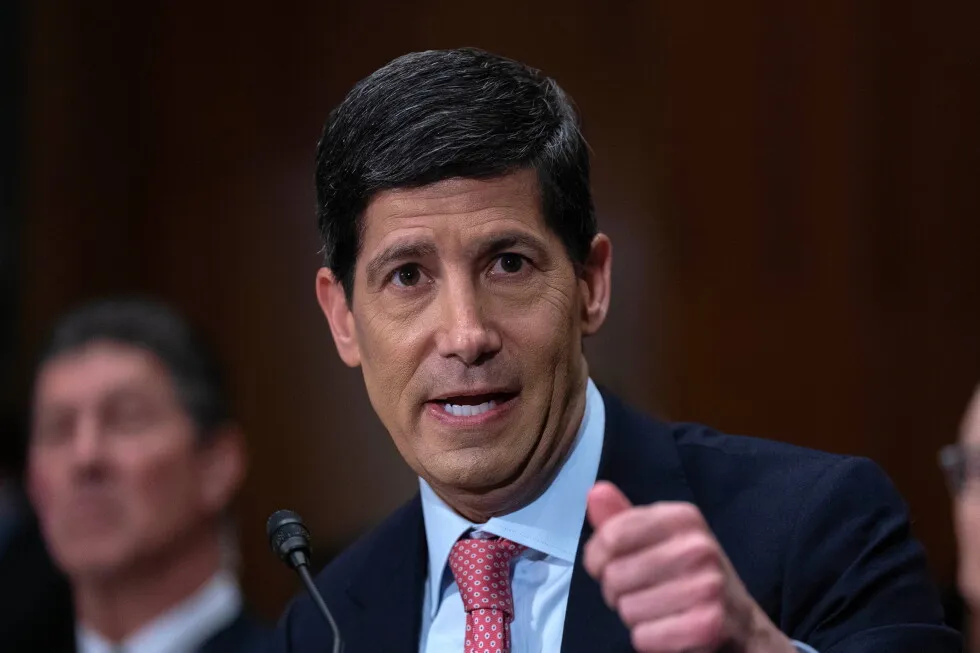
Will tough talk be enough? Fed Chair Warsh faces pressure to combat inflation 0 seconds of 1 minute, 23 secondsVolume 0% Press shift question mark to access a list of keyboard shortcuts Keyboard ShortcutsEnabledDisabled Shortcuts Open/Close/ or ? Play/PauseSPACE Increase Volume↑ Decrease Volume↓ Seek Forward→ Seek Backward← Captions On/Offc Fullscreen/Exit Fullscreenf Mute/Unmutem Decrease Caption Size- Increase Caption Size+ or = Seek %0-9 Next Up Americans face biggest food-price spike in decades 01:52 Subtitle Settings OffEnglish(US)_v Font Color White Font Opacity 100% Font Size 100% Font Family Arial Character Edge None Edge Color Black Background Color Black Background Opacity 50% Window Color Black Window Opacity 0% Reset WhiteBlackRedGreenBlueYellowMagentaCyan 100%75%50%25% 200%175%150%125%100%75%50% ArialCourierGeorgiaImpactLucida ConsoleTahomaTimes New RomanTrebuchet MSVerdana NoneRaisedDepressedUniformDrop Shadow WhiteBlackRedGreenBlueYellowMagentaCyan WhiteBlackRedGreenBlueYellowMagentaCyan 100%75%50%25%0% WhiteBlackRedGreenBlueYellowMagentaCyan 100%75%50%25%0% 00:00 01:23 01:23 More Videos 01:52 Americans face biggest food-price spike in decades 01:19 Trump says 'serious' talks are going on with Iran but warns US is 'locked and loaded' 01:25 'The last picture': A passing boater's photograph may be the 5 adults who drowned in Ohio 01:07 OpenAI says its AI technology acted on its own in an ‘unprecedented’ hack of another company 01:08 West Virginia governor says some are unaccounted for in flooding 01:03 Iran war's global effects: In Italy, a farmer battles rising costs of fuel and fertilizers 01:03 Iran war's global effects: In Nigeria, a business owner struggles to keep the generator running 01:13 A beach break in Nigeria's Lagos is becoming too expensive for many Close 1 of 5 | When the cost of nearly everything is rising, economists call it inflation. Even if paychecks also rise, inflation typically leads people feel like it’s harder to make ends meet, and it often becomes a major political issue. 2 of 5 | Federal Reserve Chairman Kevin Warsh testifies before the Senate Banking, Housing and Urban Affairs Committee to deliver the semiannual monetary policy report to Congress, on Capitol Hill, Wednesday, July 15, 2026, in Washington. (AP Photo/Jose Luis Magana) 3 of 5 | Federal Reserve Chairman Kevin Warsh testifies before the Senate Banking, Housing and Urban Affairs Committee to deliver the semiannual monetary policy report to Congress, on Capitol Hill, Wednesday, July 15, 2026, in Washington. (AP Photo/Jose Luis Magana) 4 of 5 | Federal Reserve Chairman Kevin Warsh testifies before the Senate Banking, Housing and Urban Affairs Committee to deliver the semiannual monetary policy report to congress, on Capitol Hill, Wednesday, July 15, 2026, in Washington. (AP Photo/Jose Luis Magana) 5 of 5 | Federal Reserve Chairman Kevin Warsh testifies before the Senate Banking, Housing and Urban Affairs Committee to deliver the semiannual monetary policy report to congress, on Capitol Hill, Wednesday, July 15, 2026, in Washington. (AP Photo/Jose Luis Magana)df By CHRISTOPHER RUGABER Updated 4:28 PM MESZ, July 28, 2026 Add AP News on Google Add AP News as your preferred source to see more of our stories on Google. Share Share Facebook Copy Link copied Print Email X LinkedIn Bluesky Flipboard Pinterest Reddit Washington (AP) — The Federal Reserve is expected to keep its key interest rate unchanged when it meets Tuesday and Wednesday, but chair Kevin Warsh is under increasing pressure to hike rates soon, a move that could provoke ire from President Donald Trump, who appointed him. The Iran war has reignited, pushing oil and gas prices higher — a trend that will worsen inflation in the coming months. Soaring investment in the artificial intelligence buildout is raising the cost of laptops, smart phones and electricity. And price hikes from tariffs could be in the pipeline after Trump imposed new duties on dozens of U.S. trading partners. All those trends might lead to only temporary price increases, rather than a sustained burst of inflation similar to the spike in 2021-2022. Yet inflation, according to the Fed’s preferred measure, has topped its 2% target for more than five years, making it harder for the Fed to ignore price spikes, no matter how brief. Core inflation, which excludes the volatile energy and food categories, has risen since last December and has been stuck at around 3% or higher since 2023. Without noticeable progress soon, some Fed officials have said rate hikes will be needed. “Unfortunately, inflation does not appear to be headed sustainably back all the way to 2%,” Lorie Logan, president of the Federal Reserve Bank of Dallas, said recently. “Modestly higher interest rates would better balance the outlook.” Logan is a voting member of the Fed’s rate-setting committee. Warsh, since taking over as chair in May, has emphasized that the Fed will get inflation back to 2% without specifying how. In his first news conference as chair last month, he made clear he wouldn’t provide the kind of signals about the Fed’s next steps that his predecessors, particularly Jerome Powell, did. Warsh says Fed has ‘no tolerance’ for high inflation but provides no hints on next move 1 MIN READ inflation cools more than expected in June as gas costs fall, underlying prices ease 2 MIN READ Fed minutes: Officials deeply divided over future path of US inflation 2 MIN READ But in congressional testimony earlier this month Warsh said the Fed has “no tolerance” for higher inflation. And in the first statement on rates issued under his watch, the central bank pledged that it “will deliver price stability.” Such comments, along with the resumption of the Iran war and the renewed climb of oil and gas prices, have already lifted borrowing costs. The yield on the 10-year Treasury note — which strongly influences mortgage rates — briefly topped 4.7% last Thursday, the highest in about 18 months. But Warsh’s tough talk raises expectations that he will follow through with action, current and former Fed officials say. James Bullard, a former president of the St. Louis Fed, said Warsh’s rhetoric “has been very effective” in establishing Fed credibility, “but markets are going to ask, ‘Well, what have you done for me lately?’ And they’re going to demand action.” At the same time, more Fed officials appear to be growing impatient with inflation’s stubbornness. “Sternly staring at inflation until it melts before our withering gaze is not an option,” Christopher Waller, an influential member of the Fed’s governing board, said in a July 13 speech. If core inflation keeps climbing, the Fed’s rate-setting committee “will need to consider” hiking rates “in the near term,” he said. Beth Hammack, president of the Cleveland Fed, said in a post on LinkedIn earlier this month that for the first time she is hearing business leaders call for higher rates, which is unusual since they typically support cheaper borrowing. She is also hearing from consumers “who can’t make ends meet about a growing sense of despair,” Hammack wrote. There is still tremendous uncertainty about what the Fed should do in the coming months, economists said. The most recent inflation report showed that core inflation cooled noticeably in June, and headline inflation fell sharply as gas prices declined almost 10%, a sign of what could happen if the Iran conflict is permanently resolved. The cost of apartment rents, which spiked in the pandemic, is growing much more slowly than a few years ago. John Williams, president of the New York Fed and vice chair of the Fed’s rate-setting committee, said this month that “there are encouraging reasons to expect that inflation has peaked and should edge down in the coming quarters.” He cited the decline in gas prices, before the Iran war restarted, and argued that the impact of tariffs on inflation has largely run its course. Even with new tariffs in place, they are likely to have the same limited effect of the ones they replaced. Yet the resumption of fighting in the Middle East has pushed gas prices back above a nationwide average of $4 a gallon, from just below $3.80 around the July 4 holiday. The increase will likely push headline inflation higher, just before the Fed meets again in September. And adding to the Fed’s challenge, higher interest rates can slow demand and bring down inflation, but they can’t do much to restore oil and gas supplies disrupted by war. “The Fed is looking at inflation well above goal, but mostly for reasons that it doesn’t have any influence on,” Vincent Reinhart, chief economist at Dreyfus-Mellon and a former top Fed economist, said. Warsh says Fed to keep inflation from ‘broadening’ In congressional testimony this month, Warsh suggested the Fed’s job is to prevent specific price increases for things like gas or computer gear from “broadening out” to other parts of the economy. Traditionally, the Fed would do that by hiking rates if there were signs higher prices were spreading. But Warsh may hope that his tough talk, which has pushed up some borrowing costs, will suffice in the end. “They are hoping and intending to talk the talk without having to walk the walk,” said Stephen Douglass, chief economist at NISA Investment Advisors and former analyst at the New York Fed. He doesn’t expect the Fed will raise rates this year. Other economists say inflation won’t be defeated without action by the Fed. “There has never been a time when inflation gradually moderated without impetus from the Fed,” Joseph Lavorgna, a former top economist at the Treasury Department and chief economist at SMBC Americas, said. “In other words, core inflation is not going to magically slow.” CHRISTOPHER RUGABER Rugaber has covered the Federal Reserve and the U.S. economy for the AP for 16 years. He is a two-time finalist for the Gerald Loeb award for business reporting. twitter mailto
SRCAssociated Press (AP)
LANGEN
LEANCenter
WORDS1 588
ENT12
TUE · 2026-07-28 · 14:53 GMTBRIEF NSR-2026-0728-96842
NSR-2026-0728-96842News Report·EN·Economic Impact
Will tough talk be enough? Fed Chair Warsh faces pressure to combat inflation
Federal Reserve Chair Kevin Warsh faces increasing pressure to raise interest rates to combat persistent inflation, which has exceeded the Fed's 2% target for over five years. Factors contributing to inflation include the renewed Iran war driving up oil and gas prices, AI investment increasing costs for electronics and electricity, and potential tariff hikes.
Associated Press (AP)Filed 2026-07-28 · 14:53 GMTLean · CenterRead · 7 min
Associated Press (AP)FIG 01
Reading time
7min
Word count
1 588words
Sources cited
1cited
Entities identified
12entities
Quality score
100%
§ 01
Briefing Summary
AI-generatedNEWSAR · AI
Federal Reserve Chair Kevin Warsh faces increasing pressure to raise interest rates to combat persistent inflation, which has exceeded the Fed's 2% target for over five years. Factors contributing to inflation include the renewed Iran war driving up oil and gas prices, AI investment increasing costs for electronics and electricity, and potential tariff hikes. While some Fed officials, like Lorie Logan, believe rate hikes are necessary, others, like John Williams, see encouraging signs of inflation potentially easing. Warsh has adopted a firm stance, stating the Fed has "no tolerance" for higher inflation and will "deliver price stability." However, the Fed is expected to keep rates unchanged at its upcoming meeting, and any decision to hike rates could face opposition from President Trump. Economists are divided on whether Warsh's strong rhetoric will be enough to curb inflation without actual rate increases.
Confidence 0.90Sources 1Claims 4Entities 12
§ 02
Article analysis
Model · rule-basedFraming
Economic Impact
Political Strategy
Tone
Mixed Tone
AI-assessed
CalmNeutralAlarmist
Factuality
0.70 / 1.00
Factual
LowHigh
Sources cited
1
Limited
FewMany
§ 03
Key claims
4 extracted01
Fed Chair Warsh faces pressure to combat inflation.
factualArticle
Confidence
0.90
02
Inflation often becomes a major political issue.
factual
Confidence
0.80
03
Inflation typically leads people to feel like it’s harder to make ends meet.
factual
Confidence
0.80
04
Americans face the biggest food-price spike in decades.
factualVideo title/related content
Confidence
0.70
§ 04
Full report
7 min read · 1 588 words§ 05
Entities
12 identifiedKey playerOppositionContextPositiveNeutralNegative
Organizations2
Locations7
§ 06
Keywords & salience
8 termsinflation
1.00
federal reserve
0.90
monetary policy
0.80
kevin warsh
0.70
economic pressure
0.60
cost of living
0.50
food prices
0.50
interest rates
0.40
§ 07
Topic connections
Interactive graph Network visualization showing 21 related topics
View Full Graph Person Organization Location Event|Click node to navigate|Edge numbers = shared articles