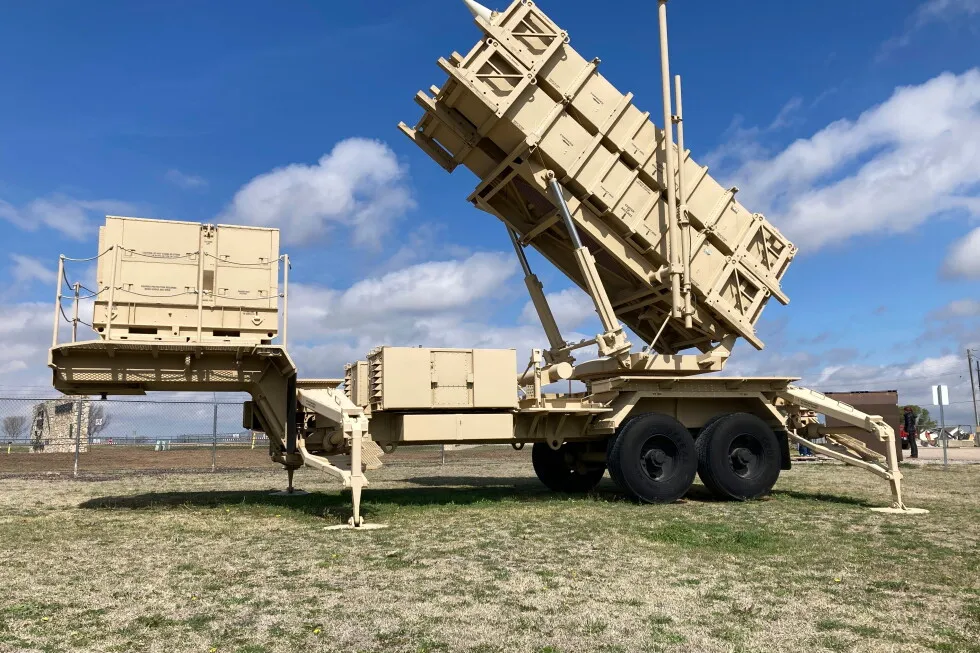
A Patriot missile mobile launcher is displayed outside the Fort Sill Army Post near Lawton, Okla., on March 21, 2023. (AP Photo/Sean Murphy, File) Updated [hour]:[minute] [AMPM] [timezone], [monthFull] [day], [year] WASHINGTON (AP) — Recent fighting with Iran used up more of the U.S. military’s already diminished stockpiles of advanced missile interceptors, potentially putting American troops at more risk if hostilities resume, a new analysis says.Shrunken inventories of Patriot and THAAD interceptors may force the U.S. and its Middle Eastern allies to take more risks to conserve those air defenses, according to the analysis from the Center for Strategic and International Studies, a Washington think tank. For example, it said, American forces may launch fewer missiles against incoming Iranian drones and missiles, raising the chance of one getting through. “That percentage may not go up a lot, but it goes up a little,” said Mark Cancian, a retired Marine colonel and now senior adviser at CSIS who co-authored Monday’s report with research associate Chris H. Park.The issue came into sharp relief when the U.S. military announced Tuesday that it had intercepted “multiple ballistic missiles from Iran in an attempted surprise attack on U.S. forces based in the Middle East.”The nation’s advanced weapons stockpiles have become a flashpoint in the five-month-long conflict, along with the threat to the lives of American service members, heightened gasoline prices and increasing costs to taxpayers. The war has been unpopular with many Americans and is posing political problems for President Donald Trump and Republicans ahead of November’s midterm congressional elections. Recent fighting adds to anxieties over weapons stockpiles Gen. Dan Caine, chairman of the Joint Chiefs of Staff, has told Trump that the state of the country’s munitions stockpile could have an impact on military operations in Iran, a U.S. official said.The official, who spoke on condition of anonymity to discuss sensitive conversations, said the message was delivered as part of Caine’s regular duties of providing military advice and options to Trump. 1 MIN READ 5 MIN READ 3 MIN READ The Pentagon, however, pushed back against concerns that its capabilities have diminished. “America’s military is the most powerful in the world and has everything it needs to execute at the time and place of the President’s choosing,” Sean Parnell, the Pentagon’s chief spokesman, said in a statement Tuesday. “We have executed multiple successful operations across combatant commands while ensuring the U.S. military possesses a deep arsenal of capabilities to protect our people and our interests.”While renewed hostilities between the U.S. and Iran had been paused in recent days before Tuesday’s attempted strikes, the Islamic Republic is capable of launching deadly attacks. It fired missiles and drones at a base in Jordan on July 17, killing three U.S. troops. Another American soldier was killed a day later in Iraq during a controlled detonation of an Iranian drone, bringing the war’s toll to 18 U.S. service members. Defense Secretary Pete Hegseth told lawmakers last week that the war has cost an estimated $37.5 billion. The Pentagon is asking Congress for $67 billion to replenish the military in the wake of the war, which would include funding for more high-end munitions, such as Patriots and THAADs, or Terminal High Altitude Area Defense interceptors. Democrats in Congress often cite the use of such finite weapons as a damning metric against the war, which Trump launched without congressional approval alongside Israel on Feb. 28. It also has raised concerns that the U.S. military would have diminished firepower in any potential future conflict with China. CSIS warned in May that it could take at least three years to replenish stockpiles of Patriots, THAADs and Tomahawk cruise missiles. Saving missiles reduces chances of interception The latest estimates from CSIS for Patriot and THAAD interceptors are based on budget documents and other publicly released information. The number of Patriot interceptors fell from 2,330 before the war to 1,030 when the April ceasefire took effect, CSIS estimated. Following the recent fighting, the stockpile is now estimated to be between 759 and 827, a decrease of at least 65% since before the conflict began.The number of THAAD interceptors fell from 452 before the war to between 232 and 262 at the start of the April ceasefire, CSIS said. The U.S. was able to replenish some of the inventory to between 234 and 278 interceptors. But the stockpile is still at least 38% smaller than it was before the conflict. Cancian said the concern is that lower inventories could influence the U.S. military’s doctrine for shooting down incoming drones and missiles. The specifics are typically classified. But as an example, Cancian said American forces could start firing off two interceptors instead of three. “It reduces the chances of interception, but you save a missile,” Cancian said. Another possibility is that American forces hold off firing any interceptors if an Iranian missile is expected to miss its target and strike an area free of people and infrastructure.“They may just let it go and accept the fact that there might be some small amount of damage,” Cancian said. ___Associated Press writer Konstantin Toropin contributed to this report.
SRCAssociated Press (AP)
LANGEN
LEANCenter
WORDS850
ENT12
TUE · 2026-07-28 · 22:53 GMTBRIEF NSR-2026-0729-96952
NSR-2026-0729-96952News Report·EN·National Security
Recent fighting with Iran further draws down key US air defense stockpiles, analysis says
A new analysis from the Center for Strategic and International Studies (CSIS) indicates that recent fighting with Iran has significantly depleted U.S. stockpiles of advanced missile interceptors, specifically Patriot and THAAD systems.
By
BEN FINLEYAssociated Press (AP)Filed 2026-07-28 · 22:53 GMTLean · CenterRead · 4 min
Associated Press (AP)FIG 01
Reading time
4min
Word count
850words
Sources cited
3cited
Entities identified
12entities
Quality score
100%
§ 01
Briefing Summary
AI-generatedNEWSAR · AI
A new analysis from the Center for Strategic and International Studies (CSIS) indicates that recent fighting with Iran has significantly depleted U.S. stockpiles of advanced missile interceptors, specifically Patriot and THAAD systems. This reduction, estimated at over 65% for Patriots and 38% for THAADs, could force the U.S. and its allies to take greater risks, such as firing fewer interceptors at incoming threats, thereby increasing the chance of successful attacks. The Pentagon, however, maintains that the U.S. military possesses sufficient capabilities. The depleted stockpiles have become a concern amid the ongoing conflict, with the Pentagon requesting substantial funds to replenish munitions. CSIS estimates it could take years to fully restore these critical weapon inventories.
Confidence 0.90Sources 3Claims 5Entities 12
§ 02
Article analysis
Model · rule-basedFraming
National Security
Conflict
Tone
Measured
AI-assessed
CalmNeutralAlarmist
Factuality
0.70 / 1.00
Factual
LowHigh
Sources cited
3
Well sourced
FewMany
§ 03
Key claims
5 extracted01
The U.S. military intercepted multiple ballistic missiles from Iran in an attempted surprise attack on U.S. forces in the Middle East.
factualU.S. military
Confidence
0.95
02
The Pentagon states America's military is the most powerful in the world and has everything it needs.
quoteSean Parnell (Pentagon)
Confidence
0.90
03
Recent fighting with Iran has depleted U.S. military stockpiles of advanced missile interceptors.
factualCenter for Strategic and International Studies
Confidence
0.90
04
Shrunken inventories of Patriot and THAAD interceptors may force the U.S. and allies to take more risks.
factualCenter for Strategic and International Studies
Confidence
0.85
05
American forces may launch fewer missiles against incoming Iranian drones and missiles, raising the chance of one getting through.
quoteMark Cancian (CSIS)
Confidence
0.80
§ 04
Full report
4 min read · 850 words§ 05
Entities
12 identifiedKey playerOppositionContextPositiveNeutralNegative
People5
Organizations3
Locations3
§ 06
Keywords & salience
8 termsair defense stockpiles
1.00
missile interceptors
0.90
iran conflict
0.80
patriot missiles
0.70
thaad interceptors
0.70
military readiness
0.60
us military
0.50
geopolitical risk
0.40
§ 07
Topic connections
Interactive graph Network visualization showing 51 related topics
View Full Graph Person Organization Location Event|Click node to navigate|Edge numbers = shared articles