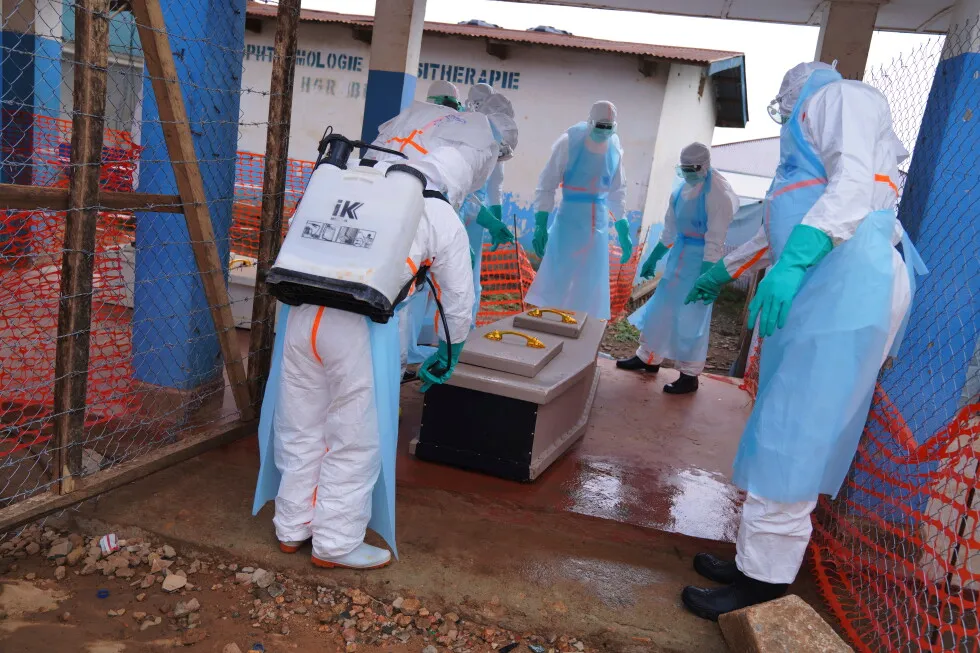
Ebola outbreak is worsening food insecurity in eastern Congo, UN agency chief warns 1 of 2 | Health workers disinfect a coffin of an Ebola victim at Ebola Treatment Center at Bunia General Hospital in Ituri, Congo, Wednesday, July 22, 2026. (AP Photo/Dirole Lotsima Dieudonne) 2 of 2 | Health workers disinfects an ambulance at Ebola Treatment Center at Bunia General Hospital in Ituri, Congo, Wednesday, July 22, 2026. (AP Photo/Dirole Lotsima Dieudonne) By CONSTANT SAME BAGALWA and PROSPER HERI NGORORA Updated 5:57 PM MESZ, July 29, 2026 Leer en español Add AP News on Google Add AP News as your preferred source to see more of our stories on Google. Share Share Facebook Copy Link copied Print Email X LinkedIn Bluesky Flipboard Pinterest Reddit BUNIA, Congo (AP) — The Ebola outbreak in eastern Congo is worsening food insecurity in a country already battling with one of the world’s largest humanitarian crises, the head of the U.N. food agency told The Associated Press on Wednesday. Speaking during a visit to Ituri province, Carl Skau, acting executive director of the World Food Program, described the outbreak as a “crisis on top of a crisis” that has compounded a catastrophic situation with over five million Congolese already experiencing emergency-level food insecurity. A long-running conflict in eastern Congo has driven nearly 10 million people into crisis or emergency levels of hunger, with Ituri province — the epicenter of the Ebola outbreak — among the most affected with 1.9 million of them, according to the WFP. Across some 48 health zones affected with Ebola, more than 2.7 million people face acute food insecurity, including 628,000 in emergency conditions, it added. “Now with Ebola crisis, this is getting worse. Markets are impacted, supply routes are impacted and so people are struggling even more to have enough to eat,” Skau told the AP. Ebola is driving up malnutrition in affected localities The ongoing Ebola outbreak, considered the fastest in history, has recorded 3,360 confirmed cases, including 1,487 deaths since it was declared on May 15. Measures introduced to slow the spread — including border closures and restriction of movements and large gatherings — have disrupted life and businesses, driving up food and fuel prices, the WFP has said. Ebola death toll in Congo rises to at least 930, including dozens of health workers 2 MIN READ Workers at an Ebola treatment center in Congo strike over unpaid salaries and bonuses 2 MIN READ Some health workers in Congo’s Ebola outbreak go on strike over pay issues as deaths near 600 2 MIN READ The U.N. food agency said it has so far delivered more than 160,000 hot meals to patients, contacts and front line workers in 17 treatment and isolation centers. In Mongbwalu, a mining town at one of the epicenters of the outbreak, residents said Ebola and the measures introduced to fight it has made it difficult for some families to feed their children. Kahambu Deborah, a 40-year-old mother of six, said she had been struggling to access her farmland due to rebel violence, and that the restrictions linked to Ebola had made things more challenging. “Accessing food here is one of the hardest things we’ve had to deal with recently. Sometimes, because of the insecurity, we can’t even go to our fields, and our children are suffering as a result,” she said. Dr. Richard Lokudu, director-general of the Mongbwalu General Hospital, said health workers are seeing more malnutrition cases in the region compared to before the outbreak, “even at the Ebola treatment center.” In Mongbwalu, the U.N. agency’s food support program has helped to “limit the movement of people seeking the means to survive,” said Tourne Kasereka, a monitoring assistant with the WFP. The outbreak has been particularly difficult to fight because the Bundibugyo virus responsible for it has no approved vaccines or treatments, unlike most of Congo’s past outbreaks. Officials have warned that it continues to spread faster than health officials can track despite an expanding response. A critical aspect of that response is getting food to those in need of it, according to Skau. “The World Food Program needs resources (and) donors to step up so that we can do more, to alleviate the pressures on the people here in Ituri,” he added.
SRCAssociated Press (AP)
LANGEN
LEANCenter
WORDS711
ENT10
WED · 2026-07-29 · 16:23 GMTBRIEF NSR-2026-0729-97235
NSR-2026-0729-97235News Report·EN·Human Interest
Ebola outbreak is worsening food insecurity in eastern Congo, UN agency chief warns
The World Food Program's acting executive director, Carl Skau, has warned that the ongoing Ebola outbreak in eastern Congo is exacerbating an already severe food insecurity crisis. The outbreak, which has seen over 3,360 confirmed cases, is disrupting markets and supply routes, making it harder for millions of Congolese to access food.
Associated Press (AP)Filed 2026-07-29 · 16:23 GMTLean · CenterRead · 3 min
Associated Press (AP)FIG 01
Reading time
3min
Word count
711words
Sources cited
2cited
Entities identified
10entities
Quality score
100%
§ 01
Briefing Summary
AI-generatedNEWSAR · AI
The World Food Program's acting executive director, Carl Skau, has warned that the ongoing Ebola outbreak in eastern Congo is exacerbating an already severe food insecurity crisis. The outbreak, which has seen over 3,360 confirmed cases, is disrupting markets and supply routes, making it harder for millions of Congolese to access food. This situation is compounded by a long-running conflict that has already pushed nearly 10 million people into crisis or emergency levels of hunger. Measures to control Ebola, such as movement restrictions, have further disrupted livelihoods and increased food prices. The WFP is providing hot meals to those affected and is appealing for more resources to alleviate the growing humanitarian pressure.
Confidence 0.90Sources 2Claims 5Entities 10
§ 02
Article analysis
Model · rule-basedFraming
Human Interest
Conflict
Tone
Measured
AI-assessed
CalmNeutralAlarmist
Factuality
0.80 / 1.00
Factual
LowHigh
Sources cited
2
Limited
FewMany
§ 03
Key claims
5 extracted01
The Ebola outbreak has recorded 3,360 confirmed cases and 1,487 deaths since May 15.
statisticArticle
Confidence
1.00
02
Measures to slow Ebola spread, like border closures and movement restrictions, have disrupted life and businesses, driving up food and fuel prices.
factualWorld Food Program
Confidence
1.00
03
A long-running conflict in eastern Congo has driven nearly 10 million people into crisis or emergency levels of hunger.
statisticWorld Food Program
Confidence
1.00
04
Over five million Congolese are already experiencing emergency-level food insecurity.
statisticWorld Food Program
Confidence
1.00
05
The Ebola outbreak in eastern Congo is worsening food insecurity in a country already battling one of the world's largest humanitarian crises.
quoteCarl Skau, acting executive director of the World Food Program
Confidence
1.00
§ 04
Full report
3 min read · 711 words§ 05
Entities
10 identifiedKey playerOppositionContextPositiveNeutralNegative
§ 06
Keywords & salience
8 termsfood insecurity
1.00
ebola outbreak
1.00
eastern congo
0.90
humanitarian crisis
0.80
world food program
0.70
malnutrition
0.60
conflict
0.50
health workers
0.40
§ 07
Topic connections
Interactive graph Network visualization showing 51 related topics
View Full Graph Person Organization Location Event|Click node to navigate|Edge numbers = shared articles