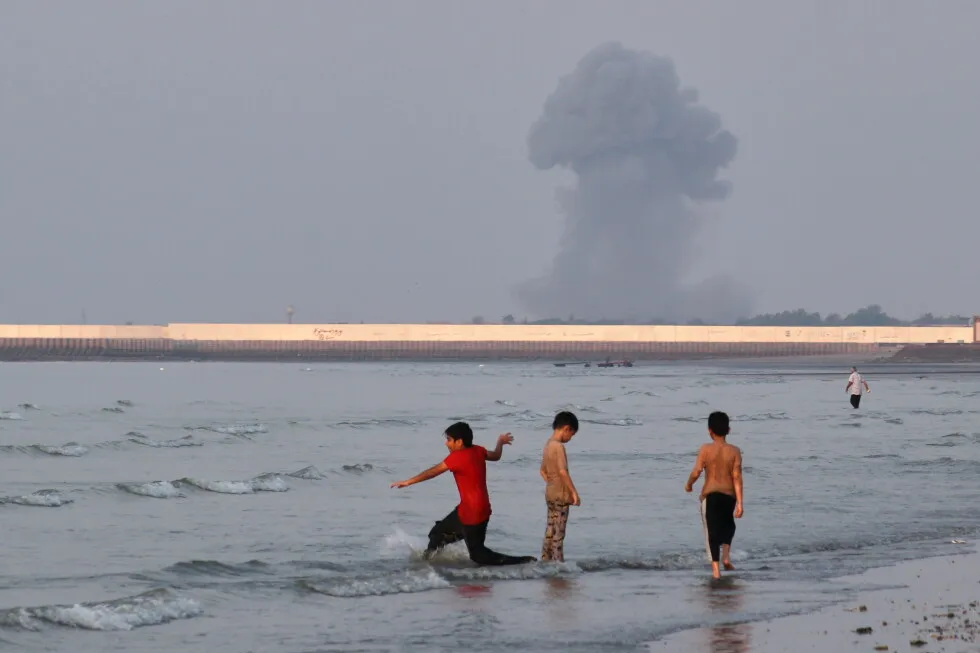
FACT FOCUS: A look at US and Iranian claims of control over the Strait of Hormuz 0 seconds of 50 secondsVolume 0% Press shift question mark to access a list of keyboard shortcuts Keyboard ShortcutsEnabledDisabled Shortcuts Open/Close/ or ? Play/PauseSPACE Increase Volume↑ Decrease Volume↓ Seek Forward→ Seek Backward← Captions On/Offc Fullscreen/Exit Fullscreenf Mute/Unmutem Decrease Caption Size- Increase Caption Size+ or = Seek %0-9 Next Up Americans face biggest food-price spike in decades 01:52 00:00 00:50 00:50 More Videos 01:52 Americans face biggest food-price spike in decades 01:20 Caught on camera: a 300 strong humpback whale supergroup gathering to feed 01:19 Trump says 'serious' talks are going on with Iran but warns US is 'locked and loaded' 01:13 Iran-war" class="entity-link entity-event" data-entity-id="38748" data-entity-type="event">Iran war's global effects: In the US, one mom balances budget and family 01:14 Iran-war" class="entity-link entity-event" data-entity-id="38748" data-entity-type="event">Iran war's global effects: In Turkey, a carpet seller sees sales plummet 01:03 Iran-war" class="entity-link entity-event" data-entity-id="38748" data-entity-type="event">Iran war's global effects: In Nigeria, a business owner struggles to keep the generator running 01:03 Iran-war" class="entity-link entity-event" data-entity-id="38748" data-entity-type="event">Iran war's global effects: In Italy, a farmer battles rising costs of fuel and fertilizers 00:33 Police say suspect in the deadly Berlin Pride attack was shot and killed Close 1 of 4 | The U.S. launched strikes on Iran early Tuesday morning, hours after President Donald Trump said Washington is “reinstating” a blockade on Iran in the Strait of Hormuz. 2 of 4 | Three boys play in the shallow waters of the Strait of Hormuz, as a plume of smoke rises from an explosion in the background, off Bandar Abbas, Iran, Monday, July 13, 2026. (Razieh Poudat/ISNA via AP) 3 of 4 | People walk past a billboard showing the late Iranian Supreme Leader Ayatollah Ali Khamenei in Islamic Revolution Square in Tehran, Iran, Sunday, July 5, 2026. (AP Photo/Vahid Salemi) 4 of 4 | President Donald Trump speaks with reporters in flight on Air Force One after landing at U.S. Air Force Base at RAF Mildenhall, in Suffolk Eastern England, Wednesday, July 8, 2026. (AP Photo/Alex Brandon) By MAE ANDERSON Updated 12:32 AM MESZ, July 14, 2026 Leer en español Add AP News on Google Add AP News as your preferred source to see more of our stories on Google. Share Share Facebook Copy Link copied Print Email X LinkedIn Bluesky Flipboard Pinterest Reddit A focal point of the Iran-war" class="entity-link entity-event" data-entity-id="38748" data-entity-type="event">Iran war is increasingly about who controls the Strait of Hormuz — a narrow, elbow-shaped waterway that for decades was a relatively safe and reliable transit route for Middle East oil and natural gas supplies. By saying that an interim ceasefire gave it the right to establish the terms under which ships traversed the strait, and threatening and firing upon vessels that did not use its preferred route, Iran has sought to exert control over the waterway and gain negotiating leverage with the United States. On Monday, President Donald Trump sought to tip the scales. He reimposed a blockade on Iran and said the U.S. controls the strait and would charge fees to ships for safe passage — essentially borrowing from the Iranian playbook. The announcement came as the U.S. and Iran have been ramping up attacks against each other to assert control over the strait, threatening a return to all-out war. The world has long considered the strait — which passes the coastlines of Iran and Oman — a free-to-use, international waterway. But soon after it was attacked by the U.S. and Israel on Feb. 28, Iran claimed sovereignty over it, disrupting world energy markets and driving up prices. Both Iran and the US say they control the Strait of Hormuz In a posting on Truth Social on Monday, Trump said the U.S. “will be, from this point forward, known as THE GUARDIAN OF THE HORMUZ STRAIT.” Iran’s paramilitary Revolutionary Guard, which controls the Islamic Republic’s ballistic missile arsenal, says Tehran controls the strait. “We will not allow a rogue and child-killing army from the other side of the world to continue its illegal interference in it,” the Guard said Sunday. Iran warns oil tankers to use approved routes in Strait of Hormuz or face a ‘forceful response’ 6 MIN READ 93 Another tanker attacked in Strait of Hormuz as US strikes Iran for 10th consecutive night 4 MIN READ US and Iran pause their attacks after days of escalation 4 MIN READ According to the United Nations Convention on the Law of the Sea, established in 1982, no country has the right to claim international waters and all ships have the right of unimpeded passage. Even though the U.S. and Iran haven’t ratified the convention, “that doesn’t matter, because this has become part of universal custom, so all states can rely on it under all circumstances,” said Marc Weller, director of the International Law Program at the University of Cambridge. Still, both Iran and the U.S. have been using tools to exert control over the strait and constrain traffic. “You have two nations, both of which are very capable — the U.S., because it has the most powerful Navy in the world, and Iran, which is geographically well positioned to disrupt commerce throughout the Strait of Hormuz — (and) can exercise a significant degree of control,” said Raymond Waid, who leads the maritime industry group at law firm Liskow & Lewis in New Orleans and is a former Navy officer. Maritime data agency Kpler said crossings declined by around 52% between Friday and Monday compared with the same period a week ago. About 14 ships passed through the strait on Sunday; before the war, about 130 ships passed through the strait daily. Iran says it has made ‘sincere’ efforts to ensure safe shipping The ability to disrupt shipping in the strait gives Iran leverage over the global economy. Tehran used this leverage early in the war by attacking transiting ships and demanding payment in some cases to allow vessels through. Just the fear of being attacked by Iranian drones or speedboats was enough to deter ship traffic. After an interim ceasefire was announced last month, Iran insisted that ships register with the recently created Persian Gulf Strait Authority to have their crews and cargo vetted. Iran also is demanding that ships only use a route near its coastline instead of a southern route along the coast of Oman, where the U.S. military had started guiding ships through. The central part of the strait has been mined by Iran, so few vessels have tried to pass using that route. Tehran is suspected of attacking ships that have used the Oman route. The United Kingdom Maritime Trade Operations Center, which issues maritime security alerts, said it received reports of six ships attacked in the strait near Oman since June 25. Iranian officials assert the right to manage traffic through the strait Washington and Tehran have debated what they agreed to regarding the strait. U.S. officials say the interim agreement signed last month called for the strait to be reopened while a more permanent resolution to the war was negotiated. Iranian officials have said a clause in the interim deal gave them the right to manage ship traffic and that, so long as they didn’t charge fees for 60 days, it was up to them to decide operating conditions. The interim agreement stated that Iran will “make arrangements using its best efforts for the safe passage of commercial vessels with no charge for 60 days only from the Persian Gulf to the Sea of Oman and vice versa.“ It also called for Iran to ”conduct dialog with the Sultanate of Oman to define the future administration and maritime services in the strait.” The US now says it will charge a fee for safe passage The U.S. said Monday it will charge a 20% toll on cargo shipped through the strait “for any and all costs necessary to do the job of providing safety and security to this very volatile section of the World.” That’s something the U.S. previously opposed, and any attempt by the U.S. or Iran to charge fees would violate global norms on freedom of navigation. The new U.S. plan echoes an earlier Iranian claim — which it opposed — that said it might charge tolls that could reach as high as $2 million per vessel. Countries can levy fees on ships for a specific service when passing through an international strait, said Weller, the international law professor. For example, Chile collects fees in the Strait of Magellan for pilotage and other services that ensure safe passage, he said. “A fee would be possible, but it has to be a fee commensurate with the actual service granted,” he said. “So it’s not anything Iran should earn money off. It’s not $2 million per vessel or something like that.” Late Monday, Iran’s Foreign Minister Abbas Araghchi used Trump’s support for tolls to mock him and legitimize Iran’s position. “POTUS is absolutely right,” he posted on X. “Whoever provides secure and safe passage of commercial vessels through the Strait of Hormuz should be compensated for this service ... 20% is of course too much. We will be fair.” AP Writer Wyatte Grantham-Philips in New York contributed to this report. MAE ANDERSON Anderson reports for The Associated Press on a wide range of issues that small businesses face. She is based in New York. twitter mailto
SRCAssociated Press (AP)
LANGEN
LEANCenter
WORDS1 546
ENT12
THU · 2026-07-30 · 00:53 GMTBRIEF NSR-2026-0730-97347
NSR-2026-0730-97347News Report·EN·Conflict
FACT FOCUS: A look at US and Iranian claims of control over the Strait of Hormuz
The Strait of Hormuz, a vital waterway for global oil and gas transit, has become a focal point of conflict between the U.S. and Iran.
Associated Press (AP)Filed 2026-07-30 · 00:53 GMTLean · CenterRead · 7 min
Associated Press (AP)FIG 01
Reading time
7min
Word count
1 546words
Sources cited
3cited
Entities identified
12entities
Quality score
100%
§ 01
Briefing Summary
AI-generatedNEWSAR · AI
The Strait of Hormuz, a vital waterway for global oil and gas transit, has become a focal point of conflict between the U.S. and Iran. Both nations claim control, with Iran asserting its right to regulate ship traffic following an interim ceasefire and the U.S. reimposing a blockade and announcing it will charge fees for safe passage. This escalation follows a period of increased attacks by both sides, threatening a return to full-scale war. International law generally considers the strait an international waterway with rights of unimpeded passage, a principle both the U.S. and Iran have challenged through their actions. Iran has disrupted shipping by demanding ships use specific routes and vetting cargo, while the U.S. now plans to charge tolls, mirroring Iran's earlier, opposed proposal.
Confidence 0.90Sources 3Claims 4Entities 12
§ 02
Article analysis
Model · rule-basedFraming
Conflict
Political Strategy
Tone
Measured
AI-assessed
CalmNeutralAlarmist
Factuality
0.70 / 1.00
Factual
LowHigh
Sources cited
3
Well sourced
FewMany
§ 03
Key claims
4 extracted01
President Donald Trump said the U.S. controls the strait and would charge fees to ships for safe passage.
quotePresident Donald Trump
Confidence
0.95
02
The Strait of Hormuz was a relatively safe and reliable transit route for Middle East oil and natural gas supplies for decades.
factual
Confidence
0.90
03
The U.S. launched strikes on Iran early Tuesday morning, hours after President Donald Trump said Washington is “reinstating” a blockade on Iran in the Strait of Hormuz.
factualAP News
Confidence
0.90
04
Iran has sought to exert control over the Strait of Hormuz and gain negotiating leverage with the United States.
factual
Confidence
0.80
§ 04
Full report
7 min read · 1 546 words§ 05
Entities
12 identifiedKey playerOppositionContextPositiveNeutralNegative
Organizations1
Locations8
§ 06
Keywords & salience
7 termsstrait of hormuz
1.00
us-iran relations
0.90
control claims
0.80
oil transit
0.70
military strikes
0.60
blockade
0.50
geopolitics
0.40
§ 07
Topic connections
Interactive graph Network visualization showing 51 related topics
View Full Graph Person Organization Location Event|Click node to navigate|Edge numbers = shared articles