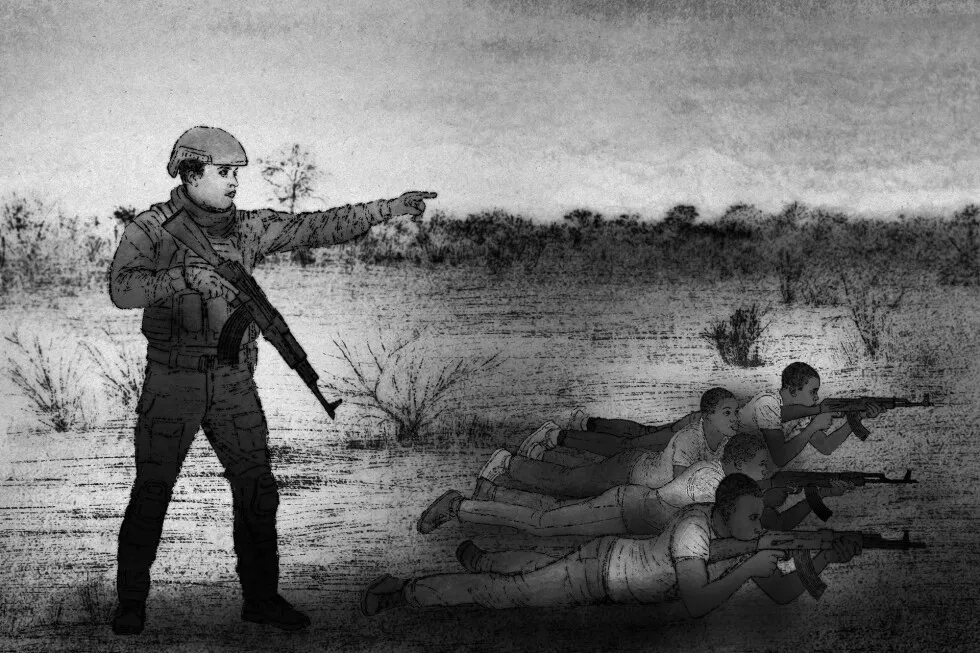
By Sam Mednick, Isabel Debre and Astrid Suárez Updated 5:13 PM MESZ, July 30, 2026 Add AP News on Google Add AP News as your preferred source to see more of our stories on Google. Share Share Facebook Copy Link copied Print Email X LinkedIn Bluesky Flipboard Pinterest Reddit Khartoum, Sudan (AP) — The teenage boy’s hands and legs were shackled to the anti-aircraft gun mounted on a pickup as Sudanese warplanes attacked. He saw another child chained to the steering wheel. As their captors sought cover, the terrified children were ordered to stay and shoot down the jets over the capital, Khartoum. If they tried to flee, they’d be killed by their captors — if the planes didn’t get them first. The boy, now 17, told The Associated Press that those who ordered him strapped to the gun were Colombian mercenaries providing military aid to Sudan’s Rapid Support Forces against the army in the war, now in its fourth year. Another child said he was forced to carry out artillery strikes and beaten for disobedience. The rare, firsthand accounts show the perils faced by tens of thousands of children believed to have been conscripted into the war by all sides. Six former child soldiers who were abducted and forced to fight with the Rapid Support Forces, known as the RSF, spoke to the AP on condition of anonymity for fear of reprisal. Two said they were trained by Colombians. Their accounts point to a wider deployment of Colombian mercenaries, who rights groups say were recruited by a state-linked firm in the United Arab Emirates to fight with the RSF. Human rights groups and Sudan’s military accuse the UAE of arming the RSF, and a U.N. panel said it had tracked weapons shipments to the RSF originating in the Gulf federation that includes Dubai. The UAE did not respond to multiple requests for comment. It has previously denied arming the RSF, saying the shipments in question were of humanitarian aid for refugees. Women say they were raped and ransomed by fighters in Sudan’s ongoing war The scars of war among survivors in Sudan Sudan’s war has left thousands missing. Many are buried in unmarked graves The boy who had been shackled to the gun burst into tears as he ran his hand over scars from the some 18 months he was forced to fight. “I was extremely scared. I just wanted to escape and go home,” he said. He said he was rounded up by RSF fighters in a market in Khartoum’s twin city of Omdurman, where he was selling cigarettes. The paramilitaries were searching for deserters and seized him by mistake, he said. He was 15 at the time. Never having held a gun, he was thrust onto the front lines in Khartoum. Scars on his head and under his eye mark where he says he was hit by shrapnel. He was later taken to an RSF base in Omdurman known as Central Reserve Camp, where he was held with dozens of other children. Their hands were bound all the time, even while eating. “We weren’t allowed to bathe. Instead, they would pour water over us while we were still bound,” he said. He said dozens of foreign mercenaries were at the base, described as Colombians by the RSF fighters there. Speaking through translators, they taught the children how to use anti-aircraft guns. They told RSF fighters to bind the children to the weapons so they couldn’t escape, he said. “When the planes flew overhead, the Colombians would retreat to their bunkers, leaving us outside shackled to the vehicles,” the teenager said. He was forced to fire, but he said he was too afraid and never hit anything. A second boy recounts beatings, and a friend’s killing The second boy described how, at age 15, he was held at an RSF camp called al-Konan, where he said Colombians trained him and other boys on heavy artillery and drones. He said he was locked up and only brought out for artillery strikes. The Colombians and the RSF used drones to choose targets, and sometimes he saw civilians through the camera. When he refused to fire, they would beat him, sometimes with an electric baton. In one case, he said, a Colombian beat him unconscious. An 18-year-old friend tried to flee and was shot dead by the RSF. He carried the body away. “I still have nightmares whenever I try to sleep,” he said. Have a news tip? Tell our investigators AP’s global investigative team accepts tips securely and confidentially. Choose the method that works best for you. Email investigative@ap.org Signal +1 (202) 281-8604 Secure and confidential Both children spoke at a facility run by the military-backed government on Khartoum’s outskirts, where more than 200 former child soldiers were being rehabilitated. Many fell into the hands of the military when it retook the capital from the RSF over the past year. A member of the military media office accompanied the AP during the visit. The official did not choose who the AP interviewed. The AP retains full editorial control of its content. Veterans of Colombia’s long wars have hired themselves out The AP could not independently verify the boys’ accounts, which are consistent with other reporting on the conflict. Multiple countries are entangled in Sudan’s conflict, and other foreigners, including Russians and Ukrainians, have taken part in hostilities. Some 10,000 Colombians have hired themselves out for foreign wars, including in Somalia, Ukraine and Sudan, according to the U.N. Colombia’s decades of internal conflict, involving guerrillas, paramilitaries and drug traffickers, have produced a large cadre of veterans prized for their U.S.-backed military training and driven abroad by meager pensions and scarce civilian job prospects. A recent law bars Colombians from fighting in foreign conflicts, but veteran groups say recruitment has continued. Human Rights Watch and Conflict Insights Group, a private research firm, have documented the presence of Colombian mercenaries alongside the RSF in Sudan’s western region of Darfur, including during the October capture of El Fasher, where RSF fighters have been accused of mass killings. In separate reports this year, Human Rights Watch and Conflict Insights Group said the Colombians were hired by an Emirati contractor and trained in Emirati military bases. The UAE denied those allegations at the time, telling the BBC it had no involvement in recruiting or training foreign fighters and that it would investigate and prosecute any entity suspected of doing so. A Colombian mercenary who fought in Darfur for six months in 2025 told the AP that hundreds of Colombians were on the front lines with the RSF at the time and involved in training recruits. He said he saw children as young as 13 fighting with the RSF. He spoke on condition of anonymity, concerned over legal consequences. Less is known of the Colombians’ role in Khartoum. Ali Qader, the head of the rehabilitation center, said several children told him Colombians trained them at camps around the capital. A former RSF fighter, who defected to the government side and spoke on condition of anonymity out of security concerns, said he saw Colombians training children in Khartoum in July 2024. A Sudanese military officer with knowledge of the situation said Colombians were training children in and around Khartoum when the RSF held the city. The officer was not authorized to brief reporters and spoke on condition of anonymity. The Colombian government said it has no official information confirming allegations that Colombians recruited or trained child soldiers in Sudan. It condemned such abuses. Tens of thousands of children as young as 8 have been recruited during Sudan’s war, according to Abdelgadir Abdullah Abu, secretary-general of Sudan’s National Council for Child Welfare, a government body. The U.N. says all sides in the conflict have used child soldiers, including militias allied with the government. Many are believed to still be on the front lines. The RSF and the Sudanese government did not respond to detailed requests for comment. The RSF have roots in the Janjaweed militias that rampaged across Darfur in the early 2000s. Sudan’s then-president Omar al-Bashir was indicted for war crimes and genocide by the International Criminal Court over that campaign. Rights groups say the RSF employs similar tactics today, and that the UAE’s alleged support for it could implicate the Gulf country. “The evidence suggests the UAE could be substantially contributing to the RSF’s widespread crimes against humanity,” said Jean-Baptiste Gallopin, a senior adviser at Human Rights Watch. Children returning from the front often have nowhere to go At the rehabilitation center, which included a soccer field and volleyball net, boys dressed in white uniforms showed an AP reporter their wounds. One was missing a hand; another had scars on his back from where he said he was tortured; a third had a bone jutting out of his side. The boy held at the Central Reserve Camp said that at one point, when tied to the anti-aircraft gun, he refused to fire on a jet. RSF fighters shot at him as punishment, wounding his foot. The wound filled with worms, he said. Eventually, the fighters abandoned him because of it, and he was later brought to the youth facility. Wiping away tears, he said he’s aching to return home. His mother died from illness during the war, and his father told him he was ashamed of what his son had done and doesn’t want to see him. Zeinab Mahjoub, a psychologist at the facility, said she tries to persuade relatives to not to abandon the boys. At the same time, the boys are wrestling with their own trauma. Sheldon Yett, the head of the U.N. children’s agency in Sudan, said it was working with the government and other parties to speed up the process of releasing the boys, trying to convince authorities to treat “children as children.” Since the AP visited the center in April, the children have been released. The boy held at al-Konan Camp said that after nearly two years, he escaped one night when a guard left a door unlocked. He tried returning to his family but someone in the area knew he had fought with the RSF and reported him to the authorities, who referred him to the center. He’s trying to move on but is wrestling with guilt. “We have made mistakes,” he said. “We want to get out of here to rebuild Sudan.” DeBre reported from Buenos Aires, Argentina, and Suárez from Bogota, Colombia. Sam Mednick Mednick is an AP correspondent for Israel and the Palestinian Territories. She focuses on conflict, humanitarian crises and human rights abuses. Mednick formerly covered West & Central Africa and South Sudan. twitter Isabel Debre DeBre writes about Argentina, Bolivia, Chile, Paraguay and Uruguay for The Associated Press, based in Buenos Aires. Before moving to South America in 2024, she covered the Middle East reporting from Jerusalem, Cairo and Dubai. twitter mailto
SRCAssociated Press (AP)
LANGEN
LEANCenter
WORDS1 816
ENT12
THU · 2026-07-30 · 15:23 GMTBRIEF NSR-2026-0730-97564
NSR-2026-0730-97564News Report·EN·Human Rights
AP Exclusive: Child soldiers recount horrors of Sudan’s war and presence of Colombian mercenaries
Child soldiers in Sudan's ongoing war have recounted harrowing experiences, including being shackled to weapons and forced to fight by Colombian mercenaries supporting the Rapid Support Forces (RSF). Six former child soldiers, abducted and conscripted by the RSF, shared their accounts with the Associated Press, with two specifically mentioning training by Colombians.
Associated Press (AP)Filed 2026-07-30 · 15:23 GMTLean · CenterRead · 8 min
Associated Press (AP)FIG 01
Reading time
8min
Word count
1 816words
Sources cited
3cited
Entities identified
12entities
Quality score
100%
§ 01
Briefing Summary
AI-generatedNEWSAR · AI
Child soldiers in Sudan's ongoing war have recounted harrowing experiences, including being shackled to weapons and forced to fight by Colombian mercenaries supporting the Rapid Support Forces (RSF). Six former child soldiers, abducted and conscripted by the RSF, shared their accounts with the Associated Press, with two specifically mentioning training by Colombians. These mercenaries, allegedly recruited by an Emirati firm, are accused of providing military aid to the RSF. The children described being subjected to violence, including beatings for disobedience, and witnessing the deaths of fellow child soldiers. These testimonies highlight the widespread use of child soldiers in the conflict, with tens of thousands believed to have been recruited by all sides. The UAE has denied allegations of arming the RSF.
Confidence 0.90Sources 3Claims 5Entities 12
§ 02
Article analysis
Model · rule-basedFraming
Human Rights
Conflict
Tone
Mixed Tone
AI-assessed
CalmNeutralAlarmist
Factuality
0.80 / 1.00
Factual
LowHigh
Sources cited
3
Well sourced
FewMany
§ 03
Key claims
5 extracted01
Child soldiers were subjected to harsh conditions, including being bound at all times and denied bathing.
quotechild soldier
Confidence
1.00
02
Teenage boy recounts being shackled to an anti-aircraft gun and forced to shoot down jets by Colombian mercenaries aiding Sudan's Rapid Support Forces.
quotechild soldier
Confidence
1.00
03
The UAE has previously denied arming the RSF, stating shipments were humanitarian aid.
factualUAE
Confidence
0.90
04
Rights groups and Sudan's military accuse the UAE of arming the RSF, with a UN panel tracking weapons shipments originating from the UAE.
factualhuman rights groups, Sudan's military, UN panel
Confidence
0.90
05
Six former child soldiers abducted and forced to fight with the RSF spoke to the AP, with two reporting training by Colombians.
factualAP reporting
Confidence
0.90
§ 04
Full report
8 min read · 1 816 words§ 05
Entities
12 identifiedKey playerOppositionContextPositiveNeutralNegative
People3
Organizations3
Locations4
Events1
§ 06
Keywords & salience
10 termssudan war
1.00
child soldiers
1.00
colombian mercenaries
0.90
rapid support forces
0.80
khartoum
0.70
forced conscription
0.70
human rights abuses
0.60
uae involvement
0.50
military aid
0.40
war crimes
0.40
§ 07
Topic connections
Interactive graph Network visualization showing 51 related topics
View Full Graph Person Organization Location Event|Click node to navigate|Edge numbers = shared articles