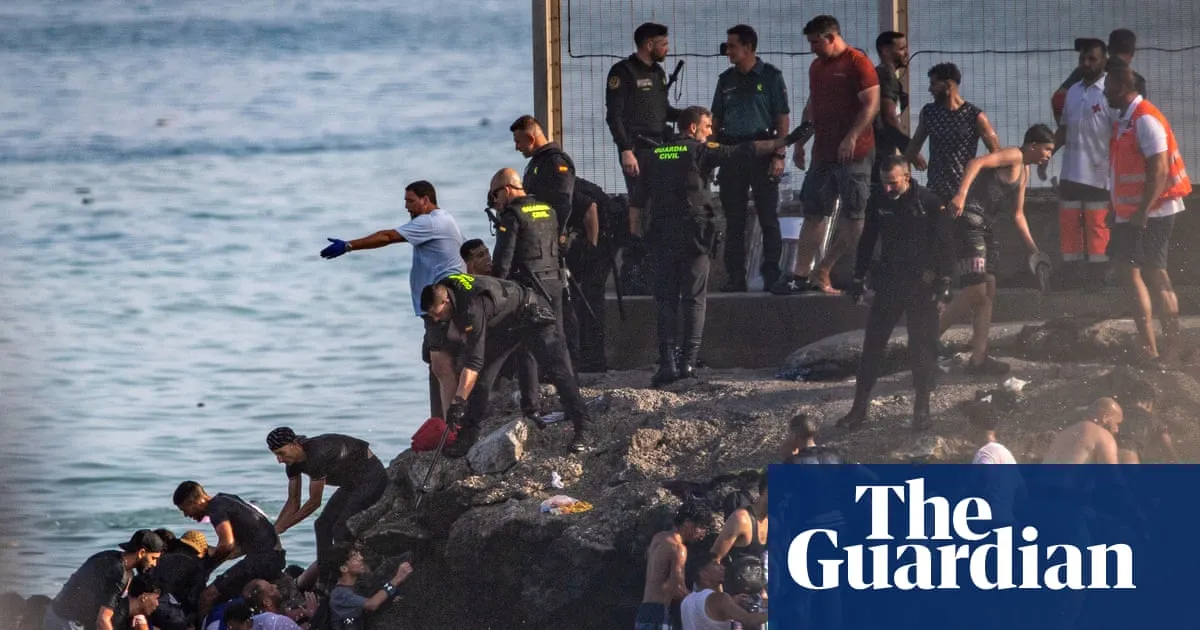
At least 18 people have died trying to reach the Spanish enclave of Ceuta after approximately 49,000 migrants entered the tiny territory from Morocco in a matter of hours, triggering a political crisis for the Madrid government and unleashing a barrage of criticism from other EU countries.The large influx of people arriving in Ceuta by swimming across from neighbouring Morocco or scaling the high border fence has caught the city of 85,000 off guard and resulted in what one local police association has called a “serious Humanitarian Crisis”.Spain’s prime minister, Pedro Sánchez, who is due to visit Ceuta on Friday with the interior minister, Fernando Grande-Marlaska, is under huge pressure from political opponents and other European countries to come up with a swift and comprehensive response.The latest incident dwarfs the last mass border crossing in May 2021, when 10,000 people entered the territory over the course of two days by taking advantage of a loosening of border controls by Morocco.People waiting on the Moroccan side of the border for a chance to cross to Ceuta. Photograph: ReutersThat crossing came amid heightened tensions between Madrid and Rabat over Spain’s decision to allow the leader of the Western Sahara independence movement, the Polisario Front, to be treated for Covid-19 in Spain. Morocco and the Polisario Front both lay claim to Western Sahara, which was under Spanish rule until 1975, when colonial authorities handed over the territory to Morocco and Mauritania.That diplomatic crisis ended in 2022 when Madrid reversed its longstanding policy of neutrality and backed Morocco’s plan for Western Sahara – a move that had caused a diplomatic rift between Madrid and Algiers, which had supported the Polisario group.Sánchez visited Algiers on 20 July – the first such visit by a Spanish head of government in four years – marking a thaw in relations with Algeria.Moroccan government sources told the Europa Press news agency that the surge of people entering Ceuta was down to “criminal organisations”, and insisted that Rabat’s cooperation with Spain remained “exemplary”.Crowds in downtown Ceuta on Friday after making the crossing. Photograph: Fabian Bimmer/ReutersOn Thursday evening, Spain’s interior ministry announced that 60 members of the armed forces would be deployed to Ceuta, along with an additional 30 Guardia Civil officers. “The armed forces will reinforce the Guardia Civil in the exercise of its powers and any others that may be necessary to maintain security in the city of Ceuta,” the ministry said.But the situation is evolving rapidly as the city struggles to cope with the massive number of arrivals.Rachid Sbihi, who leads a local workers association representing Civil Guard officers, described the situation as a “serious Humanitarian Crisis”. He said: “People are still entering. The reinforcements that have arrived are only helping the injured and other humanitarian efforts.”Without shelter, thousands of people including unaccompanied children had been left sleeping in parks and on pavements while others roamed the streets aimlessly, Sbihi said. “It’s chaotic,” he added.Among the 18 who died, many drowned, but some were killed in a crush to cross the breakwater fence at Tarajal beach, Sbihi said.Video footage on Thursday showed crowds of people walking around the breakwaters at Tarajal beach on to local roads. While most appeared to be young men, there were also families with women and small children.Hundreds of migrants run and cheer as they enter Spain’s enclave of Ceuta“Viva España!” some shouted to a freelance photographer working for the Associated Press. It was not immediately clear what had prompted so many people to cross to Ceuta.Ceuta, along with Melilla, another Spanish autonomous city in northern Morocco, has the EU’s only land border with Africa. Both cities periodically experience surges in attempted crossings by people seeking to reach Europe.Juan Jesús Vivas, the mayor-president of Ceuta, demanded the deployment of additional police and troops “to guarantee the inviolability of the frontier” and citizens’ safety. He also called on the central government to declare a national emergency over the crossings.But the government rejected calls for the declaration of a national emergency, saying such emergencies could not be declared over migration issues, and could be declared only in response to dire meteorological events – such as the current wildfires – or in the face of a volcanic or nuclear threat.Events in Ceuta have led some other EU countries to issue threats or rebukes.Spain’s foreign minister, José Manuel Albares, summoned Italy’s ambassador to Madrid on Friday after Giorgia Meloni’s far-right government called for Spain to be suspended from the Schengen free-movement zone.Meloni said Italy was prepared to take “extraordinary measures” to defend its borders, claiming that the “shocking” scenes from Ceuta demonstrated that “illegal Immigration poses a real threat to the security of Europe’s borders”.Spanish soldiers patrolling at the Spanish-Moroccan border in Ceuta on Friday. Photograph: Fabian Bimmer/ReutersMeloni, whose government has been struggling to regain traction since a failed referendum on judicial reforms in March, appears to be exploiting the incident for political gain before general elections next year in which she faces competition from a new hard-right rival, Roberto Vannacci. She has made security her key political offering.Italy’s foreign minister, Antonio Tajani, blamed the situation in Ceuta on the Sánchez government’s decision to offer a now-closed scheme to regularise the status of more than 1 million undocumented migrants and asylum seekers. He said the programme had incentivised human trafficking and was “profoundly wrong”.Tajani’s remarks prompted a sharp response from Albares, who said the comments were “unbecoming” and accused Italy of “partisan demagoguery”.The French interior minister, Laurent Nuñez, said he had given instructions for the strengthening of controls at the Spanish border.The former French prime minister Michel Barnier was more outspoken, saying France “cannot suffer the consequences of its neighbours’ migration choices”. He also appeared to criticise Spain’s regularisation scheme, saying: “If a member state makes decisions that create a pull factor for migration, we must be able to immediately protect our borders … Mastering Immigration is a condition of sovereignty, security and trust between European states.”In Spain, the opposition People’s party (PP) is calling on Sánchez to come up with a tough response, saying the small military and police reinforcements announced on Thursday night were insufficient.In a post on X, the PP’s leader, Alberto Núñez Feij, wrote: “People have continued to arrive in Ceuta throughout the night, and those on the ground describe an occupied city, with nothing sufficient being done to prevent it.”The far-right Vox party, meanwhile, was calling the incident “an invasion”.
SRCThe Guardian - World News
LANGEN
LEANCenter-Left
WORDS1 067
ENT12
FRI · 2026-07-31 · 09:43 GMTBRIEF NSR-2026-0731-97796
NSR-2026-0731-97796News Report·EN·Human Rights
At least 18 die as 49,000 people cross to Spanish enclave of Ceuta from Morocco
At least 18 people died attempting to reach the Spanish enclave of Ceuta from Morocco, with approximately 49,000 migrants crossing in a matter of hours. This influx, by swimming or scaling the border fence, has overwhelmed the city and triggered a political crisis for Spain's government, drawing criticism from other EU countries like Italy.
Sam Jones in Madrid and Angela Giuffrida in RomeThe Guardian - World NewsFiled 2026-07-31 · 09:43 GMTLean · Center-LeftRead · 5 min
The Guardian - World NewsFIG 01
Reading time
5min
Word count
1 067words
Sources cited
4cited
Entities identified
12entities
Quality score
100%
§ 01
Briefing Summary
AI-generatedNEWSAR · AI
At least 18 people died attempting to reach the Spanish enclave of Ceuta from Morocco, with approximately 49,000 migrants crossing in a matter of hours. This influx, by swimming or scaling the border fence, has overwhelmed the city and triggered a political crisis for Spain's government, drawing criticism from other EU countries like Italy. Spain's prime minister is under pressure to respond, and the military has been deployed to reinforce security. The situation is described as a "serious humanitarian crisis" with thousands of migrants, including children, left without shelter. The cause of the surge remains unclear, though Moroccan sources attribute it to "criminal organisations."
Confidence 0.90Sources 4Claims 5Entities 12
§ 02
Article analysis
Model · rule-basedFraming
Human Rights
Political Strategy
Tone
Mixed Tone
AI-assessed
CalmNeutralAlarmist
Factuality
0.80 / 1.00
Factual
LowHigh
Sources cited
4
Well sourced
FewMany
§ 03
Key claims
5 extracted01
Spain's interior ministry announced that 60 members of the armed forces would be deployed to Ceuta, along with an additional 30 Guardia Civil officers.
statisticSpain's interior ministry
Confidence
1.00
02
Moroccan government sources stated that the surge of people entering Ceuta was down to “criminal organisations”.
quoteMoroccan government sources
Confidence
1.00
03
The situation has been called a “serious humanitarian crisis” by a local police association.
quotelocal police association
Confidence
1.00
04
At least 18 people have died trying to reach the Spanish enclave of Ceuta.
statistic
Confidence
1.00
05
Approximately 49,000 migrants entered Ceuta from Morocco in a matter of hours.
statistic
Confidence
0.90
§ 04
Full report
5 min read · 1 067 words§ 05
Entities
12 identifiedKey playerOppositionContextPositiveNeutralNegative
Organizations3
Locations5
§ 06
Keywords & salience
10 termsmorocco
1.00
spain
1.00
ceuta
1.00
migrant crisis
1.00
border security
0.80
political crisis
0.70
humanitarian crisis
0.70
eu
0.60
western sahara
0.50
diplomatic relations
0.40
§ 07
Topic connections
Interactive graph Network visualization showing 51 related topics
View Full Graph Person Organization Location Event|Click node to navigate|Edge numbers = shared articles