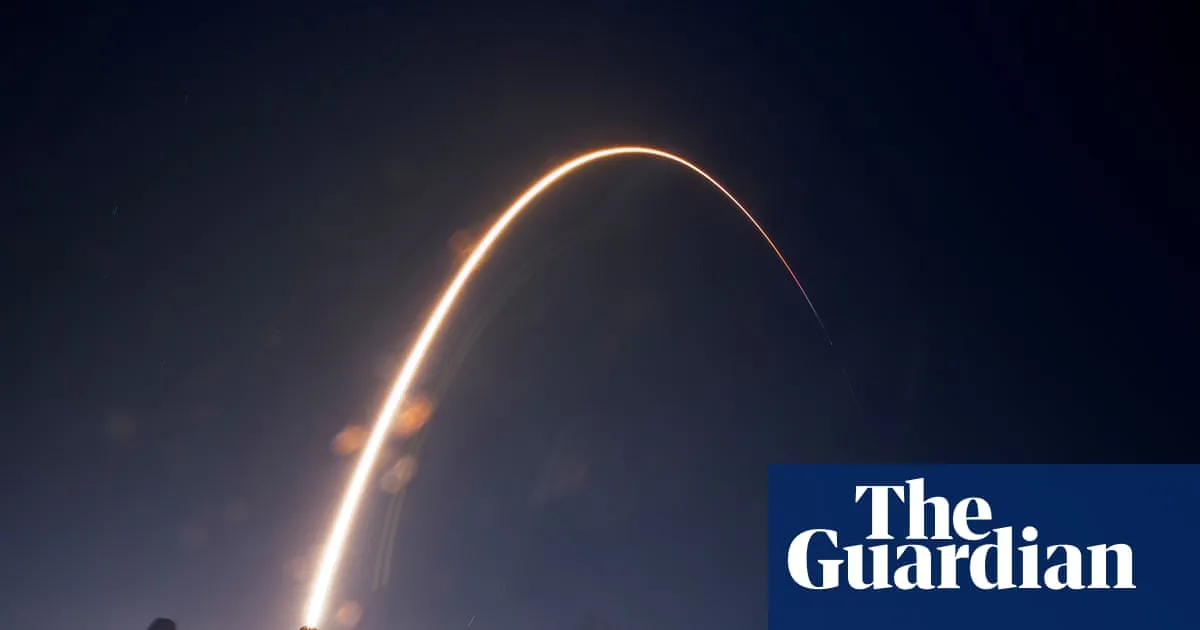
A drifting SpaceX rocket is on a collision course with the Moon after launching a pair of lunar landers more than a year ago.The rocket’s upper stage will unintentionally slam into the Moon on Wednesday, carving out a crater and sending up a plume of dust and rubble that scientists – and sky gazers – are eager to observe.Space tracking expert Bill Gray predicts an impact of 5,400mph (8,700km/h) – seven times the speed of sound – near Einstein Crater on the Moon’s sunlit western limb. With the action unfolding in the wee hours of the morning for the US, the eastern portions of the US and Canada, and much of South America, should have the best views.While scientists are not too concerned about this particular piece of space junk, it highlights the growing threat as more and more items cram into orbit.“Things are getting crowded up there,” said Gray, who plans to view the aftermath from New Brunswick, Canada.It was never SpaceX’s intent to hit the Moon. But space experts said the crash could have been avoided if the upper stage had been nudged into orbit around the sun.It will be the second dead rocket known to crash into the Moon accidentally. A Chinese rocket segment dug out a pair of craters on the lunar far side in 2022.The new smashup will occur on the Moon’s near side, packing the equivalent energy of three tons of TNT explosives.The impact flash, lasting less than a second, will probably be too dim to see from Earth, according to experts. But the stream of ejected material could stretch for several miles into space and remain visible to telescopes for tens of minutes.“Gravity on the Moon is low and there is no wind to blow the dust away,” said Los Alamos National Laboratory’s Benjamin Fernando, who is encouraging observations by professionals and amateurs alike.“Part of the reason for our interest in this event is to figure out how much of a hazard debris impacts pose to future astronauts,” he added in an email.Fernando anticipates an impact crater nearly 90ft across and 16ft deep (27 meters across and 5 meters deep), too small to see from Earth but visible to spacecraft.Nasa’s Lunar Reconnaissance Orbiter and South Korea’s Danuri lunar orbiter will gather before-and-after shots of the crash scene.
SRCThe Guardian - World News
LANGEN
LEANCenter-Left
WORDS384
ENT12
FRI · 2026-07-31 · 13:05 GMTBRIEF NSR-2026-0731-97863
NSR-2026-0731-97863News Report·EN·Technology
Drifting SpaceX rocket heading for accidental collision with moon
A SpaceX rocket's upper stage, launched over a year ago, is set to unintentionally collide with the moon on Wednesday. The impact, predicted to occur at approximately 5,400 mph near Einstein Crater, will create a crater and eject dust and rubble.
Associated PressThe Guardian - World NewsFiled 2026-07-31 · 13:05 GMTLean · Center-LeftRead · 2 min
The Guardian - World NewsFIG 01
Reading time
2min
Word count
384words
Sources cited
3cited
Entities identified
12entities
Quality score
100%
§ 01
Briefing Summary
AI-generatedNEWSAR · AI
A SpaceX rocket's upper stage, launched over a year ago, is set to unintentionally collide with the moon on Wednesday. The impact, predicted to occur at approximately 5,400 mph near Einstein Crater, will create a crater and eject dust and rubble. Scientists and sky gazers are eager to observe the event, which could provide insights into the hazards of space debris. While this particular crash is not a major concern, it highlights the growing issue of orbital crowding. This marks the second known accidental rocket crash on the moon, following a Chinese rocket segment in 2022. NASA and South Korea's lunar orbiters will document the impact site.
Confidence 0.90Sources 3Claims 5Entities 12
§ 02
Article analysis
Model · rule-basedFraming
Technology
Human Interest
Tone
Mixed Tone
AI-assessed
CalmNeutralAlarmist
Factuality
0.80 / 1.00
Factual
LowHigh
Sources cited
3
Well sourced
FewMany
§ 03
Key claims
5 extracted01
It will be the second dead rocket known to crash into the moon accidentally.
factual
Confidence
0.90
02
Space tracking expert Bill Gray predicts an impact of 5,400mph (8,700km/h) near Einstein Crater.
predictionBill Gray
Confidence
0.90
03
The rocket’s upper stage will unintentionally slam into the moon on Wednesday.
factual
Confidence
0.90
04
A drifting SpaceX rocket is on a collision course with the moon.
factual
Confidence
0.90
05
Fernando anticipates an impact crater nearly 90ft across and 16ft deep.
predictionBenjamin Fernando
Confidence
0.80
§ 04
Full report
2 min read · 384 words§ 05
Entities
12 identifiedKey playerOppositionContextPositiveNeutralNegative
Organizations3
Locations6
§ 06
Keywords & salience
10 termsmoon collision
1.00
spacex rocket
1.00
space junk
0.90
lunar landers
0.70
impact crater
0.70
orbital debris
0.60
lunar orbiter
0.50
space tracking
0.50
astronomy observation
0.40
rocket crash
0.40
§ 07
Topic connections
Interactive graph Network visualization showing 51 related topics
View Full Graph Person Organization Location Event|Click node to navigate|Edge numbers = shared articles