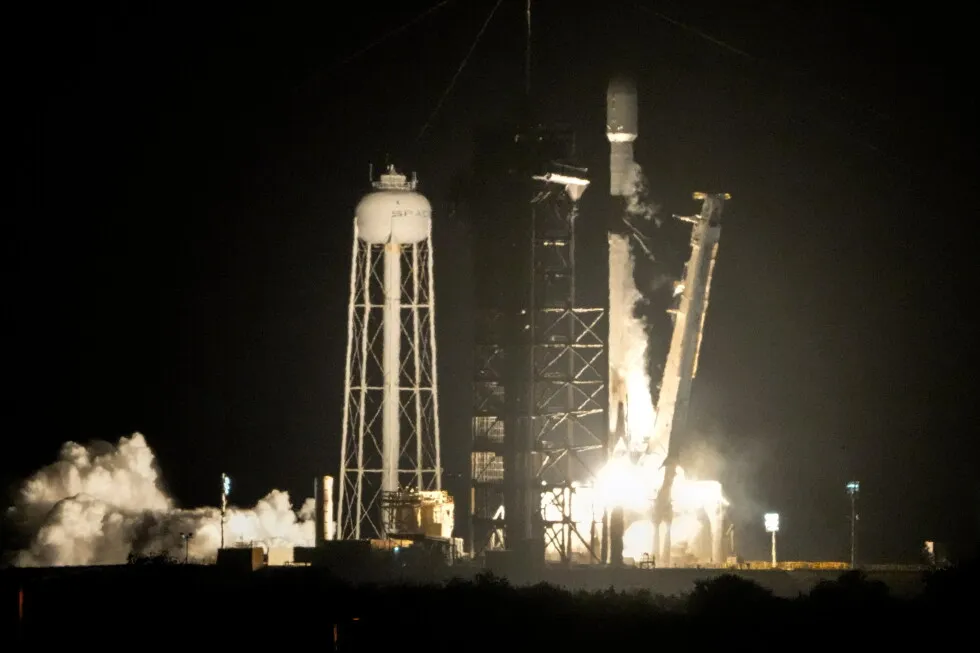
Scientists are certain a wayward SpaceX rocket slammed into the Moon as predicted 1 of 3 | Scientists say they’re certain that a SpaceX rocket has slammed into the Moon as predicted. The 5,400-mph crash has yet to be officially confirmed. But space-tracking experts say it’s inevitable that the leftover rocket segment plowed into the Moon on Wednesday after drifting off course for the past year. 2 of 3 | A SpaceX Falcon 9 rocket lifts off from pad 39A with a payload of a pair of lunar landers at the Kennedy Space Center in Cape Canaveral, Fla., Jan. 15, 2025. (AP Photo/John Raoux, File) 3 of 3 | A blue Moon rises in San Jose de Maipo outskirts of capital Santiago, Chile, May 30, 2026. (AP Photo/Esteban Felix, File) 1 of 3 Scientists say they’re certain that a SpaceX rocket has slammed into the Moon as predicted. The 5,400-mph crash has yet to be officially confirmed. But space-tracking experts say it’s inevitable that the leftover rocket segment plowed into the Moon on Wednesday after drifting off course for the past year. Add AP News on Google Add AP News as your preferred source to see more of our stories on Google. Share 2 of 3 | A SpaceX Falcon 9 rocket lifts off from pad 39A with a payload of a pair of lunar landers at the Kennedy Space Center in Cape Canaveral, Fla., Jan. 15, 2025. (AP Photo/John Raoux, File) 2 of 3 A SpaceX Falcon 9 rocket lifts off from pad 39A with a payload of a pair of lunar landers at the Kennedy Space Center in Cape Canaveral, Fla., Jan. 15, 2025. (AP Photo/John Raoux, File) Add AP News on Google Add AP News as your preferred source to see more of our stories on Google. Share 3 of 3 | A blue Moon rises in San Jose de Maipo outskirts of capital Santiago, Chile, May 30, 2026. (AP Photo/Esteban Felix, File) 3 of 3 A blue Moon rises in San Jose de Maipo outskirts of capital Santiago, Chile, May 30, 2026. (AP Photo/Esteban Felix, File) Add AP News on Google Add AP News as your preferred source to see more of our stories on Google. Share Updated [hour]:[minute] [AMPM] [timezone], [monthFull] [day], [year] Cape Canaveral, Fla. (AP) — A SpaceX rocket that launched a pair of lunar landers undoubtedly slammed into the Moon as predicted on Wednesday after drifting off course for the past year, scientists reported.Although the 5,400-mph (8,700-kph) collision had yet to be officially confirmed, space tracking experts said it was inevitable that the leftover rocket segment plowed into the Moon.It’s the latest instance of lunar litter, a problem that many fear could worsen as the U.S. and China race to put astronauts on the Moon. In 2022, a Chinese rocket unintentionally hit the Moon following a lunar mission, and many more stray rocket pieces likely struck the Moon in decades past without scientists’ knowledge. SpaceX’s Julianna Scheiman said this week that the company is working with NASA to avoid future wrecks, stressing that this projected crash was not deliberate. A combination of solar activity and gravity accidentally put it on a collision course with the Moon, she said. Retired astrophysicist Jonathan McDowell noted that observations of the dead 4-ton upper stage on Tuesday night showed it heading straight for the Moon. The anticipated crash site was a dusty, barren patch near Einstein Crater on the Moon’s sunlit western limb — near the edge of the near and far sides, which is especially difficult to observe from Earth.“There’s no doubt in my mind” that the rocket “is now in teeny, little pieces scattered over the Moon near Einstein Crater,” McDowell told The Associated Press. 5 MIN READ 2 MIN READ 2 MIN READ “As a physicist, I know that what goes up must come down,” he added. Even in the unlikely event that an asteroid struck the rocket during its final stretch, the pieces still would have hit the Moon at the same place, McDowell said. “It’s very hard to imagine ... that will put it on a very different course.”Stargazers knew it would be difficult, if not impossible, from the ground to see the plume of dust and rock ejected from the resulting crater, let alone the flash of light from the impact. Orbiting spacecraft had the best chance of witnessing anything — or at least observing the crater after the fact.Dutch scientist Marco Langbroek was among those aiming his telescope at the Moon at the appointed time, but he came up empty. “We knew this would be a long shot,” Langbroek said. Like McDowell, Langbroek said he has “no doubt” the rocket met its doom. Visual confirmation, McDowell noted, will have to wait for NASA’s Lunar Reconnaissance Orbiter to fly over the crash scene and send back photos of the impact crater. The space agency doesn’t expect that to happen until next week.The Falcon rocket’s upper stage — a fat cylinder more than 40 feet (12 meters) long — hoisted two private lunar landers from Cape Canaveral on Jan. 15, 2025. It ended up adrift after putting Firefly Aerospace’s Blue Ghost and ispace’s Resilience on course for the Moon. Resilience wrecked, but Blue Ghost aced its touchdown, becoming the first private spacecraft to do so.The Moon is the new go-to destination in space, with NASA envisioning a stampede of robotic craft over the next several years to form the foundation for a sustainable lunar base. Elon Musk’s SpaceX and Jeff Bezos’ Blue Origin will provide the lunar landers for NASA’s Artemis astronauts. Musk’s Starship is making steady progress in test flights from Texas. Bezos’ Blue Moon lander has yet to launch. One or both landers will take part in next year’s Artemis III, a docking rehearsal in orbit around Earth. A lunar touchdown by astronauts — the first since NASA’s Apollo moonshots — could follow as soon as 2028. “Things are going to get a lot busier near the Moon,” McDowell said. “At that point an impact like this on the lunar surface plowing up huge amounts of dust going for hundreds of miles around is not going to be acceptable.”The Associated Press Health and Science Department receives support from the Howard Hughes Medical Institute’s Department of Science Education and the Robert Wood Johnson Foundation. The AP is solely responsible for all content.
SRCAssociated Press (AP)
LANGEN
LEANCenter
WORDS1 062
ENT11
WED · 2026-08-05 · 15:53 GMTBRIEF NSR-2026-0805-99433
NSR-2026-0805-99433News Report·EN·Technology
Scientists are certain a wayward SpaceX rocket slammed into the moon as predicted
Scientists are certain a SpaceX rocket's upper stage, which launched two lunar landers in January 2025, has crashed into the moon as predicted. The 5,400-mph collision, though not yet officially confirmed, is considered inevitable by space tracking experts after the rocket segment drifted off course for a year due to solar activity and gravity.
By
MARCIA DUNNAssociated Press (AP)Filed 2026-08-05 · 15:53 GMTLean · CenterRead · 5 min
Associated Press (AP)FIG 01
Reading time
5min
Word count
1 062words
Sources cited
2cited
Entities identified
11entities
Quality score
100%
§ 01
Briefing Summary
AI-generatedNEWSAR · AI
Scientists are certain a SpaceX rocket's upper stage, which launched two lunar landers in January 2025, has crashed into the moon as predicted. The 5,400-mph collision, though not yet officially confirmed, is considered inevitable by space tracking experts after the rocket segment drifted off course for a year due to solar activity and gravity. This incident marks another instance of "lunar litter," a growing concern as space exploration intensifies. SpaceX is working with NASA to prevent future accidental crashes. Visual confirmation of the impact crater is expected next week from NASA's Lunar Reconnaissance Orbiter.
Confidence 0.90Sources 2Claims 5Entities 11
§ 02
Article analysis
Model · rule-basedFraming
Technology
Human Interest
Tone
Mixed Tone
AI-assessed
CalmNeutralAlarmist
Factuality
0.70 / 1.00
Factual
LowHigh
Sources cited
2
Limited
FewMany
§ 03
Key claims
5 extracted01
SpaceX is working with NASA to avoid future wrecks.
factualJulianna Scheiman (SpaceX)
Confidence
0.90
02
The rocket segment had been drifting off course for the past year.
factualspace-tracking experts
Confidence
0.90
03
The crash occurred at approximately 5,400 mph.
statisticscientists
Confidence
0.90
04
A SpaceX rocket segment has slammed into the moon.
factualscientists
Confidence
0.90
05
This is the latest instance of lunar litter, a problem that could worsen as the U.S. and China race to put astronauts on the moon.
factualarticle
Confidence
0.80
§ 04
Full report
5 min read · 1 062 words§ 05
Entities
11 identifiedKey playerOppositionContextPositiveNeutralNegative
Organizations2
§ 06
Keywords & salience
8 termsmoon impact
1.00
spacex rocket
1.00
lunar litter
0.90
space tracking
0.80
rocket segment
0.70
drifting off course
0.60
lunar landers
0.50
spacex falcon 9
0.40
§ 07
Topic connections
Interactive graph Network visualization showing 51 related topics
View Full Graph Person Organization Location Event|Click node to navigate|Edge numbers = shared articles