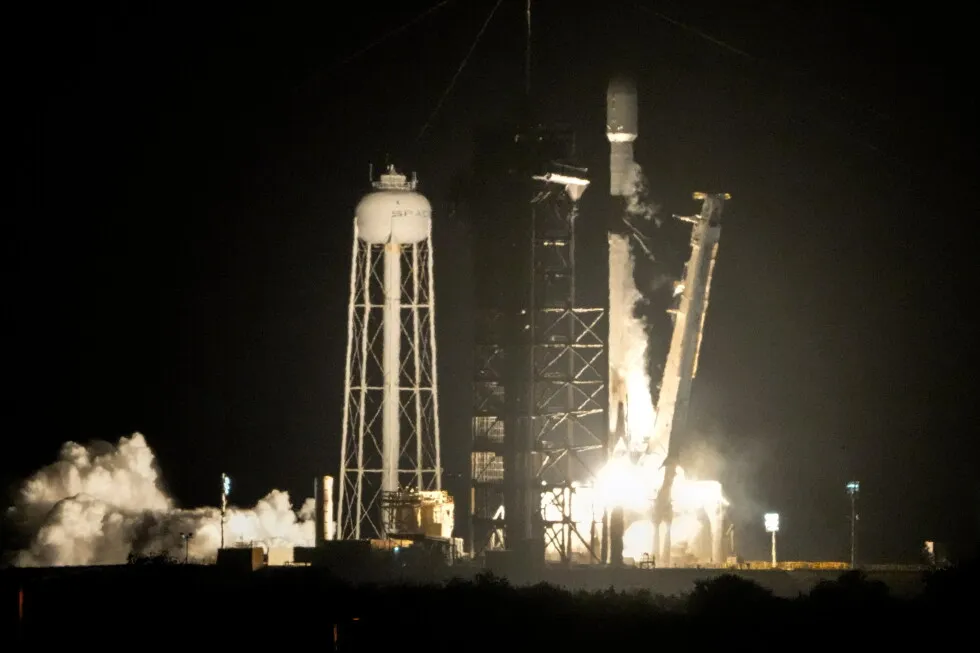
A discarded SpaceX rocket is on a high-speed collision course with the Moon 1 of 2 | A SpaceX Falcon 9 rocket lifts off from pad 39A with a payload of a pair of lunar landers at the Kennedy Space Center in Cape Canaveral, Fla., Jan. 15, 2025. (AP Photo/John Raoux, File) 2 of 2 | A blue Moon rises in San Jose de Maipo outskirts of capital Santiago, Chile, May 30, 2026. (AP Photo/Esteban Felix, File) 1 of 2 | A SpaceX Falcon 9 rocket lifts off from pad 39A with a payload of a pair of lunar landers at the Kennedy Space Center in Cape Canaveral, Fla., Jan. 15, 2025. (AP Photo/John Raoux, File) 1 of 2 A SpaceX Falcon 9 rocket lifts off from pad 39A with a payload of a pair of lunar landers at the Kennedy Space Center in Cape Canaveral, Fla., Jan. 15, 2025. (AP Photo/John Raoux, File) Add AP News on Google Add AP News as your preferred source to see more of our stories on Google. Share 2 of 2 | A blue Moon rises in San Jose de Maipo outskirts of capital Santiago, Chile, May 30, 2026. (AP Photo/Esteban Felix, File) 2 of 2 A blue Moon rises in San Jose de Maipo outskirts of capital Santiago, Chile, May 30, 2026. (AP Photo/Esteban Felix, File) Add AP News on Google Add AP News as your preferred source to see more of our stories on Google. Share Updated [hour]:[minute] [AMPM] [timezone], [monthFull] [day], [year] Cape Canaveral, Fla. (AP) — A drifting SpaceX rocket is on a collision course with the Moon after launching a pair of lunar landers more than a year ago.The rocket’s upper stage will unintentionally slam into the Moon on Wednesday, carving out a crater and sending up a plume of dust and rubble that scientists — and skygazers — are eager to observe. Space tracking expert Bill Gray predicts an impact of 5,400 mph (8,700 kph) — seven times the speed of sound — near Einstein Crater on the Moon’s sunlit western limb. With the action unfolding in the wee hours, the eastern portions of the U.S. and Canada, and much of South America should have the best views. While scientists are not too concerned about this particular piece of space junk, it highlights the growing threat as more and more items cram into orbit. “Things are getting crowded up there,” said Gray, who plans to view the aftermath from New Brunswick, Canada. It was never SpaceX’s intent to hit the Moon. But space experts said the crash could have been avoided if the upper stage had been nudged into orbit around the sun.It will be the second dead rocket known to crash into the Moon accidentally. A Chinese rocket segment dug out a pair of craters on the lunar far side in 2022.Lucky for astronomers, the upcoming smashup will occur on the Moon’s near side, packing the equivalent energy of three tons of TNT. 1 MIN READ 4 MIN READ 1 MIN READ The impact flash, lasting less than a second, will probably be too dim to see, according to experts. But the stream of ejected material could stretch for several miles (kilometers) into space and remain visible to telescopes for tens of minutes. “The gravity on the Moon is low and there is no wind to blow the dust away,” said Los Alamos National Laboratory’s Benjamin Fernando, who’s encouraging observations by professionals and amateurs alike.“Part of the reason for our interest in this event is to figure out how much of a hazard debris impacts pose to future astronauts,” he added in an email.Fernando anticipates an impact crater nearly 90 feet across and 16 feet deep (27 meters across and 5 meters deep), too small to see from Earth but visible to spacecraft. NASA’s Lunar Reconnaissance Orbiter and South Korea’s Danuri lunar orbiter will gather before-and-after shots of the crash scene. Danuri will stray within a mile or two (a few kilometers) of the SpaceX rocket just two minutes before impact, according to Fernando and his team.The abandoned rocket segment — measuring some 40 feet (12 meters) and weighing around 10,000 pounds (4,500 kilograms) — hoisted two private lunar landers on Jan. 15, 2025. One of them — Firefly Aerospace’s Blue Ghost — became the first private spacecraft to pull off a fully successful lunar touchdown. The other, Japan-based ispace’s lander, wrecked. With meteoroids and other natural objects offering little if any warning before walloping the Moon, scientists said there’s much to learn by observing well-tracked strikes by human-made objects like the one coming up. NASA hurled rocket sections and lunar modules into the Moon during the Apollo era for seismic measurements. Decades later, in 2009, NASA intentionally crashed its LCROSS spacecraft and upper stage in search of ice near the lunar south pole.With the Moon as the new travel hot spot, scientists said it’s crucial to improve debris monitoring and traffic control before packs of robots and astronauts arrive. The United States and China are racing to land astronauts on the Moon in the next few years. Elon Musk’s SpaceX and Jeff Bezos’ Blue Origin are vying to provide the lander for NASA’s yet-to-be-named moonwalkers of Artemis IV, who will succeed the 12 Apollo astronauts who strolled the lunar surface.“This impact will not be a problem,” retired astrophysicist Jonathan McDowell said in an email. “But in a future where there are long-term bases on the Moon, similar impacts would be an issue and we need not to leave rocket stages in chaotic orbits of this kind.”The Associated Press Health and Science Department receives support from the Howard Hughes Medical Institute’s Department of Science Education and the Robert Wood Johnson Foundation. The AP is solely responsible for all content.
SRCAssociated Press (AP)
LANGEN
LEANCenter
WORDS963
ENT11
FRI · 2026-07-31 · 12:23 GMTBRIEF NSR-2026-0731-97883
NSR-2026-0731-97883News Report·EN·Technology
A discarded SpaceX rocket is on a high-speed collision course with the moon
A discarded SpaceX Falcon 9 rocket's upper stage is on a collision course with the moon, set to impact on Wednesday. The rocket, which launched a pair of lunar landers over a year ago, will strike the moon's surface at approximately 5,400 mph, creating a crater and a plume of dust.
By
MARCIA DUNNAssociated Press (AP)Filed 2026-07-31 · 12:23 GMTLean · CenterRead · 4 min
Associated Press (AP)FIG 01
Reading time
4min
Word count
963words
Sources cited
2cited
Entities identified
11entities
Quality score
100%
§ 01
Briefing Summary
AI-generatedNEWSAR · AI
A discarded SpaceX Falcon 9 rocket's upper stage is on a collision course with the moon, set to impact on Wednesday. The rocket, which launched a pair of lunar landers over a year ago, will strike the moon's surface at approximately 5,400 mph, creating a crater and a plume of dust. While this accidental impact is not considered a significant concern by scientists, it highlights the growing issue of space debris. This will be the second known instance of a defunct rocket unintentionally crashing into the moon, following a Chinese rocket segment in 2022. Scientists plan to observe the event to learn more about the hazards posed by debris impacts for future lunar missions, with NASA and South Korea's lunar orbiters expected to capture before-and-after images of the impact site.
Confidence 0.90Sources 2Claims 5Entities 11
§ 02
Article analysis
Model · rule-basedFraming
Technology
Human Interest
Tone
Mixed Tone
AI-assessed
CalmNeutralAlarmist
Factuality
0.80 / 1.00
Factual
LowHigh
Sources cited
2
Limited
FewMany
§ 03
Key claims
5 extracted01
A discarded SpaceX rocket's upper stage is on a collision course with the moon.
factual
Confidence
0.95
02
This will be the second dead rocket known to crash into the moon accidentally; a Chinese rocket segment dug craters in 2022.
factual
Confidence
0.90
03
The rocket is predicted to impact the moon at 5,400 mph (8,700 kph) near Einstein Crater.
predictionBill Gray
Confidence
0.90
04
The impact flash will likely be too dim to see, but the stream of ejected material could remain visible to telescopes for tens of minutes.
predictionexperts
Confidence
0.85
05
The growing number of items in orbit highlights a threat of space becoming crowded.
factualBill Gray
Confidence
0.80
§ 04
Full report
4 min read · 963 words§ 05
Entities
11 identifiedKey playerOppositionContextPositiveNeutralNegative
People1
§ 06
Keywords & salience
10 termsmoon collision
1.00
spacex rocket
1.00
space junk
0.90
lunar landers
0.80
orbital debris
0.70
rocket impact
0.70
space exploration
0.60
crater formation
0.50
space tracking
0.40
einstein crater
0.40
§ 07
Topic connections
Interactive graph Network visualization showing 51 related topics
View Full Graph Person Organization Location Event|Click node to navigate|Edge numbers = shared articles