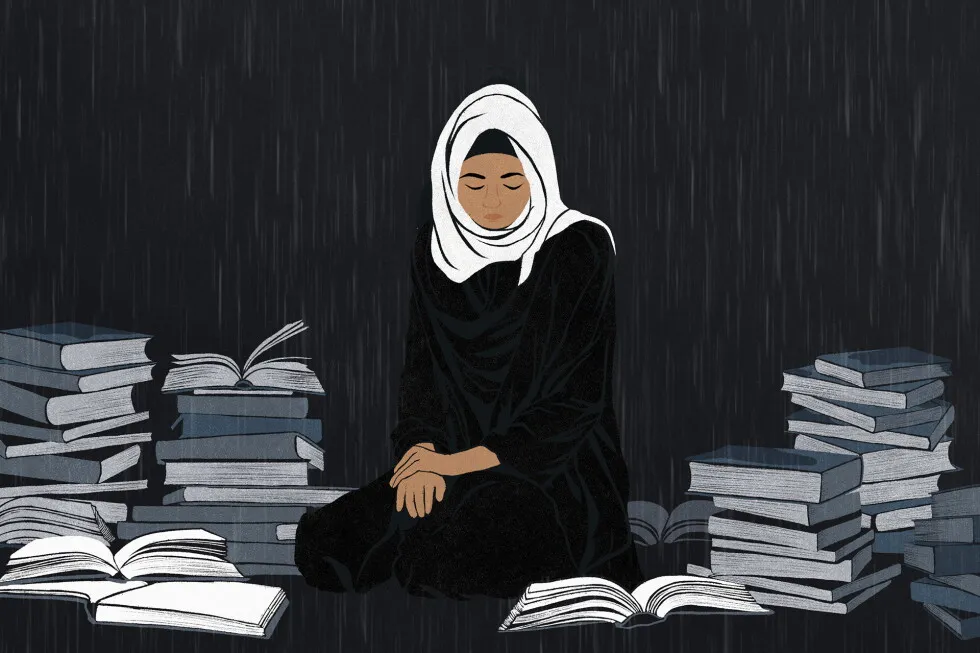
Under Taliban, barring Afghan girls from school takes an emotional toll — and a community one, too 1 of 3 | (AP Illustration / Annie Ng) 2 of 3 | (AP Illustration / Annie Ng) 3 of 3 | (AP Illustration / Annie Ng) By RIAZAT BUTT and BRAM JANSSEN Updated 5:04 PM MESZ, July 31, 2026 Add AP News on Google Add AP News as your preferred source to see more of our stories on Google. Share Share Facebook Copy Link copied Print Email X LinkedIn Bluesky Flipboard Pinterest Reddit Every day, even after the Taliban barred Afghan girls from education, Fariba went to school. The teenager left the house with her head held high, smiling, saying she would ask her teachers when she could wear her uniform again. Every evening, a crestfallen Fariba returned home. “She looked so devastated that we couldn’t recognize her,” says her mother, who asked not to be named out of fear of reprisal. “Months passed like this.” One night, the family went to bed unaware of what was to come. “We didn’t think she could reach such a breaking point,” her mother says. At just 16, Fariba died by suicide. In a note, she wrote that it was too hard to be a girl in Afghanistan. That is not new. Being a girl or a woman in war-scarred Afghanistan has been difficult for decades — and, for many rural women, for centuries. It grew far worse under the Taliban’s first repressive rule, from 1996 to 2001, and has eroded again significantly since the religious movement’s acolytes retook power in 2021 when the United States pulled out. And to hear many Afghan women and international observers tell it, things are only getting worse. Suicides like Fariba’s are a signal of the situation’s severity, and examining such cases offers one glimpse into the situation for women writ large — and how it ripples out into other crucial issues in society. When the Taliban retook power this time around, they pledged to uphold women’s rights. Instead, they closed schools to girls beyond sixth grade, citing their interpretation of Islamic law. They have also stopped medical courses for women, which in turn impacts women’s health. Months of fighting between Afghanistan and Pakistan have killed nearly 500 Afghan civilians, UN says 1 MIN READ Pakistan rejects Amnesty call for war crimes probe into Kabul airstrike 3 MIN READ Gunmen kill high-ranking Taliban official in Afghanistan in rare targeted attack 3 MIN READ Officials say they are working on conditions for the return of female education. They have not clarified what those conditions might be. International condemnation has primarily focused on other human rights violations. But the bans also damage Afghanistan’s economy and public health. Experts warn of rising child marriages, higher maternal mortality and an annual economic loss of $500 million from the secondary school ban alone. That is the macro view. For families like Fariba’s, though, the cost is personal. “This was the time for her studies, the time when she should have been progressing,” Fariba’s mother says. “It causes me so much pain when I see other girls. I can neither sleep at night nor find peace during the day.” She says she fears for her two remaining daughters. There are no recent overall statistics on suicide in Afghanistan, where U.N. experts said in 2023 that accounts of escalating suicides among women and girls were a source of increasing concern. It is forbidden in Islam and carries deep cultural stigma. Yet Afghan Witness, a U.K.-based rights group, has reported a surge in female suicides since the Taliban takeover, linking them to forced marriage, Taliban violence, and restrictions on education and employment. A doctor in southern Afghanistan says distressed girls regularly arrive at the hospital after trying to end their lives, some setting themselves alight. “Most of them are in a bad condition and die here in front of our eyes,” the doctor says. Another woman told The Associated Press that when her sister died by suicide because she could no longer study, “nobody showed sympathy. They only asked how someone could kill themselves over school.” Most who spoke to the AP did so anonymously, fearing Taliban reprisals. The nation’s Taliban government did not respond to repeated requests for interviews and comment over a period of months. Under the Taliban, restrictions on women have multiplied. Now, with education off limits, Afghanistan faces a future without female professionals — especially in medicine. The country already had a shortage of midwives and one of the world’s highest maternal mortality rates. Now, experts say, the bans will be fatal. The shortage of qualified female medical professionals means an additional 1,600 mothers and over 3,500 infants will die, UNICEF said in 2024. Dr. Najumussa Shefajo runs a private maternity hospital in Kabul. Her wards are largely empty because patients cannot afford care, but her reception area is crowded with women seeking free advice and nutrition from the fruits and nuts available. “The Taliban bring their wives here for treatment,” Shefajo says. “They ask for female doctors. Now they want female doctors?” She rolls her eyes. “The Taliban have wives, daughters, mothers. Their sons will marry and have children. Those women will need care. But who will treat them if there are no female professionals left?” Her youngest patient is 14. “A child cannot raise a child,” she says. But poverty drives families to marry off girls early, exchanging them for dowries or even gambling debts. In western Afghanistan, a teacher says that a 13-year-old student was sold for 500,000 afghanis — about $7,400. “The longer the girls stay out of school, the more violence they face,” the teacher says. “We in the villages and mountains see it. Afghan women die here without anyone hearing their voices.” Child brides face higher risks of miscarriage, stillbirth, and death in childbirth. Their children also suffer. U.N. data shows a direct link between a woman’s education level and her children’s health. Educated mothers are more likely to seek medical care, vaccinate their children, and understand nutrition and hygiene. “When women are educated, they can invest in their children’s health and education,” says Stephen Rodriques, the U.N. Development Program’s representative in Afghanistan. “A woman’s education in Afghanistan is a community health issue.” Women tend to spend on essentials — health, food, education — strengthening family and community welfare. Women with only primary schooling — or none at all — are less likely to maintain good health themselves, face barriers to medical care, and are less empowered to make decisions. The bans, Rodriques warned, will worsen these outcomes. The impact of the bans transcends health. They dismantle Afghanistan’s teaching workforce. Cultural norms mean male teachers do not teach girls beyond the primary level. With universities closed to women, the pool of female teachers is shrinking. The country is projected to face a shortage of 11,000 teachers by 2030. “Even the girls we have up to grade six have lost their morale and motivation,” says Torpekai Mohmand, principal of Maryam Afifa High School in Kabul. “They come to class, but they are discouraged.” Half of her students in grades one through six have already dropped out. Families prepare daughters for marriage or redirect school costs toward food and fuel. More than 2 million girls are barred from school beyond grade six; their numbers grow each year. Classrooms were once among the few places where girls could socialize outside the home. Some recall weeping when they said goodbye to one another. Mohmand, who worked in the Education Ministry before 2021, remembers the Taliban’s first rule in the late 1990s. Once, she says, a fighter whipped her hands in a market because they were visible. Educated women once supported households as doctors and teachers — at least in some places during some periods of time. “A girl has the same value as a boy when she is economically independent,” Mohmand says. “All that was lost when schools closed.” U.N. Women said in 2025 that the bans on university and secondary education are projected to increase child marriage by 25%, increase childbearing among adolescent girls by 45 percent, and increase maternal mortality by at least 50 percent. In April 2026, UNICEF said Afghanistan could lose up to 20,000 women teachers and 5,400 healthcare workers by 2030, losing trained female professionals while “preventing the next generation” from replacing them. Mohmand worries about all that lost time. “Some subjects, especially sciences, build lesson by lesson. Afghan girls have missed the basics. The longer the bans persist, the harder it will be to recover even one lost year.” Farahnaz, 24, had just one year left of her Dari literature degree when universities closed for women. She takes sewing classes at Mohmand’s high school. Only her eyes are visible behind her veil. She is not veiled by choice. “Education is a right to freedom,” she says. “When there is no education, there is no future. We want female doctors. We want someone to treat us.” A shrinking future for Afghanistan as losses mount Before the takeover, girls accounted for four out of 10 students in Afghanistan, and 100,000 young Afghan women were attending college, the U.N. said. Now, the majority of Afghan females are out of school after the primary years. Every additional year of schooling increases an Afghan girl’s potential earnings by 20%. Without it, her future — and Afghanistan’s — contracts. Times are hard in Afghanistan, and education is becoming a luxury. If a family cannot afford the associated costs with school — clothes, transport, stationery — for all children in the home, it is more likely that girls will be excluded. A changing curriculum, a shortage of qualified teachers, the prioritization of religious studies and the use of corporal punishment have driven down boys’ attendance as well. With the economy in crisis, parents increasingly send their children to work instead of class. Educated women once helped stabilize households and blur social divisions, Mohmand says. Teachers and doctors took their salaries home, easing financial strain and shifting perceptions of girls’ worth. “A girl is accorded the same value as a boy when she is economically independent,” Mohmand says — an optimistic notion when the entire country is considered. Yet without education, the pathways to work narrow. Fewer workers mean less household income, a smaller tax base, fewer consumers, and a weaker economy overall. The removal of women from the workforce strips away a noticeable share of Afghanistan’s gross domestic product. In 2023–24, the loss was estimated to be $1 billion. The numbers show what is being lost as fewer women complete their education and do not enter the workforce. In 2001, Afghan women’s GDP per capita was $277. By 2021, it had nearly doubled to $528, according to the U.N. One woman, a seamstress, described how quickly her livelihood collapsed after the education bans. Before the Taliban’s takeover, she had expanded from her home into a rented space with six sewing machines and workstations. She trained female apprentices, including high school graduates looking to start earning. Together, they produced more than a dozen garments a day. Much of their work was connected to schools — headscarves and uniforms. After the schools closed, clients started to disappear. The business didn’t completely stop at first, but it suffered a significant blow. Over time, the apprentices stopped coming, the orders dried up, and overheads outpaced earnings. The owner lowered the prices to cover rent and electricity, but that wasn’t enough. Mounting losses, fewer customers, a drop in household income and Taliban harassment forced her tailoring business to shut down. The workers took the clothes back home. The Taliban used to tell the seamstresses they had no reason to be in the market, working. “However, we understood how much this shop had impacted our economy and improved our lives,” the owner says. “Only we knew its importance.” Reporting for this story was supported by the Pulitzer Center. Riazat Butt, a former correspondent for AP in Pakistan, reported this story in 2025. BRAM JANSSEN Visual journalist, photographer and videographer working for the Associated Press. Covering Europe, Middle East and Africa.
SRCAssociated Press (AP)
LANGEN
LEANCenter
WORDS2 022
ENT8
FRI · 2026-07-31 · 15:23 GMTBRIEF NSR-2026-0731-97921
NSR-2026-0731-97921News Report·EN·Human Interest
Under Taliban, barring Afghan girls from school takes an emotional toll — and a community one, too
The Taliban's ban on girls' education beyond sixth grade in Afghanistan is having severe emotional and societal consequences. The article highlights the tragic suicide of 16-year-old Fariba, who was devastated by the inability to continue her studies.
Associated Press (AP)Filed 2026-07-31 · 15:23 GMTLean · CenterRead · 9 min
Associated Press (AP)FIG 01
Reading time
9min
Word count
2 022words
Sources cited
3cited
Entities identified
8entities
Quality score
100%
§ 01
Briefing Summary
AI-generatedNEWSAR · AI
The Taliban's ban on girls' education beyond sixth grade in Afghanistan is having severe emotional and societal consequences. The article highlights the tragic suicide of 16-year-old Fariba, who was devastated by the inability to continue her studies. This ban, implemented since the Taliban's 2021 return to power, also impacts public health and the economy, with experts warning of increased child marriages, maternal mortality, and an estimated annual economic loss of $500 million. The lack of female professionals, particularly in medicine, is exacerbating existing health crises, with UNICEF predicting thousands of additional maternal and infant deaths. The restrictions are dismantling the future workforce and educational system, leading to despair and a contracting future for Afghan women and the nation.
Confidence 0.90Sources 3Claims 5Entities 8
§ 02
Article analysis
Model · rule-basedFraming
Human Interest
Human Rights
Tone
Mixed Tone
AI-assessed
CalmNeutralAlarmist
Factuality
0.60 / 1.00
Mixed
LowHigh
Sources cited
3
Well sourced
FewMany
§ 03
Key claims
5 extracted01
Being a girl or woman in Afghanistan has been difficult for decades, worsening under Taliban rule.
factual
Confidence
1.00
02
The Taliban closed schools to girls beyond sixth grade, citing their interpretation of Islamic law.
factual
Confidence
1.00
03
A 16-year-old girl named Fariba died by suicide, citing it was too hard to be a girl in Afghanistan.
quoteFariba's mother
Confidence
1.00
04
The ban on secondary school for girls could result in an annual economic loss of $500 million.
statisticExperts
Confidence
0.90
05
Experts warn of rising child marriages and higher maternal mortality due to the ban on girls' education.
predictionExperts
Confidence
0.80
§ 04
Full report
9 min read · 2 022 words§ 05
Entities
8 identifiedKey playerOppositionContextPositiveNeutralNegative
People1
§ 06
Keywords & salience
8 termsafghan girls' education
1.00
taliban rule
0.90
women's rights
0.80
suicide
0.70
emotional toll
0.60
islamic law interpretation
0.50
afghanistan
0.50
women's health
0.40
§ 07
Topic connections
Interactive graph Network visualization showing 51 related topics
View Full Graph Person Organization Location Event|Click node to navigate|Edge numbers = shared articles