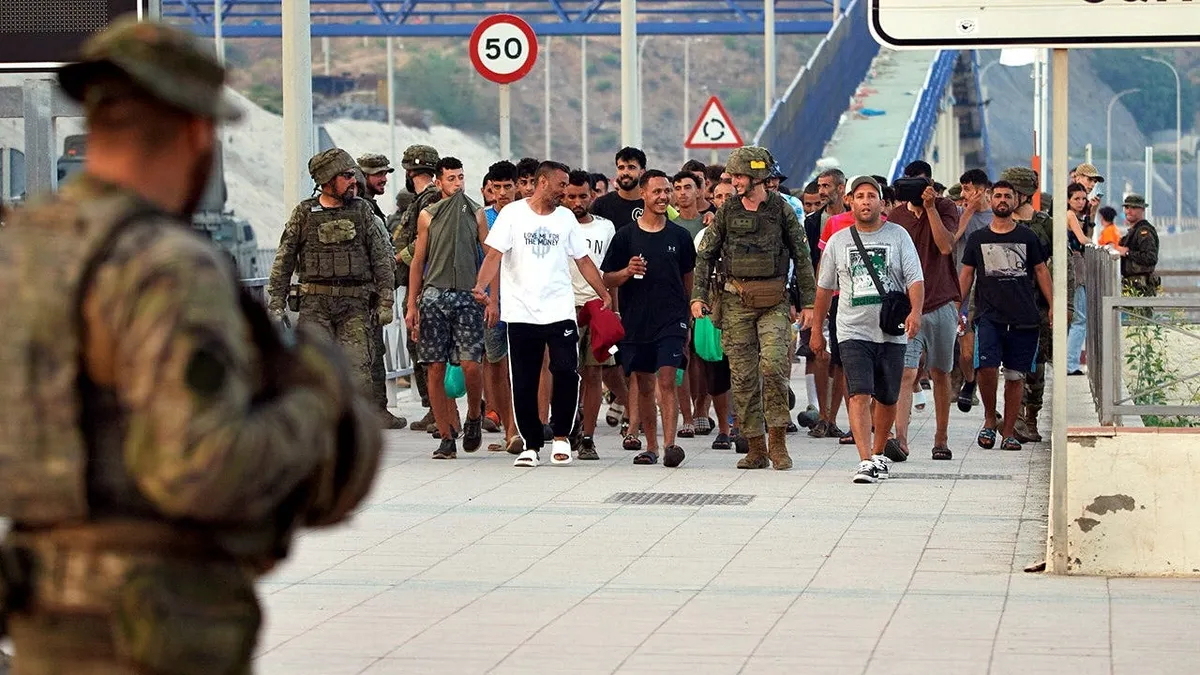
close Video Spain’s prime minister calls migrant surge an ‘attack’ on the country Fox News correspondent Stephanie Bennett reports on the political repercussions of migrants storming the Spanish enclave of Ceuta on ‘Fox Report.’ NEWYou can now listen to Fox News articles! Hören Sie sich diesen Artikel an 3 Min At least 72 migrants are dead after a chaotic rush to storm the Spanish enclave of Ceuta, turning one of Europe's latest border crises into a Humanitarian Disaster that is reigniting debate over Immigration across the continent. Spanish authorities continued searching the waters off Ceuta over the weekend for additional victims after an estimated 50,000 to 60,000 migrants — most of them young men — poured into the tiny Spanish territory in North Africa. Officials said many of the victims drowned while attempting the crossing, while others were killed in a stampede near a breakwater barrier. The mass crossing unfolded over several days, temporarily increasing Ceuta's population of roughly 84,000 by more than half. By Sunday, many migrants had returned to neighboring Morocco, while others remained in the city or tried to avoid authorities. Spain DEPLOYS MILITARY AFTER THOUSANDS OF MIGRANTS OVERWHELM BORDER ENCLAVE, AT LEAST 18 DEAD Migrants who crossed into Spain return to Morocco from the Spanish enclave of Ceuta, Saturday, Aug. 1, 2026. (AP Photo/Bernat Armangue) The deaths have intensified the political fight over Immigration in Spain and across Europe. Far-right leaders called for tighter border security and the removal of migrants who remained in the enclave. Santiago Abascal, leader of Spain's nationalist Vox party, visited Ceuta on Sunday and blasted the country's government, calling the migrant influx "an invasion" and accusing officials of failing to protect Spain's borders. Guardia Civil officers recover the body of a migrant from the water in the Spanish enclave of Ceuta, Saturday, Aug. 1, 2026. (AP Photo/Antonio Sempere) Tensions were also on display Saturday when European Parliament member Alvise Pérez faced angry counterprotesters during a rally in Ceuta. Pérez eventually took shelter inside a nearby bar before police escorted him away. MIGRANT CRISIS PUSHES Italy TO RESTORE BORDER CHECKS WITH Spain, TESTING Europe'S OPEN-BORDER SYSTEM Many local residents expressed sorrow over the loss of life, even as the political debate intensified. "It pains me deeply that young people are dying at sea. It's not right that, in the year 2026, women with children as young as two months old should be crossing the sea only to die," Karima Abenaz, a French national in Ceuta with family in Morocco, told Reuters. "In Morocco, there's food, there's everything we need," she said. "If we don't have a decent job, we should go on strike and demand our rights from the government. We shouldn't be dying at sea. It's not right." Escorted by the Spanish army, migrants who crossed into Spain return to Morocco from the Spanish enclave of Ceuta on Saturday, Aug. 1, 2026. (AP Photo/Antonio Sempere) WHITE HOUSE BLASTS SPANISH GOVERNMENT AS THOUSANDS OF MIGRANTS SURGE FROM Morocco, EMERGENCY REQUEST DENIED Other local residents said the migrants themselves should not be blamed. Mohamad Abdelkader Driss, a waiter in Ceuta, told The Associated Press that responsibility lies with the authorities. "If you open the border, of course everyone comes in, but the young men aren't to blame. The authorities are responsible," he said. Others said the events had tested Ceuta's reputation as a city where Christian, Muslim, Jewish and Hindu communities have long lived side by side. Some also voiced concerns about security and questioned whether another mass crossing could happen again. The U.S. State Department on Saturday raised its Travel Advisory for Ceuta to Level 3: Reconsider Travel in response to the surge, warning that the "massive and uncontrolled arrival of migrants from Morocco to Ceuta may lead to unpredictable and dangerous security situations."
SRCFox News - World
LANGEN
LEANCenter-Right
WORDS632
ENT12
SUN · 2026-08-02 · 17:01 GMTBRIEF NSR-2026-0802-98420
NSR-2026-0802-98420News Report·EN·Human Rights
At least 72 dead amid mass migrant rush to storm Spanish enclave of Ceuta sparking border crisis
A mass rush of an estimated 50,000 to 60,000 migrants to the Spanish enclave of Ceuta has resulted in at least 72 deaths, primarily from drowning and stampedes. The influx, which occurred over several days, overwhelmed the territory and has sparked a border crisis and intensified immigration debates across Europe.
Fox News - WorldFiled 2026-08-02 · 17:01 GMTLean · Center-RightRead · 3 min
Fox News - WorldFIG 01
Reading time
3min
Word count
632words
Sources cited
3cited
Entities identified
12entities
Quality score
100%
§ 01
Briefing Summary
AI-generatedNEWSAR · AI
A mass rush of an estimated 50,000 to 60,000 migrants to the Spanish enclave of Ceuta has resulted in at least 72 deaths, primarily from drowning and stampedes. The influx, which occurred over several days, overwhelmed the territory and has sparked a border crisis and intensified immigration debates across Europe. Spanish authorities searched for additional victims while many migrants returned to Morocco or attempted to evade authorities. Far-right politicians criticized the Spanish government's border control, labeling the event an "invasion." Local residents expressed sorrow for the loss of life, with some blaming authorities for the situation and others highlighting the humanitarian tragedy. The U.S. State Department issued a Level 3 travel advisory for Ceuta due to the unpredictable security situation.
Confidence 0.90Sources 3Claims 5Entities 12
§ 02
Article analysis
Model · rule-basedFraming
Human Rights
Political Strategy
Tone
Mixed Tone
AI-assessed
CalmNeutralAlarmist
Factuality
0.70 / 1.00
Factual
LowHigh
Sources cited
3
Well sourced
FewMany
§ 03
Key claims
5 extracted01
Santiago Abascal called the migrant influx 'an invasion' and accused officials of failing to protect Spain's borders.
quoteSantiago Abascal
Confidence
1.00
02
Far-right leaders called for tighter border security and the removal of migrants.
factual
Confidence
1.00
03
Spanish authorities continued searching the waters off Ceuta over the weekend for additional victims.
factual
Confidence
1.00
04
At least 72 migrants are dead after a chaotic rush to storm the Spanish enclave of Ceuta.
statistic
Confidence
1.00
05
An estimated 50,000 to 60,000 migrants poured into Ceuta.
statistic
Confidence
0.80
§ 04
Full report
3 min read · 632 words§ 05
Entities
12 identifiedKey playerOppositionContextPositiveNeutralNegative
Locations5
§ 06
Keywords & salience
9 termsceuta
1.00
migrant crisis
1.00
border security
0.90
humanitarian disaster
0.80
immigration debate
0.80
spain
0.70
morocco
0.60
europe
0.50
political repercussions
0.40
§ 07
Topic connections
Interactive graph Network visualization showing 51 related topics
View Full Graph Person Organization Location Event|Click node to navigate|Edge numbers = shared articles