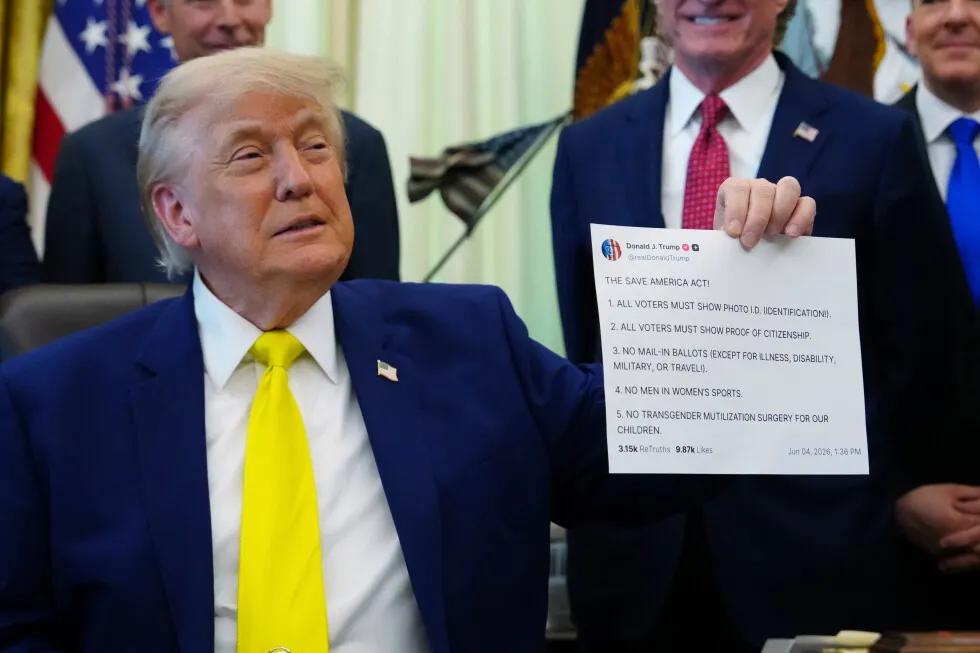
President Donald Trump holds up an image taken from his Truth Social account at an event about coal, Thursday, June 4, 2026, in the Oval Office of the White House in Washington. (AP Photo/Julia Demaree Nikhinson,File) By MELANIE LIDMAN Updated 10:09 PM MESZ, August 2, 2026 Add AP News on Google Add AP News as your preferred source to see more of our stories on Google. Share Share Facebook Copy Link copied Print Email X LinkedIn Bluesky Flipboard Pinterest Reddit TEL AVIV, Israel (AP) — President Donald Trump said late Saturday that he would halt new planned attacks on Iran pending renewed talks to wind down the war and revive stalled cargo traffic through the Strait of Hormuz. It was the latest in a pattern of announcements the U.S. president has made to first threaten massive strikes and then later call them off. The abrupt shifts have been a defining feature of the five-month conflict that has sent prices of oil and basic goods soaring — and the announcements to date have been upended by renewed attacks days or even hours afterward. Here is a look at some of Trump’s past major announcements about pausing strikes against Iran: The United States and Iran agree to a two-week ceasefire to end the intense fighting that began on Feb. 28 with Israeli and U.S. attacks. Trump makes the announcement less than two hours before a deadline he had set for Tehran to capitulate or face attacks on bridges and power plants — strikes he said would mean “a whole civilization will die.” Trump announces that the U.S. is indefinitely extending its ceasefire with Iran a day before it was to expire. He adds that he has been asked by mediators to hold off on attacks to give Iranian leaders time to come up with additional proposals. The fragile ceasefire lasts until May 8, when the U.S. carried out strikes on Iranian tankers. Is an Iran deal ‘over’ and war back on? A timeline of the conflict and talks 5 MIN READ 271 Airstrikes have paused and talks are pressing forward. But can the US and Iran take the off-ramp? 3 MIN READ 1111 US attacks Iran and Tehran retaliates across the Middle East as both vie for control of strait 3 MIN READ 1111 May 18 After a weekend of dire threats against Iran, Trump says he is holding off on a major planned military strike because “serious negotiations” were underway. “There seems to be a very good chance that they can work something out. If we can do that without bombing the hell out of them, I’d be very happy,” he said. By May 27, U.S. strikes were back on after negotiations faltered. After two days of back-and-forth attacks, Trump threatens further escalation, saying the U.S. would hit Iran “VERY HARD TONIGHT” and take “total control” of its oil and gas industries. Then, a few hours later, Trump posts on social media that there had been a breakthrough in negotiations and called off the strikes. Trump signs an initial agreement with Iran that calls for a permanent end to hostilities and for reopening of the strait, and starts a 60-day negotiating clock to reach a final deal on the future of Iran’s nuclear program. Trump left the door open to abandoning it. “It’s a memorandum of understanding, and if I don’t like it, we’ll go back to shooting at them, dropping bombs,” he said. After Iranian attacks on commercial ships in the strait, Trump launches new strikes on Iran while he is in Ankara, Turkey, attending the NATO leaders’ summit. Later, he renews his threat to “just finish the job” on Iran after saying he believes the ceasefire is over. Trump says he has paused two weeks of intense, daily U.S. strikes on Iran to give negotiations another chance. During 13 days of strikes, the U.S. military had targeted key military and commercial sites as clashes continued to escalate over shipping routes. In response, Iran had launched missiles and drones across the Middle East at countries that host U.S. troops. After telling reporters the U.S. would hit Iran “very hard,” Trump says on social media that he has canceled planned strikes, claiming Mideast allies had reached the parameters of a deal to end the war, including a reopening of the strait. “Based on this request, I have agreed, for the future benefit of the WORLD and, likewise, the survival of a successful and prosperous Iran, to cancel the attack, subject to being able to rapidly make a DEAL,” Trump said. In response, Iran’s defense minister said that the country was “neither surprised nor passive” following Trump’s announcement and said Iran continues to remain alert in the face of threats. MELANIE LIDMAN Lidman is an Associated Press reporter based in Tel Aviv, Israel.
SRCAssociated Press (AP)
LANGEN
LEANCenter
WORDS801
ENT12
SUN · 2026-08-02 · 20:23 GMTBRIEF NSR-2026-0802-98472
NSR-2026-0802-98472News Report·EN·Conflict
Trump frequently announces he’s halting strikes in Iran. But they keep happening
President Donald Trump has repeatedly announced plans to halt U.S. strikes against Iran, only for renewed attacks to occur shortly thereafter.
Associated Press (AP)Filed 2026-08-02 · 20:23 GMTLean · CenterRead · 4 min
Associated Press (AP)FIG 01
Reading time
4min
Word count
801words
Sources cited
1cited
Entities identified
12entities
Quality score
100%
§ 01
Briefing Summary
AI-generatedNEWSAR · AI
President Donald Trump has repeatedly announced plans to halt U.S. strikes against Iran, only for renewed attacks to occur shortly thereafter. This pattern of abrupt shifts has characterized a five-month conflict that has impacted global oil and goods prices. Trump's announcements to pause attacks have often been followed by Iran's continued or renewed aggression, or by the U.S. resuming strikes after negotiations faltered. These cycles of threats, pauses, and renewed strikes have occurred throughout the conflict, impacting shipping routes and escalating tensions in the Middle East.
Confidence 0.90Sources 1Claims 5Entities 12
§ 02
Article analysis
Model · rule-basedFraming
Conflict
Political Strategy
Tone
Mixed Tone
AI-assessed
CalmNeutralAlarmist
Factuality
0.70 / 1.00
Factual
LowHigh
Sources cited
1
Limited
FewMany
§ 03
Key claims
5 extracted01
Trump threatened massive strikes, saying 'a whole civilization will die' if Iran did not capitulate.
quoteDonald Trump
Confidence
1.00
02
The U.S. carried out strikes on Iranian tankers on May 8 after a fragile ceasefire expired.
factualAP News
Confidence
0.90
03
The U.S. president has made a pattern of announcements to first threaten massive strikes and then later call them off.
factualAP News
Confidence
0.90
04
President Donald Trump announced late Saturday that he would halt new planned attacks on Iran pending renewed talks.
factualAP News
Confidence
0.90
05
Abrupt shifts in announcements have been a defining feature of the five-month conflict that has sent prices of oil and basic goods soaring.
factualAP News
Confidence
0.80
§ 04
Full report
4 min read · 801 words§ 05
Entities
12 identifiedKey playerOppositionContextPositiveNeutralNegative
Organizations2
Locations6
Events1
§ 06
Keywords & salience
8 termsiran
1.00
trump
1.00
strikes
0.90
ceasefire
0.80
negotiations
0.70
strait of hormuz
0.60
oil prices
0.50
cargo traffic
0.40
§ 07
Topic connections
Interactive graph Network visualization showing 51 related topics
View Full Graph Person Organization Location Event|Click node to navigate|Edge numbers = shared articles