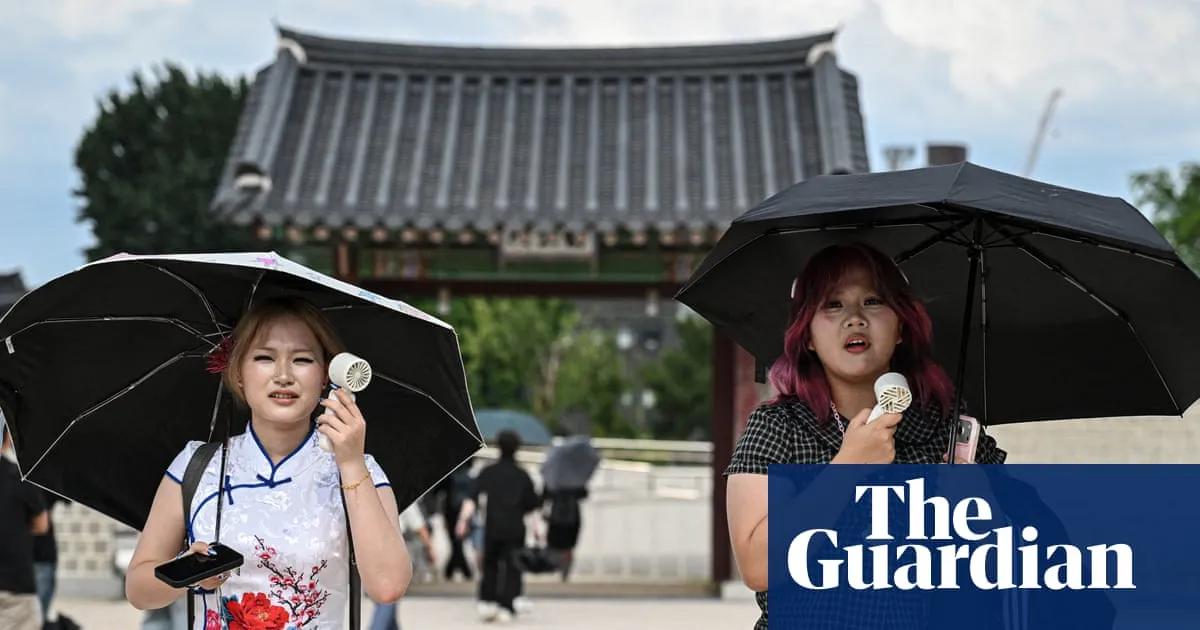
South Korea has registered its highest temperature since records began more than a century ago, as authorities warned people to “immediately” stop all outdoor activities in affected areas.The south-eastern city of Yangsan saw the temperature reach 42.5C on Sunday afternoon, the Korea Meteorological Administration (KMA) said, the highest temperature reported since modern weather observation began in 1904.Yangsan has been the centre of an ongoing heatwave, where temperatures exceeded 40C for a fifth consecutive day on Sunday, while many other cities including Daegu and Busan are seeing temperatures climb into the high 30s.People gathered in airconditioned shopping malls or cafes to escape the blistering temperatures. Ju Dong-yeol, 27, took refuge from the heat in a Starbucks in Seoul along with his parents and told AFP “it is too hot to be outside doing anything”.“I can’t think of anything else to do other than stay in airconditioned places like home, shopping malls and cafes,” the office worker said.More than 20 localities were under emergency heatwave alerts on Sunday – a new warning category introduced this year to better address rising temperatures. An emergency alert is issued when areas experiencing a heatwave are forecast to hit perceived temperatures of 38C or an actual temperature of 39C for the day.Workers harvest strawberries under parasols to protect against the scorching sun in Miryang, South Gyeongsang Province, South Korea. Photograph: YONHAP/EPAIssuing a heat warning, the weather agency urged people to “immediately stop all outdoor activities”, adding that “indoor spaces without air conditioning are dangerous”.“Move immediately to a cool place, such as a designated cooling centre or a shaded area, and stay hydrated while resting,” it advised.KMA data show the average annual number of heatwave days in the country has more than doubled to 19 in the past five years.A heatwave day is defined as one with a maximum temperature of at least 33C.South Korea’s professional baseball league was forced to cancel one game in Changwon after the city’s temperature climbed to 39.5C, marking the second consecutive game cancellation in the city.“The decision was made with the safety and health of spectators and players as the top priority, as a severe heatwave warning remains in effect for the Changwon area,” said the Korea Baseball Organization in a statement.Scientists warn that extreme weather events such as heatwaves are becoming more frequent and intense as a result of human-induced climate change.Adding to the extreme weather is the return this year of El Niño – a natural climate phenomenon that warms Pacific Ocean surface temperatures and typically occurs every two to seven years.
SRCThe Guardian - World News
LANGEN
LEANCenter-Left
WORDS423
ENT12
SUN · 2026-08-02 · 23:54 GMTBRIEF NSR-2026-0803-98477
NSR-2026-0803-98477News Report·EN·Public Health
Stop all outdoor activities’: South Korea records its highest ever temperature
South Korea has recorded its highest temperature since modern weather observation began in 1904, with the southeastern city of Yangsan reaching 42.5C on Sunday. Authorities have issued an urgent warning for people to cease all outdoor activities, stating that indoor spaces without air conditioning are dangerous.
Agence France-PresseThe Guardian - World NewsFiled 2026-08-02 · 23:54 GMTLean · Center-LeftRead · 2 min
The Guardian - World NewsFIG 01
Reading time
2min
Word count
423words
Sources cited
3cited
Entities identified
12entities
Quality score
100%
§ 01
Briefing Summary
AI-generatedNEWSAR · AI
South Korea has recorded its highest temperature since modern weather observation began in 1904, with the southeastern city of Yangsan reaching 42.5C on Sunday. Authorities have issued an urgent warning for people to cease all outdoor activities, stating that indoor spaces without air conditioning are dangerous. Yangsan has experienced temperatures exceeding 40C for five consecutive days, prompting many to seek refuge in air-conditioned public spaces. Over 20 localities are under an emergency heatwave alert, a new category introduced this year. The Korea Meteorological Administration advised people to move to cool places, stay hydrated, and rest. The frequency of heatwave days in South Korea has more than doubled in the past five years, with scientists attributing such extreme weather events to climate change and the return of El Niño.
Confidence 0.90Sources 3Claims 5Entities 12
§ 02
Article analysis
Model · rule-basedFraming
Public Health
Environmental
Tone
Mixed Tone
AI-assessed
CalmNeutralAlarmist
Factuality
0.80 / 1.00
Factual
LowHigh
Sources cited
3
Well sourced
FewMany
§ 03
Key claims
5 extracted01
The average annual number of heatwave days in South Korea has more than doubled to 19 in the past five years.
statisticKMA
Confidence
1.00
02
Authorities advised people to 'immediately' stop all outdoor activities due to extreme heat.
quoteAuthorities
Confidence
1.00
03
South Korea recorded its highest temperature ever at 42.5C in Yangsan on Sunday.
statisticKorea Meteorological Administration
Confidence
1.00
04
El Niño is contributing to the extreme weather by warming Pacific Ocean surface temperatures.
factualArticle
Confidence
0.90
05
Scientists warn that extreme weather events like heatwaves are becoming more frequent and intense due to human-induced climate change.
factualScientists
Confidence
0.90
§ 04
Full report
2 min read · 423 words§ 05
Entities
12 identifiedKey playerOppositionContextPositiveNeutralNegative
People1
Organizations3
§ 06
Keywords & salience
9 termsheatwave
1.00
extreme heat
1.00
south korea
0.90
highest temperature
0.80
weather observation
0.70
emergency alert
0.60
outdoor activities
0.50
climate change
0.40
baseball league
0.40
§ 07
Topic connections
Interactive graph Network visualization showing 51 related topics
View Full Graph Person Organization Location Event|Click node to navigate|Edge numbers = shared articles