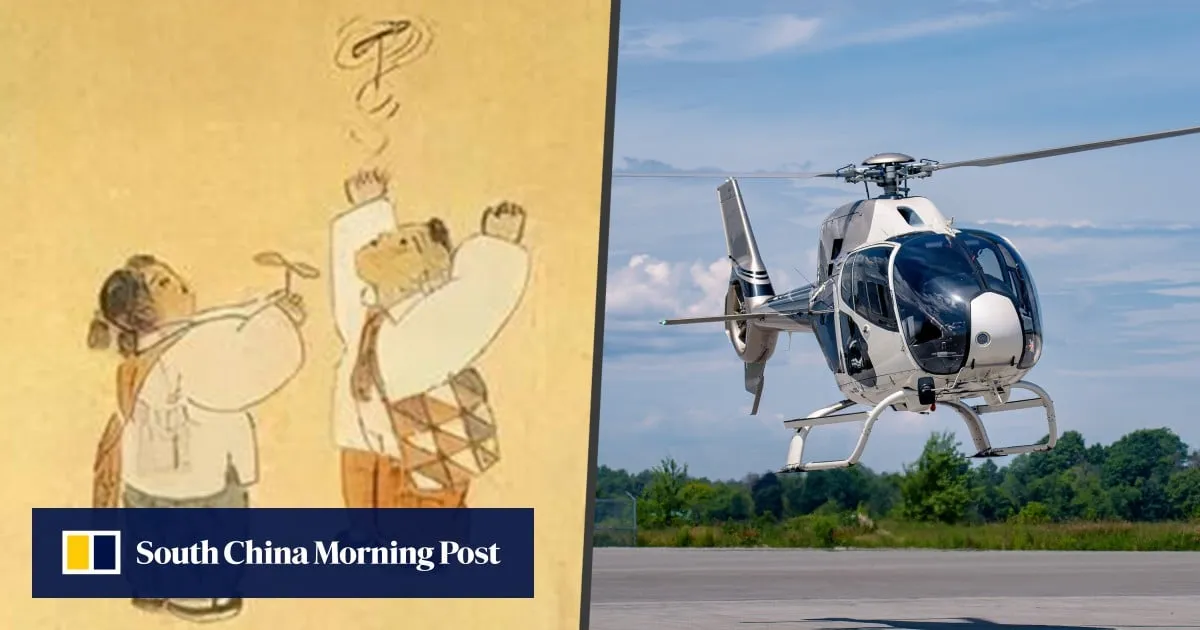
The bamboo-copter is one of the most famous gadgets from the pocket of Doraemon, an iconic robot cat from a Japanese cartoon series who employs futuristic devices to assist a clumsy boy, notably enabling the protagonists to fly.In fact, this gadget is inspired by a Chinese invention that dates back over a thousand years.The bamboo-copter was one of the earliest gadgets presented to the boy Nobita Nobi by the robotic cat character from the 22nd century.It made its first appearance in the manga in 1970. When the protagonists wear it on their heads, it spins and lifts them into the sky.It was believed to be one of the Doraemon gadgets most likely to become a reality, especially with the invention of devices such as jetpacks.Doraemon, above, is a legendary robotic cat from a popular Japanese cartoon, utilising futuristic gadgets to aid a clumsy boy. This charismatic character has captured the hearts of fans worldwide. Photo: ShutterstockHowever, the bamboo-copter had already inspired flight technology nearly a century ago.The bamboo-copter, also referred to as “bamboo dragonfly” in Chinese, is believed to have existed in China since 500 BC, though its inventor remains unknown.This T-shaped children’s toy consists of a bamboo blade and a stick inserted through a hole in the centre of the blade. By rubbing the stick between their hands, children can make it spin and take flight.Seemingly simple in design, the bamboo-copter is, in fact, a masterful balance between the blade’s dimensions, its angle, and the overall weight of the gadget.When the balance is perfect, the rotating blades push air downwards, resulting in lifting the device upwards.Despite its straightforward design, the bamboo-copter exemplifies a remarkable balance of blade dimensions, angles, and overall weight, demonstrating the artistry behind its functionality. Photo: WikipediaOne of the earliest written references to the bamboo dragonfly can be found in Baopuzi, or The Master Who Embraces Simplicity, a Taoist text about immortals written by Ge Hong during the Jin dynasty (266-420).Further ReadingGe described the structure of a wooden flying car crafted from jujube wood, featuring ox-leather straps attached to rotating blades.These rotating blades are thought to be a variation of the bamboo-copter.Ancient Chinese texts documented the aspiration of people to soar through the skies with inventions like flying cars and wooden birds. These creations were born from the timeless desire of ancient civilisations to ascend to the heavens and were inspired by the imagined vehicles of deities.Mozi Jing, or the Mohist Canon, records that Lu Ban, one of China’s most renowned inventors from the 5th century BC, created a wooden magpie that could indeed fly.Yet the techniques required for constructing these aircraft have been lost over time, leaving ambiguity regarding their existence as tangible creations or mere figments of imagination.The bamboo-copter is also thought to have influenced the development of the helicopter.The ancient Chinese bamboo-copter directly inspired the aerodynamic principles used to invent the modern helicopter. Photo: Getty ImagesThe modern helicopter was innovated by Russian scientist and pilot Igor Sikorsky in the 1930s and 40s.Reports indicate that Sikorsky drew inspiration from the bamboo-copter when designing an aircraft capable of vertical takeoff, hovering, and flying both backwards and sideways.The bamboo-copter demonstrated that a spinning rotor blade can generate vertical lift.Today, children have a wider array of toys to choose from. The bamboo dragonfly is frequently used as a teaching tool to ignite children’s interest in aerospace science.The perceptions of the bamboo dragonfly among young people have also been greatly shaped by Doraemon, which gained popularity in China during the 1980s.
SRCSouth China Morning Post
LANGEN
LEANCenter-Right
WORDS583
ENT8
MON · 2026-08-03 · 01:00 GMTBRIEF NSR-2026-0803-98501
NSR-2026-0803-98501News Report·EN·Technology
What is ‘bamboo-copter’, its links to China and Japan; how it inspired modern helicopters
The bamboo-copter, a popular gadget from the Japanese cartoon Doraemon, is inspired by a Chinese invention dating back over a thousand years. This T-shaped toy, known as a "bamboo dragonfly" in China, consists of a spinning bamboo blade that generates lift when rotated.
Fran LuSouth China Morning PostFiled 2026-08-03 · 01:00 GMTLean · Center-RightRead · 3 min
South China Morning PostFIG 01
Reading time
3min
Word count
583words
Sources cited
0cited
Entities identified
8entities
Quality score
100%
§ 01
Briefing Summary
AI-generatedNEWSAR · AI
The bamboo-copter, a popular gadget from the Japanese cartoon Doraemon, is inspired by a Chinese invention dating back over a thousand years. This T-shaped toy, known as a "bamboo dragonfly" in China, consists of a spinning bamboo blade that generates lift when rotated. Ancient Chinese texts from as early as 500 BC describe similar devices, and some scholars believe these may have influenced early concepts of flying machines. The aerodynamic principles demonstrated by the bamboo-copter are also credited with inspiring the development of the modern helicopter, innovated by Igor Sikorsky in the 1930s and 40s. Today, the bamboo dragonfly remains a teaching tool for aerospace science and is widely recognized due to its depiction in Doraemon.
Confidence 0.90Claims 5Entities 8
§ 02
Article analysis
Model · rule-basedFraming
Technology
Human Interest
Tone
Measured
AI-assessed
CalmNeutralAlarmist
Factuality
0.70 / 1.00
Factual
LowHigh
Sources cited
0
No named sources
FewMany
§ 03
Key claims
5 extracted01
The bamboo-copter is a gadget from the Japanese cartoon series Doraemon, used to enable flight.
factual
Confidence
1.00
02
A Taoist text from the Jin dynasty (266-420 AD), Baopuzi, contains one of the earliest written references to a bamboo dragonfly-like device.
factual
Confidence
0.90
03
The bamboo-copter is inspired by a Chinese invention dating back over a thousand years.
factual
Confidence
0.90
04
The bamboo-copter, also called 'bamboo dragonfly', is believed to have existed in China since 500 BC.
factual
Confidence
0.80
05
Lu Ban, a Chinese inventor from the 5th century BC, is recorded to have created a flying wooden magpie.
factual
Confidence
0.70
§ 04
Full report
3 min read · 583 words§ 05
Entities
8 identifiedKey playerOppositionContextPositiveNeutralNegative
§ 06
Keywords & salience
8 termsbamboo-copter
1.00
doraemon
0.90
flight technology
0.80
chinese invention
0.70
ancient china
0.60
rotating blades
0.50
aerodynamics
0.40
manga
0.40
§ 07
Topic connections
Interactive graph No topic relationship data available yet. This graph will appear once topic relationships have been computed.