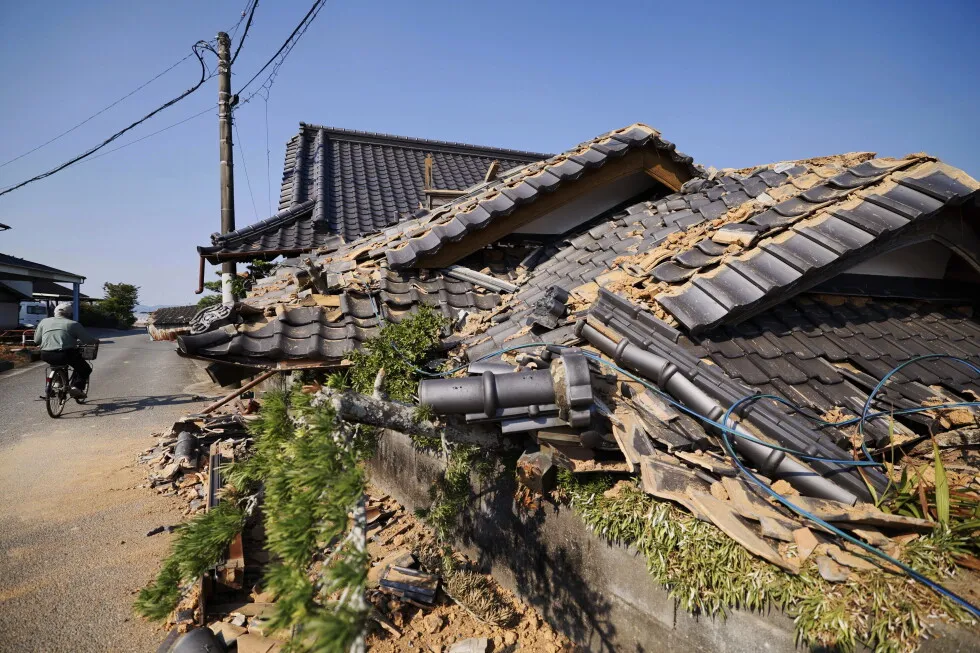
Prime minister visits quake-hit southern Japan as cleanup begins in intense heat 1 of 2 | A person rides a bicycle past damaged buildings in Hikawa, southern Japan, Sunday, Aug. 2, 2026, following a July 28 Earthquake. (Taichi Nagahisa/Kyodo News via AP) 2 of 2 | People rest at an evacuation center in Uki, southern Japan, Sunday, Aug. 2, 2026, after recent earthquakes. (Yuta Omori/Kyodo News via AP) By MARI YAMAGUCHI Updated 11:49 AM MESZ, August 3, 2026 Add AP News on Google Add AP News as your preferred source to see more of our stories on Google. Share Share Facebook Copy Link copied Print Email X LinkedIn Bluesky Flipboard Pinterest Reddit TOKYO (AP) — Residents in Japan’s quake-hit southwestern prefecture of Kumamoto put out heaps of debris for collection and the prime minister visited as the region baked under intense heat. The heat and a lack of water supplies have added to the challenges in the severely damaged areas where Prime Minister Sanae Takaichi briefly visited for the first time since a magnitude 7.1 quake hit Kumamoto Prefecture on Japan’s southern main island of Kyushu last Tuesday. Thirty-eight people died during the quake, including one who died of apparent Heat Stroke while taking shelter in a car in hot weather and one other whose cause of death is still being investigated, prefectural officials said Monday. Residents put out heaps of debris, broken furniture and damaged appliances for collection, while in the towns of Uki and Hikawa, construction of temporary housing began. More than 46,000 households remained without water and many also faced fuel shortages as the region suffers sweltering heat, stoking fears of heat-related illness. Japan-meteorological-agency" class="entity-link entity-organization" data-entity-id="3275" data-entity-type="organization">Japan Meteorological Agency predicted that temperatures would rise close to 40 C (104 F) Monday. More than 8,500 people remain at crowded emergency shelters, such as converted community centers, school gyms and classrooms, many of which lack air-conditioning. Others are sleeping in cars at town hall parking lots and parks, or outside of their homes. A woman with apparent Heat Stroke found dead while taking shelter in a car in quake-hit Japan 3 MIN READ 16 Quake survivors in southwestern Japan sleep in cars in sweltering heat as death toll rises to 34 3 MIN READ Hope dwindles for rescue in southwestern Japan quake as death toll climbs to 25 3 MIN READ Experts have long warned that inadequate shelter provision leads to crowded conditions and a lack of sanitation and privacy for people forced to leave their homes following disasters. Takaichi on Monday visited one of the area’s best-equipped shelters, with cardboard beds, partitions and air-conditioning, triggering criticisms on social media that her visit distorted reality. Meanwhile, a company that owned a general store in a collapsed shopping mall acknowledged that it had instructed two employees who were killed in a later explosion to return to the building to put sales proceeds into a safe. Two executives of Habita, a local general store operator that had a shop inside the collapsed Aeon Mall in the town of Kashima, attended the wake Sunday of one of the two victims, 22-year-old Kurumi Otake, and apologized to her parents for the death. Company sales manager Goji Yuse acknowledged that the company instructed the two to put sales proceeds into the safe if it was possible. “I wish someone had stopped her,” Otake’s tearful mother told them. “My daughter is not coming back.” The mall’s operator said it believes the explosion was due to a gas leak and occurred after about 3,000 shoppers had been evacuated to a parking lot following the quake, but some employees remained inside. Rescuers recovered five people and the bodies of seven others from the mall. The Earthquake has left 114 people injured across Kumamoto, authorities said. Some 700 homes were destroyed, and more than 11,300 buildings were damaged, according to Kumamoto Prefecture. MARI YAMAGUCHI Yamaguchi is based in Tokyo and covers Japanese politics, security, nuclear energy and social issues for The Associated Press. twitter mailto
SRCAssociated Press (AP)
LANGEN
LEANCenter
WORDS664
ENT11
MON · 2026-08-03 · 09:23 GMTBRIEF NSR-2026-0803-98569
NSR-2026-0803-98569News Report·EN·Human Interest
Prime minister visits quake-hit southern Japan as cleanup begins in intense heat
Prime Minister Sanae Takaichi visited Kumamoto Prefecture in southwestern Japan following a magnitude 7.1 earthquake that killed 38 people. The region is experiencing intense heat, with temperatures nearing 40°C (104°F), exacerbating challenges for over 8,500 people in crowded shelters and more than 46,000 households without water.
Associated Press (AP)Filed 2026-08-03 · 09:23 GMTLean · CenterRead · 3 min
Associated Press (AP)FIG 01
Reading time
3min
Word count
664words
Sources cited
3cited
Entities identified
11entities
Quality score
100%
§ 01
Briefing Summary
AI-generatedNEWSAR · AI
Prime Minister Sanae Takaichi visited Kumamoto Prefecture in southwestern Japan following a magnitude 7.1 earthquake that killed 38 people. The region is experiencing intense heat, with temperatures nearing 40°C (104°F), exacerbating challenges for over 8,500 people in crowded shelters and more than 46,000 households without water. Cleanup efforts are underway, with residents disposing of debris and temporary housing construction beginning. The prime minister's visit to a well-equipped shelter drew criticism. Separately, a company acknowledged instructing two employees to return to a collapsed mall to secure sales proceeds, leading to their deaths in a subsequent explosion. The earthquake also caused widespread damage, destroying about 700 homes and damaging over 11,300 buildings.
Confidence 0.90Sources 3Claims 5Entities 11
§ 02
Article analysis
Model · rule-basedFraming
Human Interest
Public Health
Tone
Measured
AI-assessed
CalmNeutralAlarmist
Factuality
0.80 / 1.00
Factual
LowHigh
Sources cited
3
Well sourced
FewMany
§ 03
Key claims
5 extracted01
More than 46,000 households remained without water and faced fuel shortages due to sweltering heat.
statisticarticle
Confidence
1.00
02
Thirty-eight people died during the quake, including one from apparent heat stroke while sheltering in a car.
statisticprefectural officials
Confidence
1.00
03
Prime Minister Sanae Takaichi visited quake-hit Kumamoto Prefecture for the first time since the magnitude 7.1 earthquake.
factualarticle
Confidence
1.00
04
The prime minister's visit to a well-equipped shelter triggered criticism on social media for distorting reality.
factualarticle
Confidence
0.90
05
Temperatures were predicted to rise close to 40 C (104 F) on Monday.
predictionJapan Meteorological Agency
Confidence
0.90
§ 04
Full report
3 min read · 664 words§ 05
Entities
11 identifiedKey playerOppositionContextPositiveNeutralNegative
Organizations3
Locations5
§ 06
Keywords & salience
10 termsearthquake
1.00
intense heat
0.90
southern japan
0.80
cleanup
0.70
evacuation center
0.60
heat stroke
0.60
water supplies
0.50
debris
0.50
prime minister
0.40
temporary housing
0.40
§ 07
Topic connections
Interactive graph Network visualization showing 16 related topics
View Full Graph Person Organization Location Event|Click node to navigate|Edge numbers = shared articles