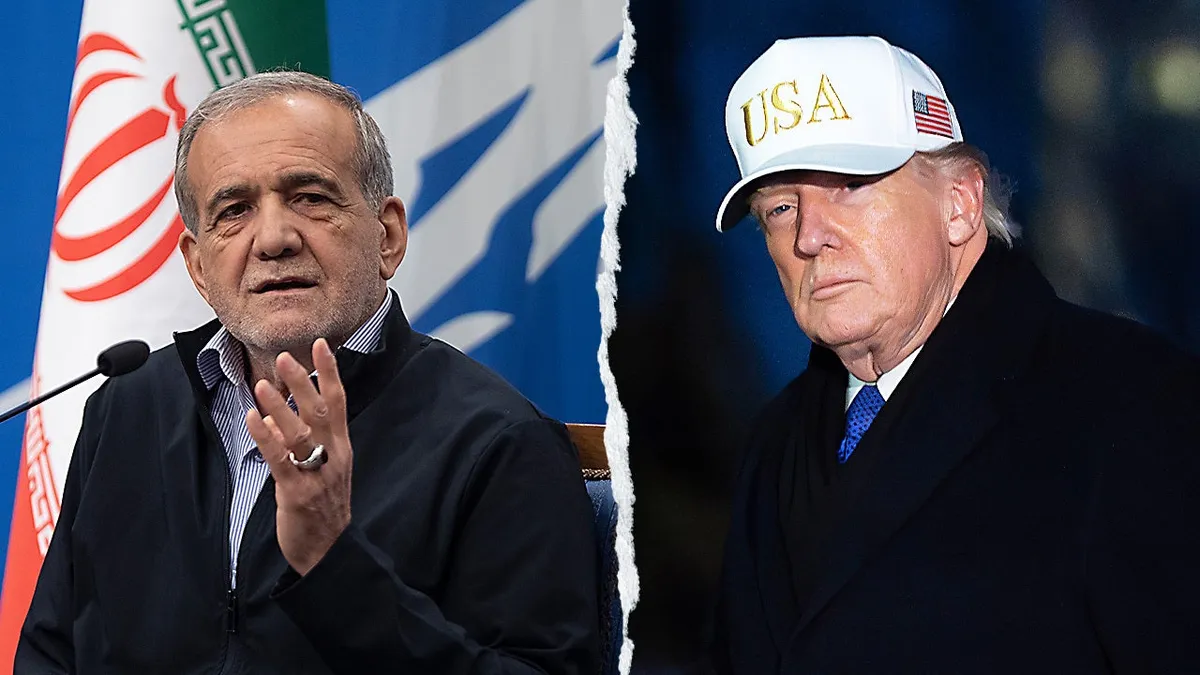
close Video Israel is 'very happy' about Hamas disarmament deal, Trump says President Donald Trump told reporters during a Friday Cabinet meeting at Camp David that Israel is "very happy" about the deal he brokered with terrorist group Hamas to disarm itself in Gaza. NEWYou can now listen to Fox News articles! Hören Sie sich diesen Artikel an 9 Min Iranian President Masoud Pezeshkian called Hamas’ newly elected leader to congratulate him and pledge Tehran’s continued support for the group’s cause, Hamas said Monday — as President Donald Trump promotes a landmark agreement intended to strip the terrorist organization of its weapons and power in Gaza. Pezeshkian congratulated Khalil al-Hayya on his election as head of the group’s political bureau and told him Iran would continue supporting the Palestinian cause, according to a Hamas statement posted in Arabic, and reviewed by Fox News Digital. "We are with you, and we support you in every action you take, despite the attacks we are facing," Pezeshkian said, according to Hamas’ account of the call. Fox News Digital has asked Iran’s mission to the United Nations to confirm that the call took place and provide an official readout. Hamas TAPS 'ULTIMATE INSTITUTIONAL SURVIVOR' AS TERROR CHIEF, SENDING MESSAGE TO Israel: EXPERT Analysts say Al-Hayya's elevation signals that Hamas, after the destruction of Gaza and the losses since Oct. 7, 2023, has prioritized organizational cohesion, armed continuity and the preservation of its Iranian relationship. (Iranian Leader Press Office/Handout/Anadolu via Getty Images) The reported conversation highlighted a central contradiction confronting Trump’s Gaza initiative: While the White House is presenting the roadmap as a landmark agreement to remove Hamas from power and secure its weapons, Iran — the group’s longtime military and financial patron — was simultaneously reaffirming its support for Hamas and its new leader. Tehran’s backing raises fresh questions about whether Hamas is prepared to surrender the arsenal at the core of its power and how the Board of Peace could enforce disarmament against a group that continues to receive political support from one of Washington’s principal regional adversaries. Trump in recent days announced what he called a "HISTORIC agreement for the COMPLETE DISARMAMENT of Hamas and all other armed groups," presenting it as a breakthrough after nearly three years of war. The stakes extend far beyond the wording of the deal: Hamas’ weapons remain the central obstacle to rebuilding Gaza, and the agreement will test whether Trump’s Board of Peace can enforce a postwar transition or whether Hamas will exploit the process to survive, regroup and retain power. At the center of the effort is Trump’s Board of Peace, the president’s handpicked vehicle for implementing his Gaza policy and potentially extending his approach to other global conflicts. Trump chairs the board, whose executive leadership includes Secretary of State Marco Rubio, special envoy Steve Witkoff, Jared Kushner and former British Prime Minister Tony Blair. The White House says the board will oversee Gaza’s transition, mobilize reconstruction funding and hold the parties accountable. But the tensions intensified Monday also on the Israeli side, when Nickolay Mladenov, Board of Peace director-general and high representative for Gaza, and board advisor Aryeh Lightstone met with Israeli Prime Minister Benjamin Netanyahu and urged Israel to halt its attacks in Gaza. Israel appeared to reject the board’s two central demands shortly afterward. "Israel will not withdraw from its current line in the Gaza Strip and will continue to thwart any threat to our civilians and soldiers," an Israeli political official said. The statement amounted to a rejection, at least for now, of demands that Israel return to the "yellow line" and halt targeted strikes in Gaza. A Board of Peace official declined to discuss the meeting but said the body remained focused on carrying out the roadmap. "We are focused on implementation," the official told Fox News Digital. "We have provided a pragmatic path forward to transform Gaza by removing Hamas from power and seeing it hand over its weapons. These steps would undoubtedly allow for the improvement of life in Gaza and enhancement of security in Israel. We remain determined to advance these objectives." Meanwhile, the Hamas terrorist group says it has agreed only to a phased and conditional process involving the storage of weapons after Israel stops its attacks, withdraws its forces and allows more aid into Gaza. Hamas has avoided the word "disarmament" in its statements and insists its weapons would remain under Palestinian control rather than being surrendered to Israel or an international force. Hamas AGREES TO COMPLETE DISARMAMENT UNDER 'HISTORIC' GAZA AGREEMENT: TRUMP A drone view shows Palestinians walking past the rubble, following Israeli forces' withdrawal from the area, amid a ceasefire between Israel and Hamas in Gaza, in Gaza City, Oct. 11, 2025. (Dawoud Abu Alkas/File Photo/Reuters) The board’s 15-point roadmap calls for Hamas to transfer Gaza’s civilian government and security responsibilities to a Palestinian technocratic body known as the National Committee for the Administration of Gaza. Hamas-run police would surrender their weapons to the committee, while heavy weapons, military production sites, weapons depots and tunnels would be addressed later through a phased decommissioning process linked to an Israeli withdrawal. The intended endpoint is that only the new Palestinian authority would possess or control weapons in Gaza. But the roadmap leaves unresolved who will enforce the process, what constitutes compliance and which side must act first. Hamas’ disarmament remains a central obstacle to rebuilding Gaza. Trump has tied reconstruction to the group laying down its weapons, while The Associated Press reported that the Board of Peace had secured approximately $7 billion in pledges by February — a fraction of the estimated $70 billion needed to rebuild the devastated territory. Moumen al-Natour, a Palestinian lawyer from Gaza and co-founder of the anti-Hamas "We Want to Live" movement, said civilians desperately want the agreement to succeed but do not trust Hamas to relinquish power. "Civilian people inside Gaza Strip… want safety, want to stop this war, want a new government, want to be alive," al-Natour told Fox News Digital. But al-Natour, who previously was imprisoned by Hamas, warned that the group would use delays and violations to remain embedded in Gaza. "I can’t trust Hamas because I know Hamas," he said, arguing that the group had repeatedly arrested and killed Palestinians who opposed its rule. He said an international force of only a few hundred personnel would be unable to secure Gaza or prevent Hamas from intimidating residents and that a much larger force and a new Palestinian police structure would be required. Drawing on a grassroots network of thousands of Gazan professionals who reject Hamas’ ideology, the "We Want to Live" movement is promoting its own plan to rebuild Gaza’s civil society and is calling for cooperation with the Board of Peace and the National Committee for the Administration of Gaza, the technocratic body tasked under the U.S.-backed transition plan with governing and rebuilding the enclave. Al-Natour also proposed allowing civilians who want to escape Hamas-controlled areas to move into protected zones near the "yellow line" — the boundary separating Israeli-held territory from the rest of Gaza — where they could live under a new Palestinian administration backed by an international security force. He said the arrangement could provide Gazans with a safer alternative while a post-Hamas governing structure is established. Hamas SAYS IT WILL DISSOLVE GAZA GOVERNMENT, BUT Israel WARNS GROUP STILL SEEKS HEZBOLLAH-STYLE CONTROL A mourner carries the body of a Palestinian who was killed in Israeli strikes, according to medics, during a funeral, in Gaza City, Aug. 2, 2026. (Dawoud Abu Alkas/Reuters) Michael Milstein, a former military intelligence officer in Israel and now head of the Palestinian Studies Centre at Tel Aviv University, said the compromise has been developing for months under pressure from Qatar, Turkey and Egypt. Milstein said Hamas may be prepared to give up control of Gaza’s day-to-day government and accept restrictions on heavy weapons but is unlikely to abandon its armed organization completely. Under the model Hamas appears to favor, Milstein said, a technocratic government and international forces would assume responsibility for public services and reconstruction while Hamas preserves its personnel, infrastructure and political influence — an arrangement resembling Hezbollah’s longtime position in Lebanon. "There is a very, very low chance that Hamas will completely disarm," Milstein told Fox News Digital, describing the roadmap as the kind of "gray area" Hamas has historically used to its advantage. The Board of Peace also is pressing for an end to actions that could derail the plan. After Israeli strikes killed civilians and reportedly destroyed medical supplies over the weekend, Mladenov, the director-general of the Board of Peace, called for de-escalation but did not identify Israel by name. "Two days of strikes across Gaza have killed civilians and destroyed medical supplies," Mladenov wrote on X, adding that he was working with the parties and regional mediators to "create the space for the full implementation of the President’s plan." Palestinians inspect the site of an overnight Israeli strike on a medicine warehouse, according to medics, next to tents sheltering displaced Palestinians, in Deir al-Balah, in the central Gaza Strip, Aug. 1, 2026, residents had been pre-warned by the Israeli military to evacuate. (Mahmoud Issa/Reuters) Israel, meanwhile, says it will not withdraw before Hamas genuinely disarms. Hamas says Israel must withdraw first. The roadmap also faces resistance inside Israel’s government. Finance Minister Bezalel Smotrich and Settlements Minister Orit Strock urged Netanyahu on Monday to convene the security Cabinet immediately and block the international stabilization force from entering Gaza, according to Israel’s N12 news outlet. In an urgent letter reported by N12 on Aug. 3, 2026, the ministers called the Board of Peace roadmap "dangerous to Israel" and argued that it contradicts Israel’s stated goals of disarming Hamas and demilitarizing Gaza. They objected that weapons would be placed under the authority of a new Palestinian body rather than removed from Gaza or handed to Israel and that Israeli troops would begin withdrawing while the disarmament process was still underway. The far-right ministers also argued that the international force would monitor the separation between Israeli troops and the new Palestinian administration rather than directly disarm Hamas. They demanded that Netanyahu prevent implementation until the roadmap is revised to require full demilitarization before an Israeli withdrawal. The letter underscores that the plan’s obstacles extend beyond Hamas: Influential members of Netanyahu’s coalition are also challenging its sequencing, enforcement and security provisions. Israeli troops are pictured outside the Gaza Strip ahead of a military operation in northern Gaza (Daphne Lemelin/AFP via Getty Images) That leaves Trump’s proclaimed milestone resting on the same question that has stalled previous Gaza negotiations: whether Hamas is truly preparing to surrender the weapons that underpin its power — or merely buying time to ensure that it remains standing when the rebuilding begins. Efrat (Effie) Lachter is a reporter for Fox News Digital with more than 15 years of experience covering conflict, global affairs, human rights and political accountability. She has directed and produced more than 200 documentary segments across more than 40 countries, documenting conflicts, humanitarian crises, corruption, human trafficking, gender-based violence and the human stories behind major world events. Lachter’s reporting has taken her into conflict zones and crisis areas across the Middle East, Europe, Asia and Africa. Her work has included uncovering human trafficking networks, revealing an ISIS underground torture prison in Syria, documenting the war in Ukraine and interviewing senior political figures and world leaders. She was also among the Western journalists who entered Russia after the war began to bring testimonies from Putin’s opposition. Lachter is the recipient of the 2022 Peres Center for Peace Award and was a 2023–2024 Knight-Wallace Journalism Fellow at the University of Michigan. She also won two Rockower Awards for Excellence in Reporting. She holds a bachelor's degree in communication and a master's degree in political science.
SRCFox News - World
LANGEN
LEANCenter-Right
WORDS1 973
ENT10
MON · 2026-08-03 · 17:20 GMTBRIEF NSR-2026-0803-98747
NSR-2026-0803-98747News Report·EN·Conflict
Iran reaffirms support for Hamas as Trump pushes to disarm terror group
Iranian President Masoud Pezeshkian reaffirmed Iran's support for Hamas and its newly elected leader, Khalil al-Hayya, according to a Hamas statement. This comes as President Donald Trump promotes a "historic agreement" for Hamas's complete disarmament in Gaza, overseen by his "Board of Peace." The reported Iranian support highlights a contradiction, raising questions about Hamas's willingness to disarm and the enforceability of the plan.
Fox News - WorldFiled 2026-08-03 · 17:20 GMTLean · Center-RightRead · 8 min
Fox News - WorldFIG 01
Reading time
8min
Word count
1 973words
Sources cited
3cited
Entities identified
10entities
Quality score
100%
§ 01
Briefing Summary
AI-generatedNEWSAR · AI
Iranian President Masoud Pezeshkian reaffirmed Iran's support for Hamas and its newly elected leader, Khalil al-Hayya, according to a Hamas statement. This comes as President Donald Trump promotes a "historic agreement" for Hamas's complete disarmament in Gaza, overseen by his "Board of Peace." The reported Iranian support highlights a contradiction, raising questions about Hamas's willingness to disarm and the enforceability of the plan. Israel has rejected demands from the Board of Peace to halt attacks and withdraw, stating it will continue to counter threats. Hamas has agreed to a phased process involving weapon storage, conditional on an Israeli withdrawal and increased aid, but avoids the term "disarmament" and insists weapons remain under Palestinian control. Internal Israeli opposition also exists, with some ministers deeming the plan dangerous.
Confidence 0.90Sources 3Claims 4Entities 10
§ 02
Article analysis
Model · rule-basedFraming
Conflict
Political Strategy
Tone
Mixed Tone
AI-assessed
CalmNeutralAlarmist
Factuality
0.60 / 1.00
Mixed
LowHigh
Sources cited
3
Well sourced
FewMany
§ 03
Key claims
4 extracted01
Trump announced what he called a "HISTORIC agreement for the COMPLETE DISARMAMENT of Hamas and all other armed groups."
factualDonald Trump
Confidence
0.90
02
President Donald Trump told reporters that Israel is "very happy" about a deal he brokered with Hamas to disarm itself in Gaza.
factualDonald Trump
Confidence
0.90
03
Iranian President Masoud Pezeshkian called Hamas’ newly elected leader to congratulate him and pledge Tehran’s continued support for the group’s cause.
factualHamas statement
Confidence
0.80
04
Analysts say Al-Hayya's elevation signals that Hamas has prioritized organizational cohesion, armed continuity and the preservation of its Iranian relationship.
factualAnalysts
Confidence
0.70
§ 04
Full report
8 min read · 1 973 words§ 05
Entities
10 identifiedKey playerOppositionContextPositiveNeutralNegative
People3
Locations4
§ 06
Keywords & salience
10 termsiran support
1.00
hamas disarmament
1.00
donald trump
0.90
gaza
0.80
palestinian cause
0.70
terror group
0.60
khalil al-hayya
0.50
masoud pezeshkian
0.50
organizational cohesion
0.40
armed continuity
0.40
§ 07
Topic connections
Interactive graph Network visualization showing 51 related topics
View Full Graph Person Organization Location Event|Click node to navigate|Edge numbers = shared articles