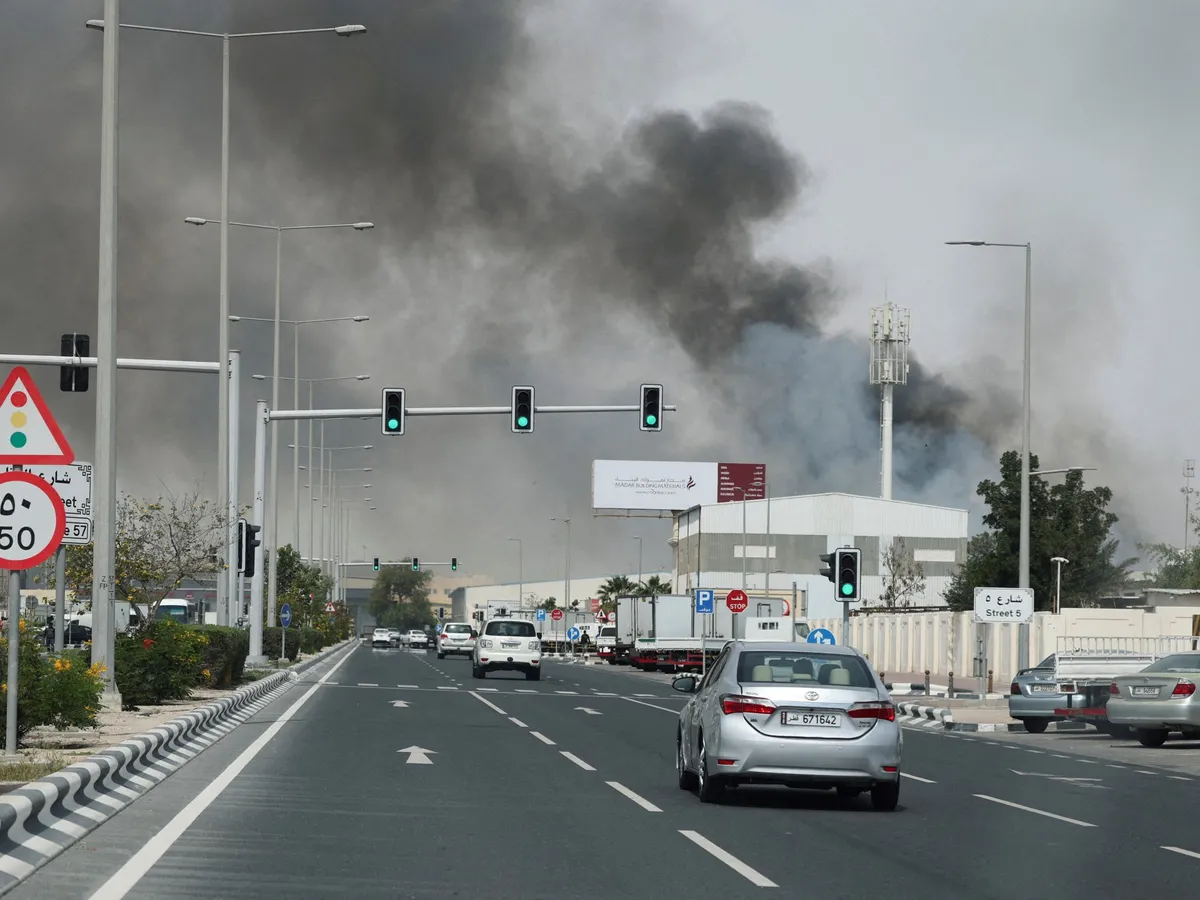
Iran’s attacks exposed the limits of outside guarantees and the need for a Gulf-built security architecture.Vice President of the Center for International Policy Research.Published On 4 Aug 2026Smoke rises after reported Iranian missile attacks, following United States and Israel strikes on Iran, as seen from Doha, Qatar, March 1, 2026 [Mohammed Salem/Reuters]Peace has been announced in the Gulf more often than it has been kept. A ceasefire arrived within weeks of the first Iranian strikes on Gulf territory and did not survive the spring. A memorandum followed in the summer and was dead inside a month. Each pause was announced with more confidence than the last and ended the same way: drones over power stations and desalination plants, another chokepoint closed, the bombing resumed days after it was suspended. Envoys still shuttle in and out of Tehran. The governments in Riyadh, Doha and Abu Dhabi do not regard that as an end to the war, and after five months they are right not to.So the argument about how this region secures itself cannot wait for the shooting to stop. Whether the current diplomatic track survives or goes the way of the two before it, the Gulf will still live beside a state with the will and the means to strike its neighbours. That is not a problem of goodwill. It is a problem of geographic destiny. What the Gulf needs is a security ecosystem, not another security umbrella.The war has already shown what it must build on. Anyone in Doha on the morning of February 28 watched Gulf air and missile defences, built over a decade of investment and integrated with US systems, hold. They intercepted the overwhelming majority of what Iran fired. The strikes themselves were not confined to military targets; in Qatar for example 65 percent of Iranian attacks was aimed at civilian targets, including airports, power stations, energy facilities and the desalination plants that supply roughly nine in 10 glasses of drinking water in the Gulf.Tehran’s campaign against the Gulf was never purely military. It was an attempt to make Gulf capitals bear the costs of a war others had started until they demanded an end on Iran’s terms, while inflicting maximum pain on the global economy. The coercion failed: Gulf states neither escalated nor caved to Tehran, in part because the shield held. But Iran still inflicted economic damage and exposed maritime vulnerabilities whose consequences will be felt for some time.Many analysts in Washington and Tel Aviv read the Gulf governments’ refusal to escalate as passivity, while Tehran read it as weakness. But restraint backed by functioning defences is not the same as restraint born of vulnerability. It is why the Gulf remains one of the few parties every side will still take a call from, and why a channel to Tehran remains open even after the bombing resumed.The harder conclusion is one nobody in the region enjoys acknowledging: decades spent cultivating security guarantees did not keep the Gulf out of a war it neither started nor was consulted about. Its integrated defences worked; the political security architecture around them did not.The temptation now is to reach for the familiar: a bigger US guarantee, or the recurring fantasy of an “Arab NATO”. Both assume protection is something the region receives rather than something it assembles. Such an ecosystem has four layers: US and European enabling capacity, a Gulf Cooperation Council (GCC) core, wider regional partnerships and an industrial base.Any serious architecture must begin with the US. Nothing replaces US equipment, missile defence, intelligence, logistics and command-and-control systems, and no Gulf planner I know pretends otherwise. The question is what partnership can survive a war in which Gulf states were attacked while decisions were taken elsewhere. Vague expectations of protection are not enough. Joint planning, interoperability and responsibilities written down in advance are. The Gulf will not diversify away from the US. It will diversify with it.Europe complements rather than replaces the US pillar. Its navies already operate in these waters, and the war strengthens the case for deeper cooperation in maritime defence, training and infrastructure protection. NATO belongs here too, though not as a club the Gulf should join. It offers standards, doctrine and experience making different militaries work together at speed.At the core sit the GCC and its national forces: integrated air and missile defence, shared early warning, maritime awareness, intelligence fusion and cybersecurity. The same urgency applies to hardening the energy, water and transport arteries on which Gulf societies and much of the world economy depend. National forces defended against Iranian attacks, but there was no Gulf capability able to meet the threat posed by the closure of the Strait of Hormuz. That gap must be closed.Around that core sits the R4, established by Egypt, Saudi Arabia, Türkiye and Pakistan. It links Gulf and Levantine security to the Palestinian cause and gives a Gulf-centred framework strategic mass the GCC cannot generate alone. Its members do not share identical policies, but they reject attacks on sovereignty, disruption of shipping, the use of armed proxies and the settlement of political questions by force.Pakistan’s brokering of the Islamabad memorandum showed both the group’s weight and its limits. The R4 should neither replace the GCC nor harden into an alliance.By late July, the broader regional response was beginning to take operational form. On 28 July, Saudi and US aircraft struck militia sites across eastern Iraq, in what US Central Command said was a response to more than 30 Islamic Revolutionary Guard Corps (IRGC)-directed drone attacks over 72 hours.Two days later, after Riyadh convened representatives from 43 countries and the European Union, Saudi Arabia announced a 14-state maritime defence coalition for the Bab al-Mandeb, the Red Sea and the Gulf of Aden. It included the R4 in its entirety, alongside Qatar, Kuwait, Bahrain and Jordan. Riyadh chose to convene a regional response rather than wait for one.The coalition is a statement of intent rather than a force at sea, and its relationship to the European Union’s Aspides mission remains undefined. But it begins to translate the R4’s consultative weight into regional action. Within the broader regional framework, Qatar and Oman open otherwise inaccessible channels, Saudi Arabia convenes, and Türkiye, Egypt and Pakistan provide military capacity and geostrategic depth.Qatar’s smaller arrangements offer another model. Its joint Typhoon squadron with the United Kingdom and combined command with Türkiye show how mixed forces can be built without waiting for a treaty. Similar arrangements could support maritime surveillance, counter-drone defence and logistics in months rather than decades. Industry is also critical. The Gulf holds capital and political will; Türkiye, Egypt and Pakistan hold production lines and engineering depth. Moving beyond cheque-book procurement to joint production is the test. Barzan Holdings and the UAE’s EDGE Group agreed to establish a joint venture that EDGE’s chief executive said would cover missiles, unmanned systems and satellites. Strategic autonomy does not mean building every weapon at home. It means no foreign political decision can switch off the region’s essential defences.The Gulf’s relationships with Russia and China must also be brought within this security framework. US officials accused Moscow of having passed Tehran the locations of US warships and aircraft. The Financial Times reported that the IRGC had acquired a Chinese commercial imaging satellite, and Washington sanctioned three China-based firms for providing satellite imagery that enabled Iranian strikes against US forces. Moscow and Beijing denied the allegations. The principle is simple: an external power whose technology helps others strike Gulf states or Gulf shipping cannot expect the rest of the relationship to remain undisturbed. Both must still be included in discussions on transparency and maritime security, particularly China, the Gulf’s largest trading partner.Iran and Israel are the long-term problem. For now, the ecosystem must deter while keeping military channels open and protecting civilians and commercial shipping. Later, it should remain open to both, on conditions: respect for sovereignty, an end to interference and proxies, and, in Israel’s case, genuine movement towards a two-state solution. Permanent isolation is not the objective. No arrangement will be believed while the Palestinian question is treated as an afterthought.None of this should wait on the talks. What these months have shown is narrower than self-sufficiency and considerably more useful. Gulf states have real defensive capacity, and it works when national systems are fused with US, British and other partner capabilities rather than replaced by them. They also carried messages between enemies while under fire, and one has convened a 14-country coalition around a plan to keep a waterway open. That is the shift worth naming. For 50 years, these states have consumed security on terms set by others. What is emerging is a region beginning to produce it.The views expressed in this article are the author’s own and do not necessarily reflect Al Jazeera’s editorial stance.
SRCAl Jazeera
LANGEN
LEANCenter
WORDS1 463
ENT12
TUE · 2026-08-04 · 11:05 GMTBRIEF NSR-2026-0804-98986
NSR-2026-0804-98986Analysis·EN·Conflict
Misread as passive, the Gulf is quietly ending fifty years of dependence
Recent Iranian attacks on Gulf nations, targeting both military and civilian infrastructure, have revealed the limitations of external security guarantees. Despite these attacks, Gulf states demonstrated restraint, relying on their own integrated air and missile defenses, which largely held.
Rashid Al-MohanadiAl JazeeraFiled 2026-08-04 · 11:05 GMTLean · CenterRead · 6 min
Al JazeeraFIG 01
Reading time
6min
Word count
1 463words
Sources cited
0cited
Entities identified
12entities
Quality score
100%
§ 01
Briefing Summary
AI-generatedNEWSAR · AI
Recent Iranian attacks on Gulf nations, targeting both military and civilian infrastructure, have revealed the limitations of external security guarantees. Despite these attacks, Gulf states demonstrated restraint, relying on their own integrated air and missile defenses, which largely held. This experience has highlighted the need for a self-assembled Gulf security ecosystem, rather than relying on external protection. Such an architecture would involve US and European enabling capacity, a GCC core, wider regional partnerships, and an industrial base, with a focus on joint planning and interoperability. The war has underscored that decades of cultivating security guarantees did not prevent the Gulf from being drawn into a conflict where decisions were made elsewhere, emphasizing the necessity of a locally-driven security framework.
Confidence 0.90Claims 5Entities 12
§ 02
Article analysis
Model · rule-basedFraming
Conflict
Diplomatic
Tone
Measured
AI-assessed
CalmNeutralAlarmist
Factuality
0.40 / 1.00
Mixed
LowHigh
Sources cited
0
No named sources
FewMany
§ 03
Key claims
5 extracted01
The Gulf needs a security ecosystem, not another security umbrella, to address its security challenges.
factual
Confidence
0.90
02
Gulf air and missile defenses, integrated with US systems, intercepted the overwhelming majority of Iranian missile attacks.
factual
Confidence
0.90
03
Gulf governments' refusal to escalate was misread by analysts in Washington and Tel Aviv as passivity or weakness, when it was restraint backed by functioning defenses.
factual
Confidence
0.80
04
65 percent of Iranian attacks in Qatar were aimed at civilian targets, including airports, power stations, energy facilities, and desalination plants.
statistic
Confidence
0.80
05
Tehran's campaign against the Gulf was an attempt to make Gulf capitals bear the costs of a war others had started until they demanded an end on Iran’s terms, while inflicting maximum pain on the global economy.
factual
Confidence
0.70
§ 04
Full report
6 min read · 1 463 words§ 05
Entities
12 identifiedKey playerOppositionContextPositiveNeutralNegative
Organizations1
Locations9
§ 06
Keywords & salience
9 termsgulf security architecture
1.00
iran attacks
0.90
dependence on outside guarantees
0.80
security ecosystem
0.70
gulf states
0.60
economic damage
0.50
air and missile defences
0.50
maritime vulnerabilities
0.40
diplomatic track
0.40
§ 07
Topic connections
Interactive graph Network visualization showing 51 related topics
View Full Graph Person Organization Location Event|Click node to navigate|Edge numbers = shared articles